

Billions of dollars are flowing into artificial intelligence every year. Boards are approving AI budgets. Engineering teams are shipping models. Executives are announcing AI-first strategies.
Deloitte's 2026 AI governance report reinforces this information starkly. While 74% of companies plan agentic AI deployment, only 21% have mature governance frameworks in place.
It clearly indicates how technology is not the problem, governance is. This is precisely why AI transformation is a problem of governance - not a problem of model quality, compute power or vendor selection.

What Does It Exactly Mean to Say AI Transformation Is A Problem Of Governance?
When most people hear the word "governance," they think of legal documents, compliance audits, or corporate red tape. That framing is exactly why so many organizations get it wrong.
AI governance is not paperwork. It is the operational infrastructure that decides what your AI systems are permitted to do, what data they are allowed to touch, who is accountable when something goes wrong, and how your organization detects, explains, and corrects AI failures in real time.
Without that infrastructure in place, even a technically excellent AI model becomes a liability.
The core challenge of AI transformation is not training a better model or choosing the right cloud provider. It is answering four questions that most organizations cannot answer cleanly:
- Who owns the decisions this AI system makes?
- What rules does it follow when the rules are not obvious?
- How do we know when it starts behaving differently than expected?
- What happens when it fails?
These are governance questions. Not technology questions.
5 Ways AI Transformation Deployments Fail in Production
After building AI systems for organizations across financial services, healthcare, logistics, and retail, we’ve noticed how the failure patterns are strikingly consistent.
1. No Policy Enforcement Layer
Most enterprises configure AI behavior through system prompts, natural language instructions written at deployment time and rarely reviewed thereafter.
Prompt injection attacks, catalogued by OWASP as the top vulnerability in LLM applications are the SQL injection of the AI era. An attacker embeds a malicious instruction in user-supplied input that overrides the system prompt and causes the model to bypass safety boundaries, exfiltrate data or produce harmful outputs. Without an enforcement layer that operates independently of the model, every deployment is one adversarial prompt away from a compliance incident.
This risk multiplies the moment you move from a single chatbot to coordinated agentic AI frameworks - systems like LangGraph, AutoGen, or CrewAI that let multiple AI agents plan, call tools, and act with limited human review. An enforcement layer that worked for one model rarely scales across a multi-agent framework unless governance is designed in from the orchestration layer down.
2. No Audit Trail for Regulated Decisions
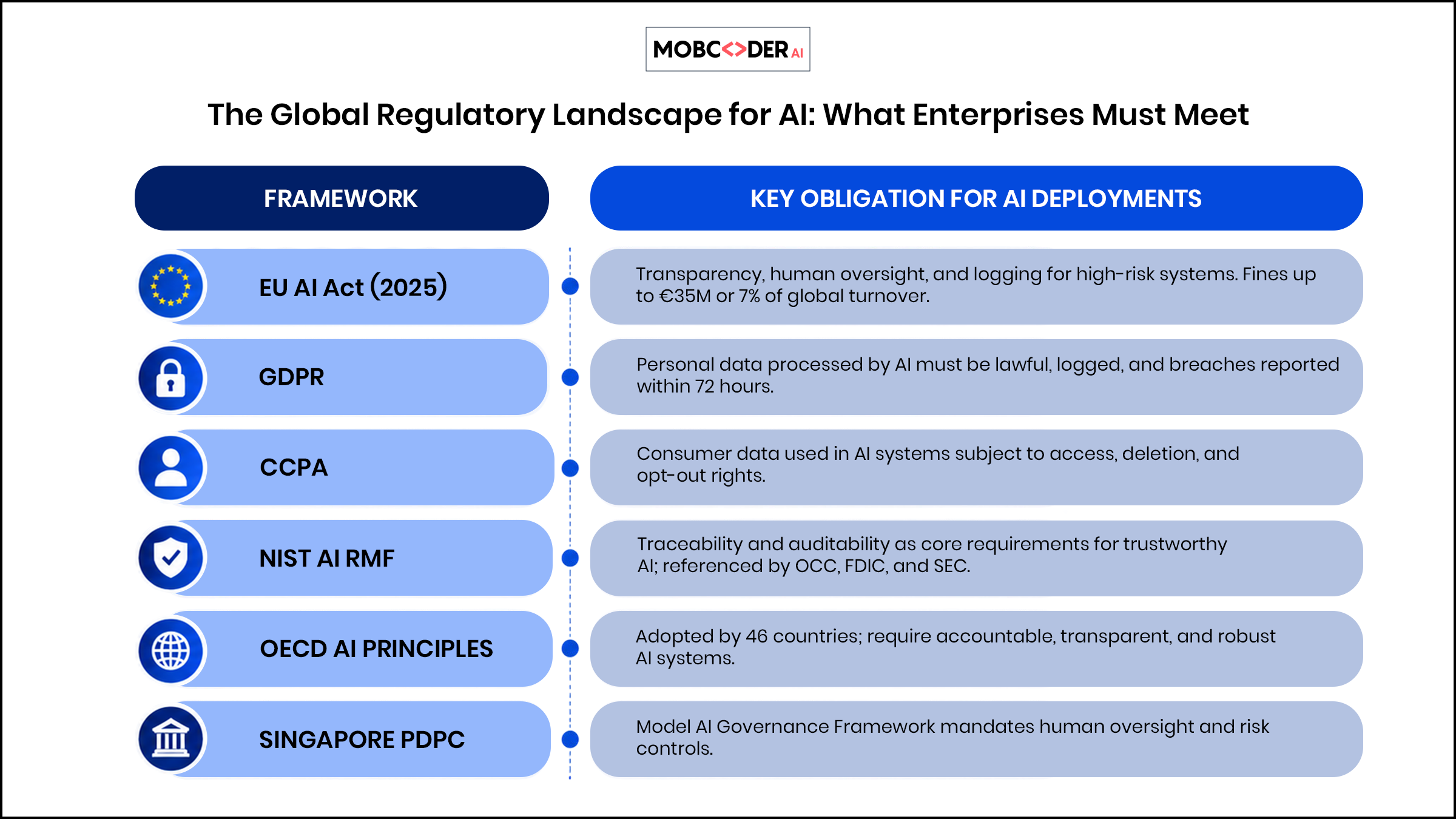
In regulated industries, every consequential AI decision must be explainable, traceable and auditable. The NIST AI Risk Management Framework explicitly identifies traceability as a core requirement for trustworthy AI. The EU AI Act's Article 12 mandates logging for all high-risk AI systems.
Yet most enterprise AI deployments produce no structured decision record.
This gap is most visible in customer-facing AI chatbots. Few organizations maintain a complete, queryable AI chatbot conversations archive - a searchable, timestamped record of every chatbot interaction, the data it accessed, and the decision logic it followed. Without that archive, a regulator’s request for evidence of a specific decision becomes a forensic exercise instead of a five-minute lookup, and early warning signs like repeated hallucinations or misuse patterns go unnoticed.
3. Data Exposure and Privacy Violations
Large language models synthesize information from their full context window in ways developers never anticipate. Under GDPR, CCPA and the growing body of global data regulations, an AI output that inadvertently exposes personal information is a scheduled risk.
GDPR Article 33 requires breach notification within 72 hours. Without real-time monitoring of AI outputs, organizations become aware of violations only when someone complains, routinely after the reporting window has already closed.
4. Hallucination in High-Stakes Outputs
A healthcare assistant that states an incorrect drug interaction.
A legal tool that cites a case that does not exist.
A financial platform that references a regulatory figure since revised.
As documented by researchers at Stanford, hallucination is a structural property of how LLMs generate text, not a bug that will be fixed in the next model release.
The only viable enterprise-grade mitigation is output-side enforcement that validates responses against source context before they reach end users. Telling users to "verify AI outputs" is not a governance strategy. It is a liability transfer.
The same verification discipline applies to visual AI outputs. Just as fact-checkers and brand teams rely on image search techniques like reverse image search to confirm whether a visual is authentic, original, or AI-generated, enterprises deploying image-based AI systems need equivalent verification checkpoints before visual content reaches end users or regulators.
5. No Incident Response Capability for AI
When an AI system fails, most organizations have no defined process for what happens next. No escalation path. No root cause analysis workflow. No documented rollback procedure.
AI incident response cannot be improvised at the moment of failure. It must be designed before deployment, tested regularly and owned by a named individual with authority to act.
Why Enterprise AI Governance Are Failing Right Now
The data tells a clear story. Only 43% of organizations have a formal AI governance policy. Only 1% of companies describe themselves as truly AI-mature. And a striking 57% of companies are deploying autonomous AI systems with no structured accountability framework in place.
There are three specific forces proving why AI transformation is a problem of governance.
The Agentic AI Problem
Agentic AI systems take autonomous actions across multiple enterprise tools that are being deployed at a pace that governance infrastructure simply cannot keep up with. These systems can trigger workflows, send communications, access financial data and make purchasing decisions without human review at every step.
When an agentic system makes an error, the question of who approved that decision frequently has no clean answer. This is not a technology limitation. It is an AI governance vacuum.
For companies building and deploying agentic AI solutions, establishing accountability structures before deployment is not optional, it is the difference between AI that creates value and AI that creates legal exposure.
This is also why identity and trust verification has become part of agentic AI governance. Voice-cloning fraud and synthetic identity attacks against contact centers and onboarding flows have pushed enterprises toward dedicated identity-verification layers - vendors like Pindrop and Anonybit offer voice/deepfake-detection and decentralized biometric authentication respectively, the kind of identity-governance infrastructure that agentic AI frameworks increasingly need wrapped around them. When an autonomous agent can authorize a transaction or reset an account, governance has to extend to who - human or synthetic - that agent is actually talking to, not just what the agent is allowed to do.
The Shadow AI Problem
Research suggests that roughly 78% of knowledge workers are already using AI tools at work that their employers did not authorize, evaluate or monitor. Confidential data is being processed by third-party models under unknown terms. Proprietary workflows are being accessed by public AI systems. And in most cases, there is no audit trail.
This is the shadow AI problem and it is a direct result of organizations deploying AI without an AI policy framework that employees understand and actually follow.
The Regulatory Pressure Problem
The external compliance environment is tightening fast. The EU AI Act's high-risk system obligations are now in effect, carrying penalties up to 35 million euros or 7% of global annual turnover. In the United States, over 1,100 AI-related bills were introduced in 2025 alone.
Organizations that have not built AI compliance structures into their transformation programs are now facing regulatory deadlines with governance systems that are not ready.
 The Three Layers of a Real AI Governance Framework
An effective enterprise AI governance framework is not a single document or a one-time audit. It is a living system built across three layers.
Layer 1: Policy - Defining the Rules
Every AI initiative should begin with a written AI policy that answers basic but critical questions. What problems is AI allowed to solve in this organization? What data can be used? What ethical boundaries apply to every AI system regardless of the use case?
A clear policy layer creates alignment before any code is written. It also gives you a foundation for AI risk management - because you cannot manage risks you have never defined.
Layer 2: Process - Enforcing the Rules
Policy without process is intention without action. Your process layer is where governance becomes real. It should include:
- Model Review Processes - A cross-functional review before any AI system goes into production, covering accuracy, bias, data provenance, and failure modes.
- AI Bias Audits - Regular checks to ensure model outputs remain fair across different user groups, especially as data distributions shift over time.
- Drift Monitoring - Automated systems that detect when a model's real-world performance starts to deviate from its baseline, triggering human review before failures compound.
- Incident Response Plans - A documented process for what happens when an AI system produces harmful, incorrect, or unexpected outputs. Not if - when.
- AI Change Management - Clear protocols for updating, retraining, or retiring AI systems as business needs evolve. AI accountability does not end at launch.
Layer 3: People - Owning the Rules
Governance systems need human owners. The most important step most organizations skip is assigning clear, named accountability for AI decisions.
This means having executive-level sponsorship for the overall AI transformation strategy. It means having AI product managers who translate governance requirements into system specifications. It means having compliance teams who track regulatory changes and translate them into internal policy updates. And it means training end users to understand AI outputs critically rather than treating them as authoritative.
The organizations getting this right are treating AI oversight as a leadership capability - not a technical afterthought delegated to the engineering team.
Why Reactive Cleanup Does Not Work
The natural organizational response to AI governance failures is reactive: wait for an incident, investigate it, patch the system prompt, and move on. This approach fails for three structural reasons.
- AI failures are rarely visible until they are consequential. A model that exposes sensitive data in 0.3% of responses will go undetected for months in a high-volume production system- until the exposure affects a regulator, a journalist, or a high-profile customer.
- The speed of AI production outpaces the speed of manual oversight by orders of magnitude. An enterprise AI system handling tens of thousands of interactions per day cannot be governed by human review.
- The McKinsey Global Survey on AI 2024 found that fewer than half of organizations with deployed AI report having processes in place to address AI risks, even as deployment accelerates.

The cost of adding governance after deployment is estimated to be five times higher than building it in from the start. By the time problems surface, they are embedded in production systems that are hard to change and expensive to remediate.
Four Governance Mistakes That Kill AI Transformation Programs
Mistake 1: Building first, governing later
The cost of adding governance after deployment is estimated to be five times higher than building it in from the start. The OWASP Top 10 for LLM Applications identifies prompt injection as the number one vulnerability in AI deployments- the SQL injection of the AI era. Without an enforcement layer built in from the start, every deployment is one adversarial input away from a compliance incident.
Mistake 2: Treating AI governance as compliance only
Real governance is about building AI systems the business can trust, scale, and be accountable for. Compliance is a floor, not a ceiling.
Mistake 3: No named owners
When AI accountability is everyone's responsibility, it becomes nobody's responsibility. Governance requires named individuals with real authority to stop AI deployments that do not meet standards.
Mistake 4: Treating governance as a one-time exercise
AI models drift. Regulations change. Business rules evolve. A governance framework that is not continuously updated is one that will eventually fail.
How Mobcoder AI Embeds Governance Into Every Transformation
At Mobcoder AI, we have worked with enough enterprises to know exactly what happens when AI transformation skips governance. Models that performed well in testing fail in production. Accountability gaps that seemed minor during development become serious reputational and legal problems at scale. AI investments that looked promising in a pilot get cancelled because the business cannot demonstrate control.
That is why governance is not a separate workstream in our process. It is embedded from the first conversation.
Whether we are delivering AI strategy and consultation, building machine learning solutions, deploying generative AI development capabilities, or integrating advanced agentic AI systems, we work with clients to define accountability structures, document policy requirements, establish monitoring frameworks, and build the organizational processes needed to sustain AI performance after launch.
We also help clients think through AI data analytics pipelines with data governance built in from the start - because data quality and data sovereignty are not infrastructure concerns. They are governance concerns.
Governance is not a constraint on AI transformation. It is what makes AI transformation durable.
The Bottom Line
AI transformation is a problem of governance. Not because the technology is hard - the technology has never been more accessible. But deploying AI that an organization can actually trust, control, scale, and be accountable for requires infrastructure that most companies have not built yet.
The organizations winning with AI in 2026 are not the ones with the most powerful models. They are the ones that have built governance into the foundation of every AI initiative - and can prove it to their customers, their regulators, and their boards.
If your organization is serious about AI transformation, start with governance. Define who owns it. Write the policies. Build the processes. Train the people. Then build on top of that foundation.
The technology will take care of itself.