

Summary: This blog explains how an AI chatbot conversations archive turns raw conversations into structured, actionable data for improving output quality, meeting compliance and understanding user behaviour. In 2026 it has become the foundation for building smarter and scalable businesses using AI.
Most companies deploy AI chatbots to reduce support costs and headcount. Sure, it works. But that’s not where the full potential of a chatbot is. Every conversation between a human and a bot is a blueprint of what users need, how they think and where your product or service lies. Yet in most cases, that conversation (the golden insight) disappears the moment the chat ends.
That’s why you need an AI chatbot conversations archive that turns those everyday interactions into actionable intelligence and helps you understand your customers better.
What Is an AI Chatbot Conversations Archive?
An AI chatbot conversations archive is a structured, searchable system that stores every interaction between users and your AI chatbot. Think of it as an advanced chat log.
A modern archive captures:
- The full message history between the user and the bot
- Timestamps and sessions
- User intent and sentiment
- Tool or API calls made by the chatbot during the session
- Privacy overlays, including PII (Personally Identifiable Information) tags and redaction maps
- Retention flags based on data type and jurisdiction
Instead of operating on assumptions about what users want, an archive gives your team concrete, searchable evidence. Businesses deploying AI chatbots as their digital team members need this infrastructure for the long run.
Why Do Businesses Need a Chatbot Conversations Archive?
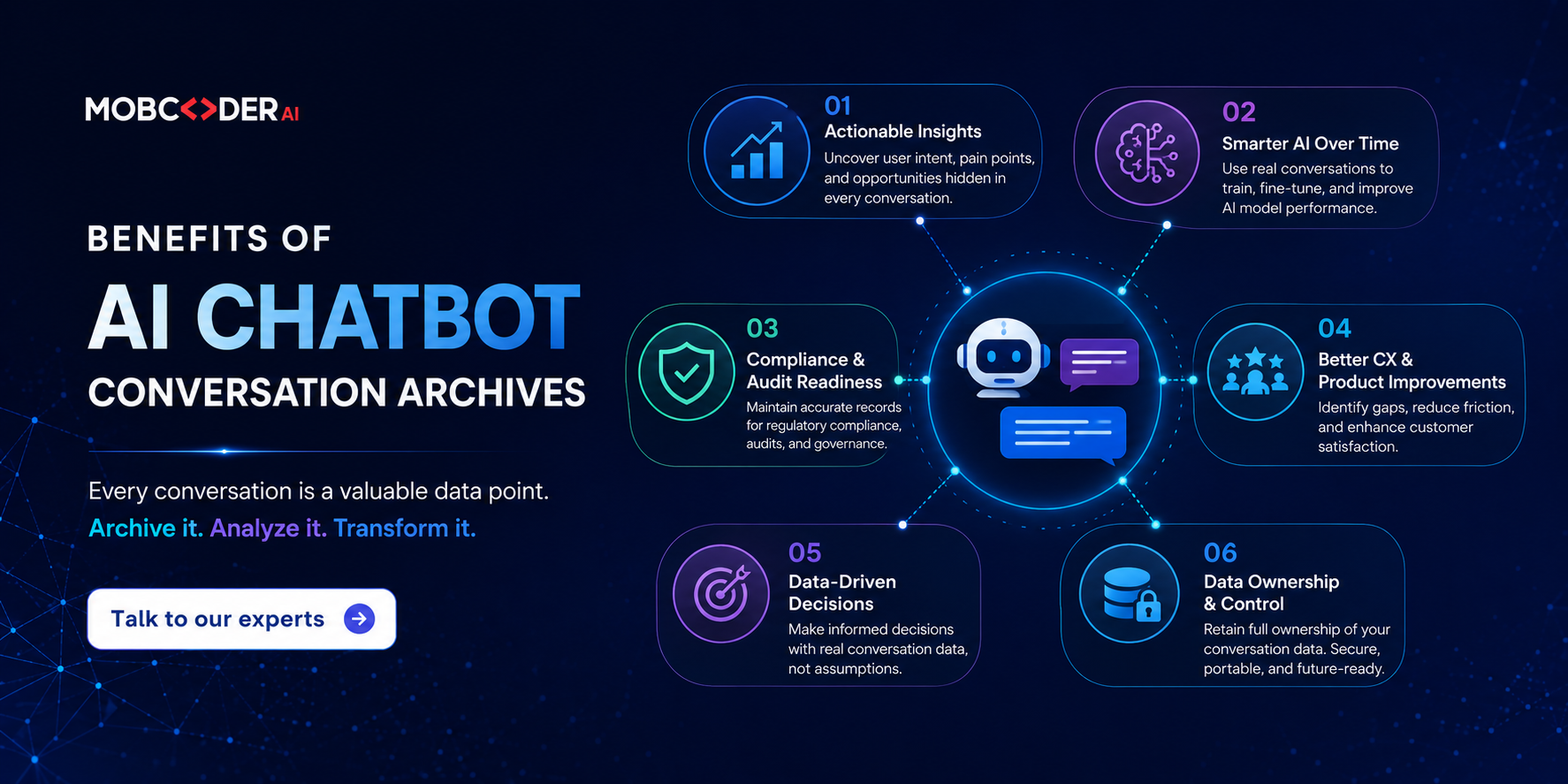
Every chatbot interaction captures real customer intent. Without an archive, you lose the data that tells you what customers actually need. The following reasons make it a must have for your chatbot infrastructure:
1. Improve Chatbot Performance Over Time
Many users type queries how they actually speak to a human. They combine multiple problems or stuff keywords into one message. They use abbreviations, slang and informal language that your bot may not be trained to understand.
With an archive, you can pull up every conversation where the bot gave an incorrect response, missed the user's intent or escalated to a human agent unnecessarily. You then feed those real examples back into your training pipeline and watch performance improve. This is where machine learning pipelines become essential for continuous improvement.
Let’s understand this with an example: a retail company gets questions related to delayed delivery all the time. By reviewing archived conversations, their team can find out what their customers were asking. Once those real phrases are added to the chatbot's training data, escalations on that topic can drop significantly within weeks.
2. Build a Feedback Loop for AI Model Training
Archived chatbot conversations hold some of the most valuable data. It contains real user language, genuine concerns and actual failure points of the chatbot. These things are extremely difficult to simulate in a controlled environment.
With a proper AI chatbot conversations archive, you create a constantly growing dataset that can be used to:
- Upgrade your model with new real-world examples
- Build regression test suites that check whether new model versions handle old problematic queries
- Fine-tune your bot's tone, accuracy and intent recognition using data from your actual user base. Companies utilizing generative AI development can automate this fine-tuning process at scale.
3. Meet Compliance and Regulatory Requirements
Regulated industries store records of digital communications compliant to the legal practices. Healthcare chatbots must comply with HIPAA. Financial services bots fall under FINRA and SEC record-keeping rules. Businesses operating in the EU must account for GDPR requirements, which means managing user consent, data minimization and the right to remove.
An AI chatbot conversations archive helps you meet these requirements by:
- Storing chats with clear timelines and context
- Maintaining audit records you can access anytime in future
- Identifying and managing sensitive PII data
- Enabling quick data export or deletion when users request it
Without an archive, proving compliance for any industry during an audit becomes extremely difficult.
4. Understand Your Customers at Scale
Customer surveys give you answers based on predefined questions and answers, like a filtered opinion. Whereas, chatbot archives give you an unfiltered, real-time record of what they actually think and want.
The archived chats are useful across teams:
- Product teams can use archives to identify features users ask about most.
- Marketing teams can pull exact customer phrasing to improve website copy, product descriptions and ad language.
- Support managers can review query patterns to spot recurring issues and address them promptly.
The depth of insight available from a well-maintained chatbot archive is difficult to match with any other data source.
5. Enable Safety Forensics and Incident Response
When a chatbot produces a harmful or incorrect response, you need to understand why it happened. With archives, you can properly trace every conversation step-by-step, to find our root cause, accountability and recreate what exactly happened. This way you can prevent the same issue from occurring again in the future.
How Does Modern AI Chatbot Conversations Archive Works
Here’s how a conversation archive works behind the scenes to make chats are usable & secure:
The Storage Architecture
Modern chatbot archives use a two-layer storage model: Hot storage and cold storage.
Hot storage keeps current conversations readily accessible. This layer supports live features like personalization, session continuation and real-time agent review. Data in hot storage is typically indexed for fast query performance.
Cold storage archives older conversations for long-term audit or compliance. Common formats include Parquet and Delta Lake, which are efficient for large-scale query collecting. Data moves from hot to cold storage based on age, access frequency or need of the business.
The Data Structure
Each archived conversation is like a complete data set, far more than a text transcript. A conversation archive entry includes:
- Message exchanges that happens back-and-forth between user and bot
- Tool call records of when your chatbot calls an external API (a shipping tracker, a payment system, a knowledge base), the archive logs the exact call
- Model metadata to see which AI model responded, token usage, response latency and provider request IDs
- PII handling for sensitive data, redaction maps showing what has been masked, and retention policy flags
- Trace IDs of unique identifiers that allow any conversation to be reconstructed later
The Role of OpenTelemetry
Many industries are increasingly standardizing around OpenTelemetry's GenAI semantic conventions for capturing AI interactions. OpenTelemetry standards here refer to a set of common rules for how AI interactions are tracked, structured and stored.
This shift means chatbot archives are becoming more portable and vendor-neutral. Whether your bot runs on OpenAI, Anthropic, or an open-source model, OpenTelemetry-compliant archiving ensures your data is structured consistently and can move between platforms without breaking anything.
Vector Databases and Semantic Search
One of the most valuable capabilities in a modern AI chatbot conversations archive is semantic search. It is the ability to find context behind the actual conversation, rather than focusing on just texts.
If you search for "payment issues," a basic keyword system returns only conversations that contain those exact words. A semantic search system powered by a vector database also returns conversations where users said "my card isn't working," "the checkout failed," or "I keep getting an error when I pay." This way you can make the maximum use of the archive for analytics, training and support.
Key Features of a Well-Built Chatbot Archive System
Archiving solutions come in different types. When evaluating or building a chatbot conversation archive, look for mentioned capabilities:
Encryption and access controls
Many times conversations include confidential information about users. This means your archive should implement encryption for all stored and transferred data, as well as access controls based on roles to allow only the right people to access the data.
Search functionality
It’s critical to be able to filter by keyword, date range, type of user, type of intent, sentiment or conversation result.
Automated tagging and classification
Using artificial intelligence algorithms for automatic classification of conversations into categories like topic, emotion, status of the problem and escalation route will significantly simplify the process of analysis.
Data export capability
Your conversation archives should allow exporting of data to be used in ML models, reports and analytics.
Automated summaries
In case of long or complex conversations, having a summary generated automatically will save time on reading through each line of the dialogue.
Retention policy management
There are various types of data which need to be stored differently, depending on the jurisdiction or the type of data.
How to Set Up an AI Chatbot Conversations Archive
Now that you have understood the importance of chatbot conversations archive, you need to follow certain steps to get it live:
Step 1: Define What You Need to Store
Start by planning and mapping what is the motive with your chatbot interactions. Finalize the platforms where your bot will operate. It could be web, mobile or messaging apps. Check for a few more things like - does it make external API calls? Does it handle sensitive information?
Step 2: Choose Your Storage Infrastructure
For most businesses, a hybrid hot/cold storage model makes practical and financial sense. Use a fast, indexed database for recent conversations (the last 30 to 90 days depending on your use case) and a cost-effective long-term store for historical data.
Step 3: Implement Proper Metadata and Trace IDs
At the collection layer, make sure every conversation is assigned a unique trace ID and that metadata fields model version, timestamps, token counts, PII flags are captured consistently. This groundwork is what makes your archive genuinely useful for debugging and compliance later.
Step 4: Build Your Search and Analytics Layer
Whether you use an observability platform, a business intelligence tool or build custom tooling, your team needs a practical interface for querying the archive. Define the key use cases like support review, performance analysis, training data export, compliance reporting and make sure the search interface supports all of them.
Step 5: Establish Data Governance and Privacy Policies
Before your archive goes live, document your data retention schedules, PII handling procedures, access control policies and the process for handling user data requests. If you operate in GDPR-regulated markets, this step is not optional.
Step 6: Create a Continuous Improvement Loop
The archive's value compounds over time only if your team actually uses it. Build a regular calendar, weekly or monthly, for reviewing conversation patterns, identifying training opportunities and updating your chatbot accordingly. The businesses that get the most from their archives treat them as active tools, not passive storage.
Industry-wise Use Cases of AI Chatbot Conversations Archive
E-commerce: Retailers analyze chatbot conversations to understand buying intent, identify product questions that are not answered on product pages and spot checkout friction points before they impact conversion rates. The language intelligence powering these bots comes from advanced NLP services.
Healthcare: Chatbots in healthcare store interactions in order to comply with HIPPA regulations, conduct quality checks and constantly improve symptom-checking and scheduling processes. There is an urgent need to handle personal data properly due to strict regulations in this industry.
Financial Services: Financial institutions such as banks and fintechs store conversations between chatbots and clients in order to detect fraud and enhance AI-assistant performance.
Education: Educational institutions analyze the communication between students and AI tutors in order to improve educational content, spot difficult concepts and enhance explanations provided by chatbots based on students' language.
SaaS and Tech: Software companies use archives to identify feature gaps, improve onboarding flows and ensure support bots stay current as products evolve.
Privacy and Compliance Considerations While Using AI Chatbot Conversations Archive
An AI chatbot conversations archive that handles user data responsibly is not just a legal requirement, it is a competitive differentiator. Users and enterprise buyers increasingly scrutinize how companies manage conversation data.
Key principles to apply:
- Data minimization: Store what you need for legitimate business purposes. Avoid archiving data that has no clear use case.
- Purpose limitation: Be explicit about why you are storing conversation data and limit its use to those stated purposes.
- User transparency: Disclose to users that conversations may be stored and explain how that data is used. This is required under GDPR and increasingly expected by users globally.
- Right to erasure: Build the technical capability to locate and delete all data associated with a specific user when they exercise their right to be forgotten.
- Breach response: Have a documented process for identifying, containing, and reporting data breaches that involve archived conversation data.
The Future of AI Chatbot Conversations Archives
The role of conversation archives is expanding rapidly. As AI systems move toward agentic behavior, taking multi-step actions on behalf of users, the importance of detailed, accurate archives grows significantly. Modern agentic AI systems use archived data to make smarter, context-aware decisions across sessions.
2026 is the year where several trends are shaping how businesses approach chatbot archiving:
Agentic memory systems: Modern archives are evolving from static logs into dynamic memory layers that give AI agents persistent context across sessions and across users. This shift is already visible in platforms like ChatGPT's memory features, Claude's project memory, and developer-focused tools like Mem0. To understand why this matters for business strategy, see our guide on why conversational AI is crucial for digital transformation.
RAG integration: Retrieval-augmented generation systems increasingly pull from conversation archives to inform AI responses, making the quality and structure of archived data directly relevant to the quality of live AI output. Learn more about how generative AI development is reshaping these capabilities.
Standardized telemetry: The adoption of OpenTelemetry's GenAI conventions is creating a shared language for conversation archiving that makes data more portable, more interoperable, and more useful across the tooling ecosystem.
Conversational SEO: As search becomes more conversational, the language patterns captured in chatbot archives provide a direct window into how users naturally phrase questions -insight that is increasingly valuable for content strategy and AI search optimization.
Conclusion
An AI chatbot conversations archive is not a nice-to-have feature. For any business running a customer-facing or internal AI chatbot in 2026, it is foundational infrastructure.
Every conversation your chatbot has is a signal. An archive is how you turn those signals into a system that gets smarter over time.
If you are building or scaling an AI chatbot and want to ensure your conversation data is structured for long-term value, Mobcoder AI can help you with the right architecture decisions that will save significant time and cost down the road.