


A conventional AI application may primarily need to protect its inputs, outputs, model and data. An AI agent needs to protect all of those plus the actions it is authorized to take.
This is why AI agent security needs to be considered before an agent gets access to production systems or sensitive business data.
An official US government website called NIST shared its 2026 AI Agent Standards Initiative Report. It specifically focuses on helping agents operate securely on behalf of users, with research areas including agent security and identity. Therefore, agentic AI development companies have to practise responsible AI for today’s businesses.
To make every deployment compliant-ready, experts at Mobcoder AI follow an AI agent security checklist that covers the key controls, from authentication and least-privilege access to prompt injection protection, data isolation and more.
What Is AI Agent Security?
AI agent security refers to the practices and controls used to protect an AI agent, the data it can access, the tools it can use and the actions it can perform. It covers several layers of an agentic system, including:
- User and agent authentication
- Authorization and access control
- Enterprise data and customer data
- Prompts, context and memory
- Tools, APIs and databases
- Secrets and credentials
- Agent actions and workflows
- Monitoring and audit logs
- Security testing
- Governance and compliance
The important distinction is that securing the AI model alone is not enough. An agent could use a well-secured model and still expose customer data if retrieval permissions are incorrectly configured. It could also misuse a legitimate API if it has more permissions than its task requires.
AI Agent Security Checklist Before Production
A production-ready AI agent needs controls around identity, data, actions and failure modes. Mobcoder AI follows this checklist to verify that your agent can operate securely, protect sensitive data, and remain accountable before it goes into the real-world.
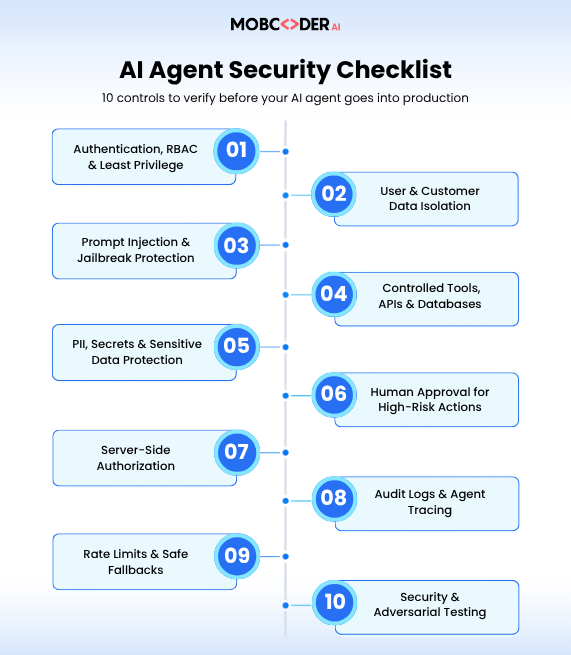
1. Implement Authentication, RBAC and Least-Privilege Access
A question should be clear since the development call: Who is allowed to interact with the agent and what is the agent allowed to do?
Every user, service and agent interacting with production systems should have an identifiable identity and appropriate authentication. Role-Based Access Control (RBAC) can then define what different users are permitted to do. For example, an administrator may have broader access than a reviewer or standard user. But user permissions are only part of the equation.
The principle of least privilege should also apply to the AI agent itself. The agent should receive only the permissions required to complete its assigned task, nothing more.
For example, a customer-support agent may need permission to read a customer's order history, check shipment status, create a support ticket, etc. It may not need permission to delete customer records, change user permissions, access payroll data, run arbitrary database queries.
This permission limits the potential impact of a compromised account, malicious instruction or unexpected agent behavior.
Before development, make sure you have:
- Distinct identity for agents where appropriate
- Defined roles and permissions
- Least privilege to users and agents
2. Enforce Proper User and Customer Data Isolation
Data isolation becomes particularly important when one AI application serves multiple customers, organizations or users. A retrieval system might contain documents from hundreds of customers. If tenant boundaries are not enforced correctly, an agent could retrieve information belonging to the wrong customer. Therefore, isolation is needed to exist across the entire data path.
A common approach is to associate every record or document with a customer or tenant ID and enforce that identifier throughout backend queries and retrieval operations.
This example will help you understand it better: Customer A's agent request should only retrieve documents, records and vector embeddings associated with Customer A. And this request should not depend solely on instructions given to the model. The application should enforce the boundary technically.
Before production, verify:
- Every customer record has an ownership or tenant identifier.
- Retrieval queries enforce tenant boundaries.
- Vector search respects authorization.
- APIs validate tenant access server-side.
- Cached results cannot cross customer boundaries.
- Testing includes deliberate cross-tenant access attempts.
3. Protect Against Prompt Injection and Jailbreaks
Prompt injection is one of the most important risks to consider when building secure AI agents. An attacker does not necessarily need to compromise the underlying infrastructure. They may simply provide instructions designed to change the agent's behavior. Those instructions can come directly from a user or be hidden inside external content. For example, imagine an AI agent that reviews incoming invoices. An invoice could contain hidden instructions attempting to persuade the agent to ignore its original task or expose information from its context. This is why external content should be treated as untrusted input.
AI agent guardrails can reduce the risk by controlling what instructions, information and actions the system accepts.
Add useful controls into your agent like:
- Clear instruction hierarchy
- Input and content filtering
- Retrieval controls
- Tool allowlisting
- Tool-specific authorization
- Output validation
- Sensitive-data filtering
- Human approval for high-risk actions
- Adversarial testing
4. Restrict the Tools, APIs and Databases an Agent Can Access
An AI agent should not automatically receive access to every system available within an organization. Every tool creates another potential path to data or action. Consider an AI sales assistant. It might need access to, CRM customer records, product information, meeting schedules, etc.
That does not mean it should also have unrestricted access to other important aspects like financial systems, employee records, production infrastructure, database administration tools. The safer approach is to expose narrowly defined tools with explicit permissions. For each tool, clearly define:
- What the tool does
- Which agents can use it
- Which users can authorize its use
- What data it can access
- Which operations it supports
- What parameters are allowed
- Whether the operation is reversible
- Whether human approval is required
5. Protect PII, Secrets and Other Sensitive Data
AI agents can process large amounts of business information, which means sensitive data can move through more components than in a traditional application. Sensitive data should be identified and protected throughout the AI workflow. Depending on the use case, controls may include:
- Encryption in transit and at rest
- Data masking
- Redaction
- Tokenization
- Data minimization
- DLP controls
- Secure secret management
- Restricted access to sensitive data
- Careful control over what data is sent to external model providers
One rule should be non-negotiable: Never embed passwords, API keys or access tokens directly inside prompts, source code or client-side applications. Secrets should be managed through appropriate secret-management systems and exposed to applications only when required.
Teams should also consider what information appears in prompts, model responses, tool calls and logs. A secure database does not help much if sensitive credentials are accidentally written into application logs.
6. Require Human Approval for Sensitive or Irreversible Actions
AI agents can automate tasks, but not every action should be fully autonomous. For sensitive, high-risk or difficult-to-reverse operations, a human approval step can provide an additional control.
A useful pattern is:
This is commonly referred to as human-in-the-loop. The important point is that human approval should be based on risk rather than applied blindly to every agent interaction. A low-risk action such as retrieving a product specification may not need approval. And deleting production data should be treated very differently.
7. Enforce Authorization on the Server Side
Security controls should never depend only on what the frontend displays. For example, disabling a "Delete Customer" button for a particular user does not guarantee that the underlying API cannot be called directly. Every sensitive backend operation should independently verify:
Who is making the request?
Is the request coming from a user, service or AI agent?
What permissions does that identity have?
Which resource is being accessed?
Is that specific operation authorized?
This is especially important for AI agents because an agent may dynamically select tools or construct requests based on its context. Authorization needs to remain outside the model's control.
In practical terms: The model can request an action. The application decides whether that action is permitted. This separation is one of the most important AI agent security principles for production systems.
8. Maintain Audit Logs and Trace Agent Actions
When an AI agent performs a complex workflow, simply storing the final answer may not be enough. Security and engineering teams need to understand what happened along the way.
The objective is not necessarily to capture or expose private model reasoning. Instead, teams need a reliable record of the observable actions and decisions surrounding the agent.
This becomes particularly valuable when investigating unauthorized access, data leakage, unexpected tool calls, etc.
9. Add Rate Limiting and Safe Fallback Behaviour
Security isn't only about preventing unauthorized actions. It is also about controlling what happens when systems behave unexpectedly. Rate limits can protect AI systems against:
Excessive usage
Automated abuse
Accidental request spikes
Resource exhaustion
Denial-of-service attempts
The agent should also have a defined fallback when something goes wrong. For example, what should happen when:
The model becomes unavailable?
A required API fails?
A tool returns malformed data?
Is confidence insufficient?
A security check fails?
A request exceeds a defined threshold?
The safest response may be to stop execution, return a controlled response or escalate to a human rather than allowing the agent to continue making uncertain decisions.
A production AI agent should have a safe failure mode, not just a successful execution path.
10. Conduct Security and Adversarial Testing Before Going Live
AI agent security testing should cover more than normal functional testing. An agent may work perfectly when given expected inputs and still fail when confronted with malicious or unexpected ones.
For example, if an agent can retrieve customer documents, testing should deliberately attempt to make it retrieve another customer's documents. If an agent can call a payment API, testing should attempt to manipulate the workflow into making an unauthorized transaction. The objective is to test the complete agent system, not just the underlying model.
AI Agent Compliance Checklist
Security and compliance overlap, but they are not the same thing. There is no universal compliance checklist that applies to every AI agent. Requirements depend on factors such as the data being processed, industry, geography, customers and intended use.
For example, an application processing personal data may need to consider GDPR requirements, while a healthcare application may have additional obligations related to protected health information. Enterprise customers may also require controls aligned with frameworks such as SOC 2. The relevant requirements should influence the system from the beginning rather than being treated as a final documentation exercise.
These requirements should shape the agent's architecture, data handling, access controls, monitoring, and governance from the beginning rather than becoming a documentation exercise at the end. We've already covered how AI transformation is a problem of governance and how successful AI adoption depends on defining ownership, accountability, risk boundaries, and oversight alongside the technology itself.
Final Takeaway
Our AI experts at Mobcoder AI have put together this checklist to help teams evaluate boundaries before an AI agent reaches production. It brings together the security controls that matter across identity and access, data isolation, prompt injection, tool permissions, sensitive data, human approval, authorization, monitoring, safe fallbacks, and adversarial testing.
Use this AI agent compliance checklist as a pre-production security gate to identify gaps before they become production risks and to make sure an agent’s level of autonomy matches the access and controls your system can safely support.