


A server goes quiet at 2 a.m. Nobody's watching the dashboard. Twenty minutes later, a page fires but not to a human. It goes to an agent that's already pulled the logs, correlated the spike with a deployment from six hours earlier, ruled out three false leads, and written up a root-cause summary before the on-call engineer has even opened their laptop.
That's the practical shape of a remote diagnostic agent, and it's quietly becoming one of the more consequential categories inside the broader agentic AI wave. Not because it's flashy there's nothing glamorous about log correlation but because it removes hours of grinding, error-prone work from teams that are already stretched thin. If you've spent any time around infrastructure, healthcare device fleets, industrial equipment, or connected vehicles in the last year, you've probably run into some version of this technology, even if nobody called it by name.
This piece is for people who already understand agents and don't need the 101. We're going to get into what actually differentiates a remote diagnostic agent from a monitoring dashboard, how the pipeline works end to end, where it breaks down, and what it takes to build one that a team will actually trust in production.
What Exactly Is a Remote Diagnostic Agent?
A remote diagnostic agent is an autonomous or semi-autonomous software system that observes a device, application, or infrastructure component from a distance, reasons over the telemetry it collects, and produces a diagnosis sometimes paired with a recommended or automatically executed fix without a human manually digging through logs first.
The word "remote" is doing real work in that definition. The agent isn't sitting on the machine it's diagnosing in the traditional sense of a local utility; it's typically deployed as a lightweight collector on the target system, streaming structured data (logs, metrics, traces, hardware telemetry, sensor readings) to a reasoning layer that lives elsewhere often cloud-hosted, sometimes edge-deployed for latency-sensitive cases. That reasoning layer is where the "agent" part earns its name: it doesn't just flag a threshold breach, it forms and tests hypotheses.
This is the line that separates a diagnostic agent from classic monitoring. A monitoring system tells you a metric crossed a line. A diagnostic agent tells you why, cross-references it against history, and increasingly, tells you what to do about it with a confidence score attached, not a guess dressed up as certainty.
How Remote Diagnostic Agents Actually Work
Strip away the marketing language and the architecture is fairly consistent across domains, whether you're looking at a data-center fleet, a connected car, or a piece of medical equipment.
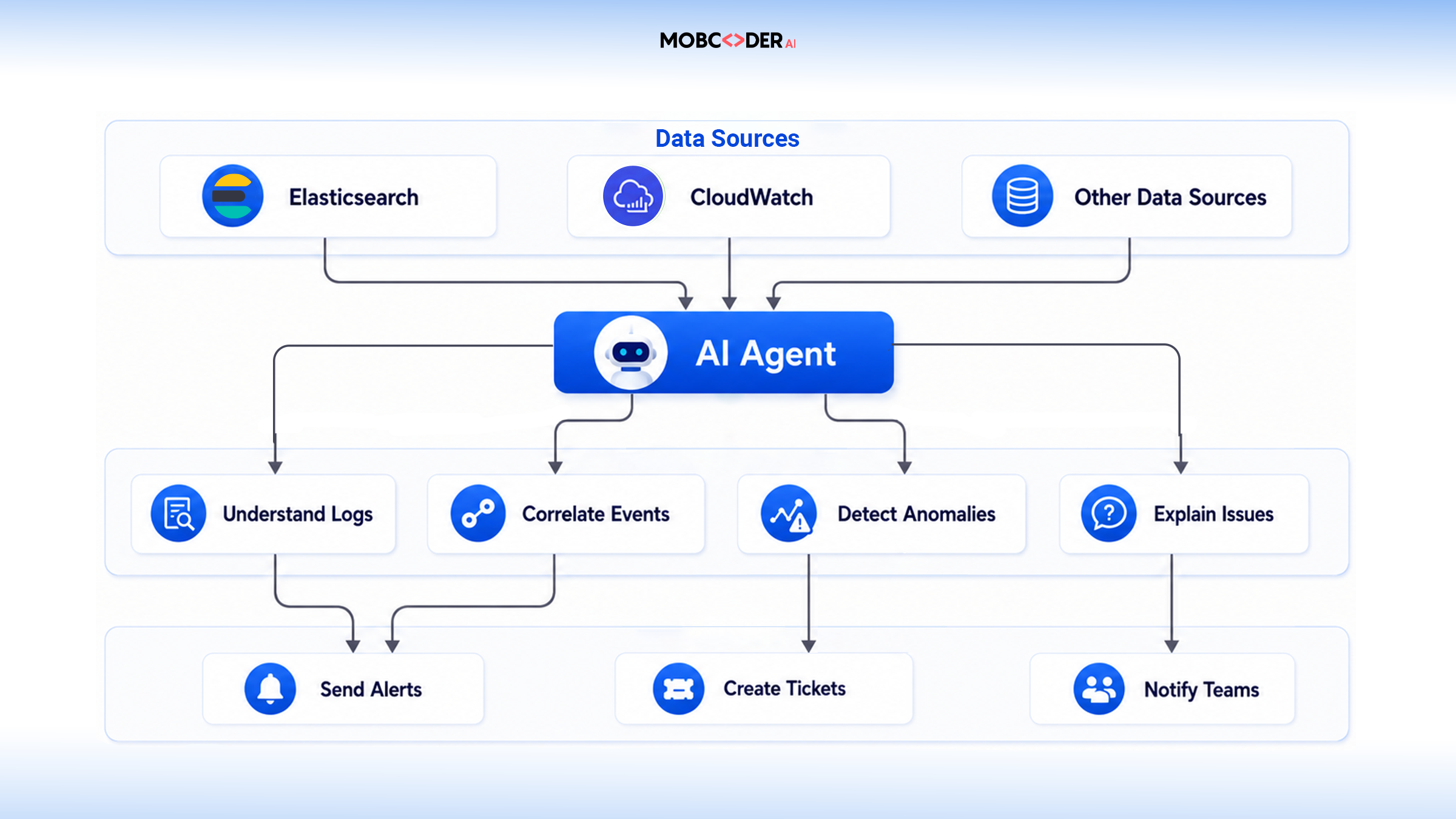
Telemetry Collection
A small agent runs on or near the target system and reads whatever signals are available: system logs, process lists, network state, hardware health indicators like SMART data from drives or thermal sensors, application traces, and depending on the domain domain-specific signals like ECU fault codes in vehicles or vibration data on industrial equipment. The collection layer is intentionally lightweight; it's not doing the thinking, it's gathering evidence.
Baseline and Anomaly Detection
Before an agent can say something is wrong, it needs a working definition of normal. Most production-grade agents maintain a rolling baseline per system, learning what typical CPU load, error rates, memory patterns, or sensor readings look like for that specific asset, not some generic industry average. Deviations get scored against that baseline rather than a hardcoded threshold, which is why these systems catch slow-burn issues: a drive with early SMART warning signs, say that a static alert rule would miss entirely.
Correlation and Hypothesis Formation
This is the part that actually resembles reasoning. The agent doesn't look at one signal in isolation; it tries to connect a spike in error rate to a deployment event, a memory leak to a specific service, a fault code to a known failure pattern from a global history of similar cases. Multi-agent frameworks are increasingly common here; one sub-agent handles log parsing, another handles metric correlation, another checks the deployment history, and an orchestrating layer synthesizes their findings into a single hypothesis. If you're weighing whether to build this in-house, this is usually the point where teams start evaluating dedicated agentic AI development services rather than trying to bolt agent behavior onto an existing rules engine.
Report Generation
Raw findings get translated into something a human or another system can act on. This is a generative task in the literal sense: an LLM component takes structured findings (issue, confidence rating, affected components, secondary anomalies) and writes a coherent explanation, which is a distinct capability from the detection logic itself and is often built through separate generative AI development services layered on top of the diagnostic pipeline. A well-designed report includes three things: the identified issue with a confidence rating, the proposed remediation, and any flagged secondary anomalies that didn't trigger an alert but are worth watching.
Remediation (Sometimes)
Some agents stop at diagnosis. Others are cleared to act -restarting a service, rolling back a deployment, throttling a noisy process. The industry is moving toward the latter, but cautiously, and AWS's DevOps Agent is a useful case study in how that trust gets built incrementally. It launched in late 2025 with intentionally limited write capabilities -investigate and recommend, human implements the fix -and by mid-2026 had expanded into release-readiness checks and automated pre-production testing as adoption data justified more autonomy. That's less a fixed limitation than a staged rollout, and it's the right pattern for most organizations still earning trust in these systems.
Why This Matters More Now Than It Did Two Years Ago
Three things changed roughly at once. LLMs got good enough at structured reasoning to correlate messy, multi-source telemetry without hand-crafted rules for every scenario. Cloud providers built the infrastructure to make agent deployment practical at scale Bedrock AgentCore and similar platforms turned "build an agent" from a research project into an engineering task. And the sheer volume of systems needing to be watched exploded, driven by IoT proliferation, hybrid cloud sprawl, and distributed workforces that pushed device fleets outside the neat perimeter IT teams used to manage.
The result is a shift Gartner has put a specific number on: it projects 70% of enterprises will be running agentic AI to operate their IT infrastructure by 2029, up from under 5% in 2025 -a shift from reactive, human-triggered troubleshooting toward proactive, agent-driven detection and remediation, with human operators moving into a supervisory role rather than a first-responder one. That's not a small shift in job description, it changes what "good" looks like for an ops team.
Remote Diagnostic Agents Across Different Industries
It's worth being specific here, because the phrase gets used loosely.
IT infrastructure and DevOps is probably the fastest-moving segment right now. Agents triage incidents, correlate deployment history with error spikes, and increasingly handle the kind of 2 a.m. troubleshooting that used to eat into an SRE's sleep. A dedicated Server Intelligence Agent is a good example of this pattern applied narrowly to server-layer telemetry rather than trying to boil the ocean across an entire stack.
Automotive has arguably the most mature deployment of this pattern outside of pure software. Modern vehicles run hundreds of ECUs, and when a sensor detects an anomaly, say, in fuel injection or battery discharge it can generate a fault packet that a cloud-based agent analyzes before the driver ever sees a warning light. Some manufacturers have gone further, layering generative copilots on top that explain the issue in plain language and estimate repair cost before the car even reaches a shop.
Healthcare is moving more cautiously, for good reason the cost of a wrong hypothesis is categorically different. But remote patient monitoring paired with AI-assisted diagnostics is now formally billable in the U.S. under CPT codes for remote physiologic monitoring (99453, 99454, 99457), which is as concrete a signal as any that the category has moved past the pilot-program stage into standard reimbursed practice.
Industrial equipment uses a close cousin of the same architecture for predictive maintenance catching bearing wear, thermal drift, or vibration anomalies weeks before they'd otherwise cause unplanned downtime, which is where the economics of this technology are the clearest: the cost of catching a failure early is nearly always a fraction of the cost of an emergency shutdown.
What Makes a Good Diagnostic Agent (and What Makes a Bad One)
Not all of these are built the same, and the gap between a genuinely useful agent and a noisy one usually comes down to a handful of decisions.
A good agent explains its confidence, not just its conclusion. If it can't tell you how sure it is, treat the output the same way you'd treat an unverified tip worth checking, not worth acting on blindly.
A good agent has a memory of its own mistakes. Systems that learn from prior incidents that looked like a database issue but turned out to be a networking one, for instance, get measurably better over time. Systems without that feedback loop just repeat the same misdiagnoses politely.
A good agent knows the difference between diagnosis and action. The most trustworthy systems in production right now are the ones that were deliberate about where the human stays in the loop, rather than trying to automate everything on day one because it's technically possible.
A bad agent is a black box. If nobody on the team can explain why it flagged something or why it didn't it's not going to survive the first false positive that costs someone a weekend.
This is also where governance stops being a compliance checkbox and starts being an engineering requirement. As agents get more autonomy, write access, remediation permissions, the ability to touch production, the question of who's accountable when an agent makes a bad call becomes a real operational risk, not a hypothetical one. That's the exact argument laid out in AI Transformation Is a Problem of Governance, and it applies just as much to a diagnostic agent with remediation rights as it does to any other autonomous system making decisions on a company's behalf.
A Simple Look at the Pipeline in Code
Most production systems are more elaborate than this, but the core loop collect, evaluate against baseline, escalate to a reasoning model only when something's actually anomalous looks roughly like this in practice:
import statistics
from dataclasses import dataclass

@dataclass
class HealthSample:
    cpu_pct: float
    mem_pct: float
    error_rate: float
    disk_reallocated_sectors: int

def is_anomalous(sample: HealthSample, baseline: list[HealthSample], z_threshold: float = 3.0) -> dict:
    """Flag a sample if it deviates significantly from the rolling baseline."""
    findings = {}

    error_rates = [s.error_rate for s in baseline]
    mean_err = statistics.mean(error_rates)
    stdev_err = statistics.pstdev(error_rates) or 0.01
    z_score = (sample.error_rate - mean_err) / stdev_err

    if z_score > z_threshold:
        findings["error_rate_anomaly"] = {
            "z_score": round(z_score, 2),
            "current": sample.error_rate,
            "baseline_mean": round(mean_err, 4),
        }

    if sample.disk_reallocated_sectors > 0:
        findings["disk_early_warning"] = {
            "reallocated_sectors": sample.disk_reallocated_sectors,
            "note": "Not failing yet, but trending toward a failure point.",
        }

    return findings

def escalate_to_reasoning_agent(findings: dict, context: dict) -> str:
    """
    Only hit the LLM reasoning layer when local anomaly detection
    actually finds something — keeps cost and noise down.
    """
    if not findings:
        return "No escalation needed."
    # In production this call would go to your diagnostic-reasoning
    # endpoint, passing findings + recent deploy history + logs
    return f"Escalating {len(findings)} finding(s) for root-cause analysis: {list(findings.keys())}"
The point of showing this isn't the code itself, it's the pattern: cheap, deterministic checks run constantly at the edge, and the expensive reasoning layer only gets invoked when there's actually something worth reasoning about. Agents that skip this step and send every data point to an LLM burn budget fast and add latency nobody asked for.
Where This Overlaps with Other Specialized Agents
Remote diagnostic agents don't operate in isolation, and it's worth understanding how they relate to other narrow-purpose agents rather than treating "AI agent" as one undifferentiated category. A Messaging Security Agent, for instance, solves a completely different problem scanning communication channels for phishing and data leakage but it shares the same underlying design philosophy: narrow scope, high domain specificity, and a clear boundary on what it's authorized to act on. That's generally a better bet than a single general-purpose assistant trying to cover monitoring, security, and communication all at once. Purpose-built agents tend to be more accurate precisely because they're not trying to be everything.
Build vs. Buy: What Teams Actually Run Into
Off-the-shelf diagnostic tools cover the common cases well: general server health, standard cloud infrastructure, and common application stacks. Where they tend to fall short is anything domain-specific: proprietary hardware, legacy systems with undocumented failure modes, or workflows that need to plug into internal tooling nobody outside the company has ever heard of.

That's usually the fork in the road. Teams with fairly standard infrastructure and a tight timeline lean toward existing platforms. Teams with specialized environments, strict data residency requirements, or a need for the agent to integrate deeply with internal runbooks and escalation paths tend to end up building something custom, working with a partner that specializes in AI agent development services to get the domain-specific reasoning right rather than trying to force a generic tool to understand a system it was never trained on.
Either path is defensible. What's not defensible is skipping the evaluation and assuming a general-purpose monitoring dashboard with an AI label slapped on it will behave like a genuine diagnostic agent. The difference is in the reasoning layer, not the dashboard.
Getting Started Without Overbuilding
The teams that get the most value out of this fastest usually don't try to boil the ocean on day one. They pick one high-friction diagnostic problem, a recurring incident type, a fleet of devices with a known failure pattern, a class of alerts that consistently turns out to be noise and build or deploy an agent scoped tightly to that problem. Once it's earned trust on a narrow scope, expanding it is a much easier conversation than trying to launch something that diagnoses everything on the first attempt.
If you're mapping out where a remote diagnostic agent fits into a broader modernization plan, that's usually a conversation worth having with a team that does AI development services end to end, since the diagnostic agent itself is rarely the only piece it typically needs to plug into existing observability tooling, ticketing systems, and deployment pipelines to actually deliver on the promise.