


If you've been anywhere near a DevOps Slack channel in the last year, you've probably heard the phrase "server intelligence agent" thrown around more than once. Maybe it was in a vendor pitch. Maybe a colleague mentioned it after another 3 a.m. pager alert that turned out to be nothing or worse, turned out to be something and nobody caught it in time.
Either way, you're here because you want a straight answer: what actually is a server intelligence agent, how is it different from the monitoring tools you already have, and is it worth the switch?
Let's get into it.
What Is a Server Intelligence Agent?
A server intelligence agent is a software agent that lives on or near your server infrastructure and continuously observes, interprets, and acts on system behavior - CPU load, memory pressure, disk I/O, network traffic, process health - in real time, without waiting for a human to read a dashboard.
That's the short answer. Here's the longer, more useful one.
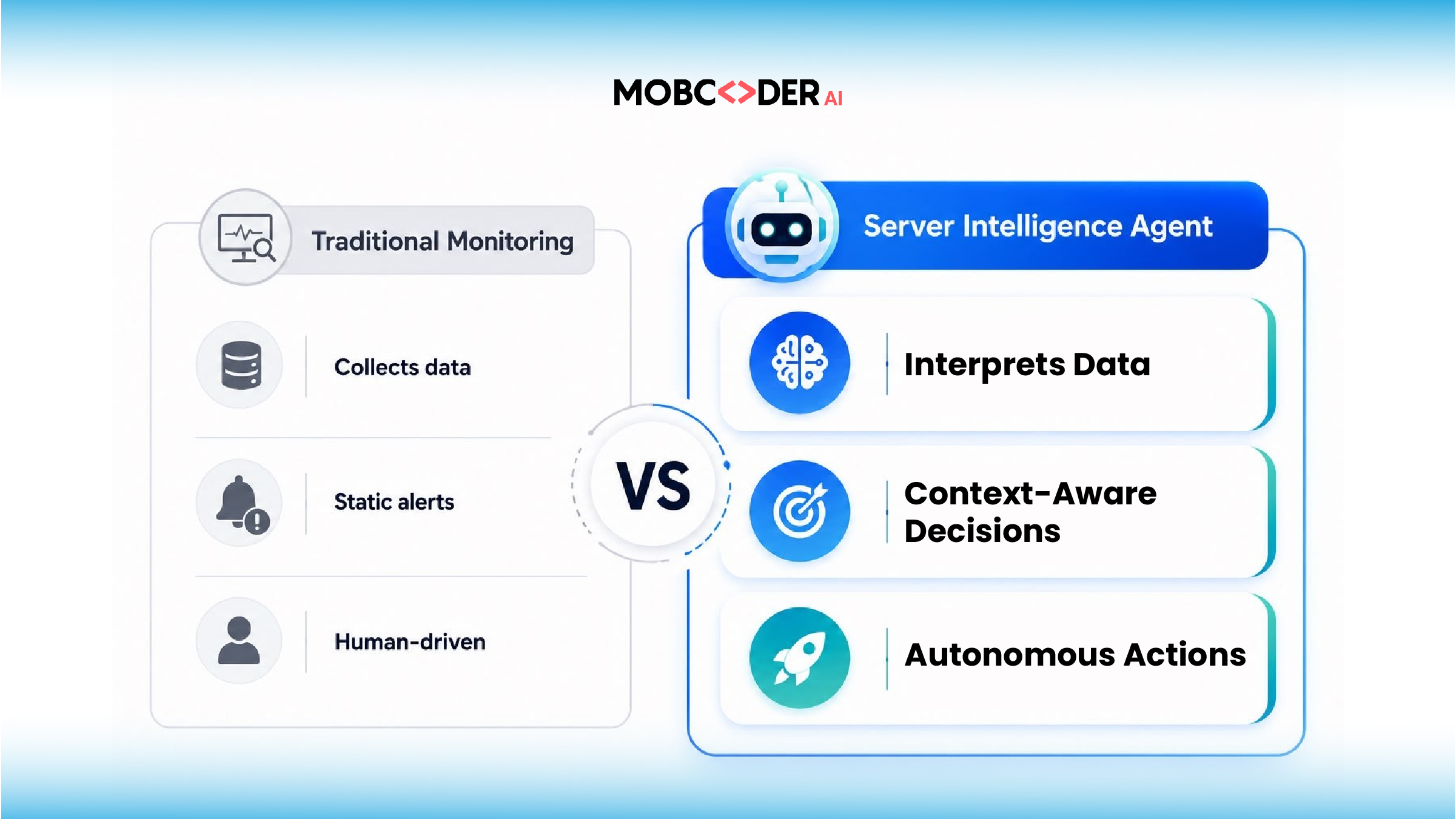
Traditional monitoring tools collect metrics and forward them somewhere for a human (or a rigid rule engine) to interpret later. A server intelligence agent does the interpretation itself, at the source, as the data is generated. It doesn't just tell you the CPU hit 92%. It tells you why it hit 92%, whether that's normal for a Tuesday afternoon deploy or the early signature of a memory leak that's going to take down a checkout service in forty minutes.
This is the core distinction people miss: a server intelligence agent isn't a fancier dashboard. It's a decision-making layer that sits directly inside your infrastructure.
Why This Category Exists Now
Server environments used to be simple enough that static thresholds worked fine. Alert if CPU > 80%. Alert if disk > 90%. Page someone if a service stops responding.
That approach breaks down in modern environments for a few reasons:
- Containers and ephemeral infrastructure. Pods spin up and die in seconds. A "server" today might not exist five minutes from now, which makes long-lived, rule-based monitoring nearly useless.
- Distributed workloads. A single user request might touch a dozen microservices. A spike in one place is often the symptom, not the cause, and static thresholds have no concept of causality.
- Scale that outpaces human attention. Nobody is staring at forty dashboards waiting for a line to move. By the time a human notices, the incident is already in production.
- Cost of downtime keeps rising. For SaaS products and e-commerce platforms, a few minutes of degraded performance translates directly into lost revenue and support tickets.
Static, threshold-based monitoring was built for a world of a handful of long-running servers. We're not in that world anymore. That gap is exactly what a server intelligence agent is designed to close - not by collecting more data, but by making sense of the data closer to where it's created.
How a Server Intelligence Agent Actually Works
At a high level, most server intelligence agents follow a loop that looks something like this:
- Observe - continuously pull telemetry from the OS, container runtime, application logs, and network layer.
- Contextualize - compare current behavior against historical patterns, not fixed thresholds. A CPU spike at 2 a.m. means something different than the same spike during a marketing campaign launch.
- Reason - use pattern recognition or a reasoning model to decide whether the anomaly is benign, worth flagging, or worth acting on immediately.
- Act or Escalate - auto-remediate where it's safe to do so (restart a hung process, scale a resource, throttle a noisy neighbor), or escalate to a human with the full context already attached.
That last point matters more than people give it credit for. The most frustrating part of on-call work isn't getting paged - it's getting paged with zero context and having to reconstruct the story from five different dashboards. A good server intelligence agent hands the engineer a narrative, not just a number.
A Simplified Example
Here's a stripped-down illustration of what the reasoning loop of a server intelligence agent might look like in code. This isn't production-grade, but it shows the shape of the logic: collect metrics, detect deviation from a learned baseline, and only then decide whether to act or ask an LLM-based reasoning layer for a diagnosis.
PlainBashC++C#CSSDiffHTML/XMLJavaJavaScriptMarkdownPHPPythonRubySQL
import psutil
import time
import statistics

# Rolling baseline instead of a static threshold
cpu_history = []
BASELINE_WINDOW = 60 # seconds of history to consider "normal"

def get_cpu_snapshot():
return psutil.cpu_percent(interval=1)

def is_anomalous(current, history):
if len(history) < 10:
return False # not enough data to judge yet
mean = statistics.mean(history)
stdev = statistics.pstdev(history) or 1
z_score = (current - mean) / stdev
return z_score > 3 # significant deviation, not just a normal spike

def diagnose_with_reasoning_agent(current, history, process_list):
"""
 In a real deployment, this would call a reasoning model (e.g. via the
 Anthropic API) with the metric history and top processes, and ask it
 to classify the anomaly and suggest a remediation step.
 """
prompt = f"""
 Current CPU usage: {current}%
 Recent history: {history[-10:]}
 Top processes by CPU: {process_list[:5]}

 Classify this as: normal_spike, resource_leak, or incident.
 Suggest one safe remediation action if applicable.
 """
# response = call_llm_api(prompt) # placeholder for the actual API call
return prompt # returned here for illustration only

while True:
cpu_now = get_cpu_snapshot()
top_procs = sorted(
psutil.process_iter(['name', 'cpu_percent']),
key=lambda p: p.info['cpu_percent'],
reverse=True
)

if is_anomalous(cpu_now, cpu_history):
diagnosis = diagnose_with_reasoning_agent(cpu_now, cpu_history, top_procs)
print("Anomaly detected. Escalating with context:\n", diagnosis)
else:
print(f"CPU at {cpu_now}% - within normal range")

cpu_history.append(cpu_now)
if len(cpu_history) > BASELINE_WINDOW:
cpu_history.pop(0)

time.sleep(5)
The important part isn't the psutil calls - it's the shift in philosophy. Instead of asking "did we cross a fixed line?", the agent asks "is this different from what's normal for this system, at this time?" That's the difference between monitoring and intelligence.
Server Intelligence Agents vs. Traditional Monitoring vs. APM
It's worth being precise about the differences here, because the terms get used loosely.
None of these tools necessarily replace the others. A lot of mature setups run APM for tracing and a server intelligence agent for the "is something actually wrong right now, and what should we do about it" layer on top.
Where Server Intelligence Agents Are Already Being Used
This isn't a theoretical category. It's showing up in a few concrete places:
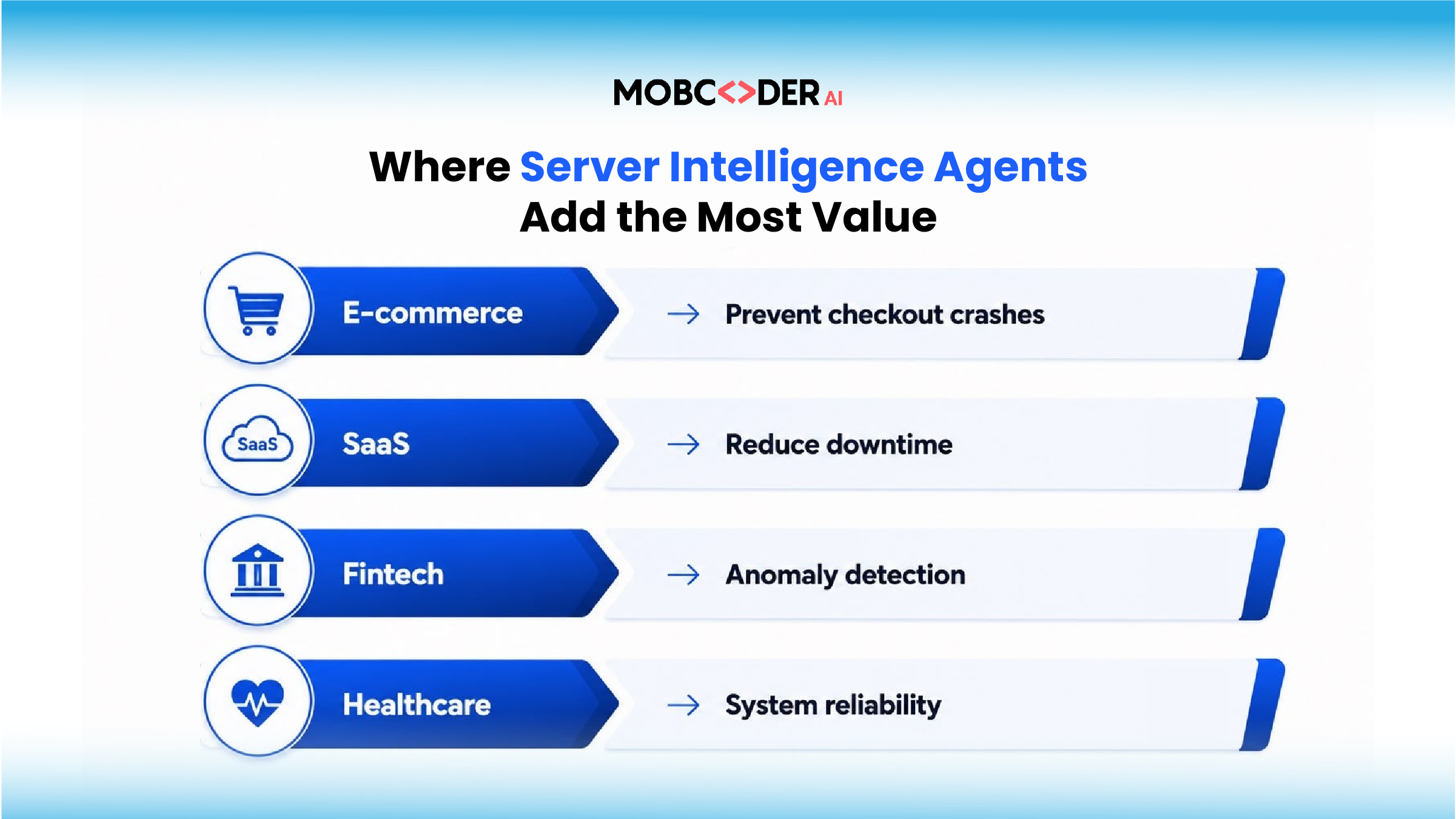
E-commerce and high-traffic retail: Flash sales and checkout flows are exactly the kind of unpredictable, spiky load where static thresholds fail. An agent that understands "this is a sale event, not an attack" prevents both false alarms and missed real incidents.
SaaS platforms with strict SLAs: When uptime is a contractual obligation, catching degradation before customers notice is the whole game. Intelligence agents that can distinguish a slow database query from a full outage buy engineering teams precious minutes.
DevOps and platform engineering teams: Instead of maintaining a wall of dashboards, teams are increasingly letting an agent triage first and surface only what actually needs a human decision.
Security-adjacent monitoring: Server intelligence agents often work alongside more specialized agents, like a messaging security agent that inspects traffic and communication channels for abuse, phishing patterns, or data exfiltration attempts. The server-level agent watches infrastructure health; the messaging security agent watches content and communication integrity. Together they cover a much wider surface than either does alone - which is why more security-conscious teams are pairing infrastructure intelligence with dedicated messaging and communication security layers rather than treating them as separate, disconnected tools.
The Governance Question Nobody Wants to Answer First
Here's the part that gets skipped in most vendor pitches: giving an autonomous agent the ability to restart services, scale resources, or make judgment calls about your infrastructure is not a purely technical decision. It's a governance decision.
Who approved the agent's remediation logic? What's the audit trail when it takes an action at 3 a.m. with nobody watching? What happens when it's wrong?
This connects to a broader pattern a lot of engineering leaders are already running into: AI transformation is, at its core, a problem of governance far more than it's a problem of model quality. The technology to build a capable server intelligence agent is genuinely available today. The harder work is deciding permission boundaries, rollback procedures, and accountability before you let an agent touch production. Teams that skip this step tend to either over-restrict the agent until it's useless, or under-restrict it until an autonomous action causes an incident of its own.
A well-designed server intelligence agent should ship with:
- Clearly scoped permissions (read-only vs. remediation-capable actions)
- A full audit log of every decision and action taken
- Human-in-the-loop approval for anything destructive or irreversible
- Rollback paths for every automated action it's allowed to take
If a vendor or internal team can't answer "what happens when it's wrong," that's a governance gap, not a technical detail to sort out later.
Do You Actually Need One?
Not every setup needs a full autonomous intelligence layer. A few honest signals that you do:
- Your on-call engineers spend more time gathering context than actually fixing problems
- You're running containerized or auto-scaling infrastructure where "normal" changes hour to hour
- Incidents are frequently caught by customers before your team notices
- Your monitoring stack generates so many alerts that engineers have started ignoring them
If none of that sounds familiar, a solid APM setup and sane alerting rules might genuinely be enough for now. There's no prize for adopting agentic infrastructure before you need it.
Building a Server Intelligence Agent: What It Actually Takes
If you decide it's time, building one isn't a weekend project. A production-grade server intelligence agent typically needs:
- Telemetry pipelines that can stream OS, container, and application-level metrics without adding meaningful overhead.
- A baseline model - statistical or ML-based - that learns what "normal" looks like for your specific systems instead of relying on someone's guess at a threshold.
- A reasoning layer, often built on top of an LLM, that can take an anomaly plus context and produce a human-readable diagnosis, not just a number.
- An action layer with strict guardrails for anything that touches production.
- Feedback loops so the agent's judgment improves as engineers confirm or correct its diagnoses over time.
This is where most in-house teams underestimate the effort. The monitoring part is the easy 20%. The reasoning, governance, and safe-action layers are the hard 80%, and they're exactly where specialized experience in agentic AI development services pays off.
This is also the point where a lot of teams decide it's more efficient to work with a partner who has already solved these problems across multiple environments, rather than rebuilding the reasoning and governance layers from scratch. That's the kind of work our team at Mobcoder AI focuses on daily, from scoping the right architecture to shipping an agent your engineers will actually trust in production.
How Mobcoder AI Approaches This
We build custom agentic systems for infrastructure, security, and operations teams who need something more capable than static dashboards but don't want to hand over the keys to a black box.
Our approach usually spans:
- AI agent development services to design the observation, reasoning, and action loop specific to your stack - whether that's Kubernetes-based, VM-based, or a hybrid environment.
- Agentic AI development services for teams that need multiple coordinating agents - for example, a server intelligence agent working alongside a messaging security agent, each specialized but sharing context.
- Generative AI development services where the reasoning layer benefits from large language models that can explain anomalies in plain language instead of raw metric dumps.
- AI development services more broadly, for teams that need the surrounding infrastructure like data pipelines, dashboards, and integration work, built alongside the agent itself.
Every engagement starts with the governance conversation, not the tooling one. We'd rather spend the first two weeks scoping permission boundaries and rollback logic than ship an agent that makes a call nobody signed off on.
Final Thoughts
A server intelligence agent isn't a buzzword layered on top of existing monitoring - it's a genuine shift in where the thinking happens. Instead of humans interpreting dashboards after the fact, the interpretation happens at the source, in real time, with enough context to actually be useful.
The technology to build this well exists today. The harder, more important work is deciding how much autonomy to grant, how to audit it, and how to roll back when it's wrong. Get that part right, and the rest - the telemetry, the models, the remediation logic - becomes a lot more straightforward to build.
If you're weighing whether to build this in-house or bring in a team that's already solved the governance and architecture questions, that's exactly the conversation to have before writing the first line of code.