






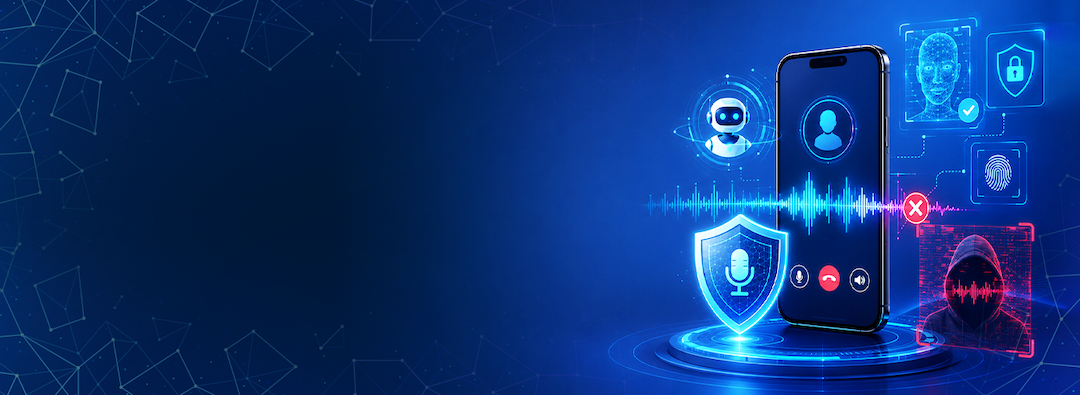

From cloned voices to deepfake video calls, fraud has moved beyond simple deception to highly coordinated, AI-driven attacks. What started as a $243,000 voice scam in 2019 has escalated to multimillion-dollar breaches by 2026. Traditional defenses aren’t built for this speed.
Agentic AI, Pindrop, and Anonybit are. Together, they create a three layer defense which is intelligent and real-time is built to detect, adapt and stop fraud as it unfolds. Agentic AI, Pindrop, and Anonybit form a three-layer identity-fraud defense-Agentic AI orchestrates real-time decisions, Pindrop detects synthetic/cloned voices, and Anonybit verifies identity using decentralized, breach-resistant biometrics. Together they catch and stop voice fraud in seconds instead of the minutes or hours a manual review process takes.
Why Traditional Security System Is Breaking Down in 2026
Passwords get leaked.
Security questions can be Googled.
SMS OTPs can be intercepted.
Biometric databases which once thought to be the gold standard now have become honeypots that attackers actively target.
The core problem isn't that these tools were poorly designed.
It's that they were designed for a world where attackers were human, moved at human speed and needed to compromise things one at a time.
Sadly, that world no longer exists.
- Contact centers globally log a fraud attempt every 46 seconds, according to industry fraud-monitoring reports. Voice fraud attacks rose over 1,300% in recent years, per voice-security industry benchmarks.
- AI-powered bots can now call a contact center, clone a customer's voice pattern, pass knowledge-based authentication, and trigger a transaction-without a single human fraudster ever picking up a phone.
- Static defenses don't work against automated, AI-driven attacks. The response has to be equally autonomous. That's what this stack delivers.
What Is Agentic AI and How Does It Work in Security?
Quick answer: Agentic AI in security means a system that observes conditions, evaluates risk, and takes action on its own-continuously-instead of waiting for a human to review each alert.
Agentic AI refers to AI systems that pursue goals autonomously. Unlike a chatbot that waits for a question, an agentic AI system monitors conditions, evaluates signals, makes decisions and takes action continuously, without waiting to be told what to do at each step.
Modern agentic AI frameworks provide the architecture that enables these systems to coordinate data, evaluate risk signals, and execute real-time responses across complex security environments. In a security context, this changes the game entirely.
A traditional fraud detection system flags a suspicious event. Then it waits for a human to look at it, decide what to do and act. That whole loop takes minutes. Sometimes hours. A sophisticated fraud attack unfolds in seconds.
An agentic AI system does something different.
The moment it detects an anomaly, unusual session behavior, a mismatched device fingerprint, a spike in the risk score from Pindrop's voice analysis - it acts immediately. It raises the authentication threshold for that session. It quietly routes the call to a fraud specialist queue. It logs the pattern for future detection. All before the caller has finished their second sentence.
These systems process multiple data streams simultaneously: device signals, behavioral baselines, session metadata, prior authentication history, and real-time call data. Nothing waits in a queue.
For businesses building or expanding their agentic AI capabilities, this represents a foundational shift, AI systems that don't just automate tasks but actively defend the environments they operate in.
What is Pindrop and How Does it Detect Fake Voices?
Quick answer: Pindrop is a voice-security platform that analyzes over 1,300 signals in a call (audio, device, behavior) to assign a real-time liveness score and flag synthetic or cloned voices.
Pindrop is a voice security and identity verification platform focused on detecting fraud, authenticating callers and identifying synthetic or manipulated voice activity across contact centers and virtual meetings.
That's harder than it sounds. Modern text-to-speech engines can produce audio that sounds completely natural to the human ear. Pindrop isn't listening like a human. It's analyzing over 1,300 signals across voice, device, and behavior in real time - and assigning a liveness score within seconds.
What kinds of signals? Things like:
- Spectral artifacts in synthesized audio that differ from organic human speech
- Micro-inconsistencies between the claimed device and the call's actual audio fingerprint
- Background noise patterns that don't match expected environments
- Behavioral cues that differ between live human speech and AI-generated playback
Pindrop Pulse for Meetings extends this approach to virtual meetings, with support for platforms such as Webex, Zoom, and Microsoft Teams, analyzing audio/video indicators for potential impersonation and synthetic manipulation.
For contact centers specifically, every inbound call gets scored silently in the background. If the score crosses a risk threshold, the agentic layer is immediately notified. Authentication requirements can be escalated, the call routed differently, or the session flagged - all without interrupting the caller or tipping off the attacker.
The fraud scenario Pindrop was built to stop: a bot calls in with a cloned voice, passes the IVR's basic prompts, and escalates to a human agent to authorize a transaction. Pindrop catches it at the voice signal layer before that escalation happens.
What Is Anonybit and Why Decentralized Biometrics Matters
Quick answer: Anonybit stores biometric data as encrypted, fragmented shards spread across multiple nodes instead of one central database, so there's no single point of breach-and no full biometric record to steal.
Anonybit addresses one of the most serious risks in biometric security: centralized biometric storage.
Here's the issue. Traditional biometric authentication stores sensitive biometric data - fingerprints, face scans, voice prints - in a centralized database. That database is incredibly valuable to attackers. One successful breach doesn't expose one person's data. It exposes every user in the system. And unlike a leaked password, you can't issue someone a new face or new fingerprints.
Anonybit's architecture removes that vulnerability entirely. Instead of storing complete biometric records in one place, it fragments biometric data into anonymous encrypted shards and distributes them across multiple cloud nodes. No single node holds enough information to reconstruct a usable credential. There's no central target to breach.
Authentication can be positioned around privacy-preserving verification: instead of relying on a single centralized biometric template, the model distributes sensitive biometric data in a way that reduces the risk of a single breach exposing complete biometric records. The match is mathematically verified without being reversible.
The framework supports facial recognition, voice prints, fingerprints, iris scans, and palm recognition. For high-value transactions, multi-modal authentication can be required - combining two or more biometric signals - which makes spoofing exponentially harder.
Anonybit has also been discussed in the context of identity-bound AI agents, where consequential AI actions are linked back to verified human authorization. This is especially relevant as enterprises look for stronger accountability around autonomous AI systems.
For businesses managing GDPR or other data minimization requirements, this architecture also reduces regulatory exposure. No single system holds a complete biometric record.
How Agentic AI Pindrop Anonybit Work Together in Real-Time
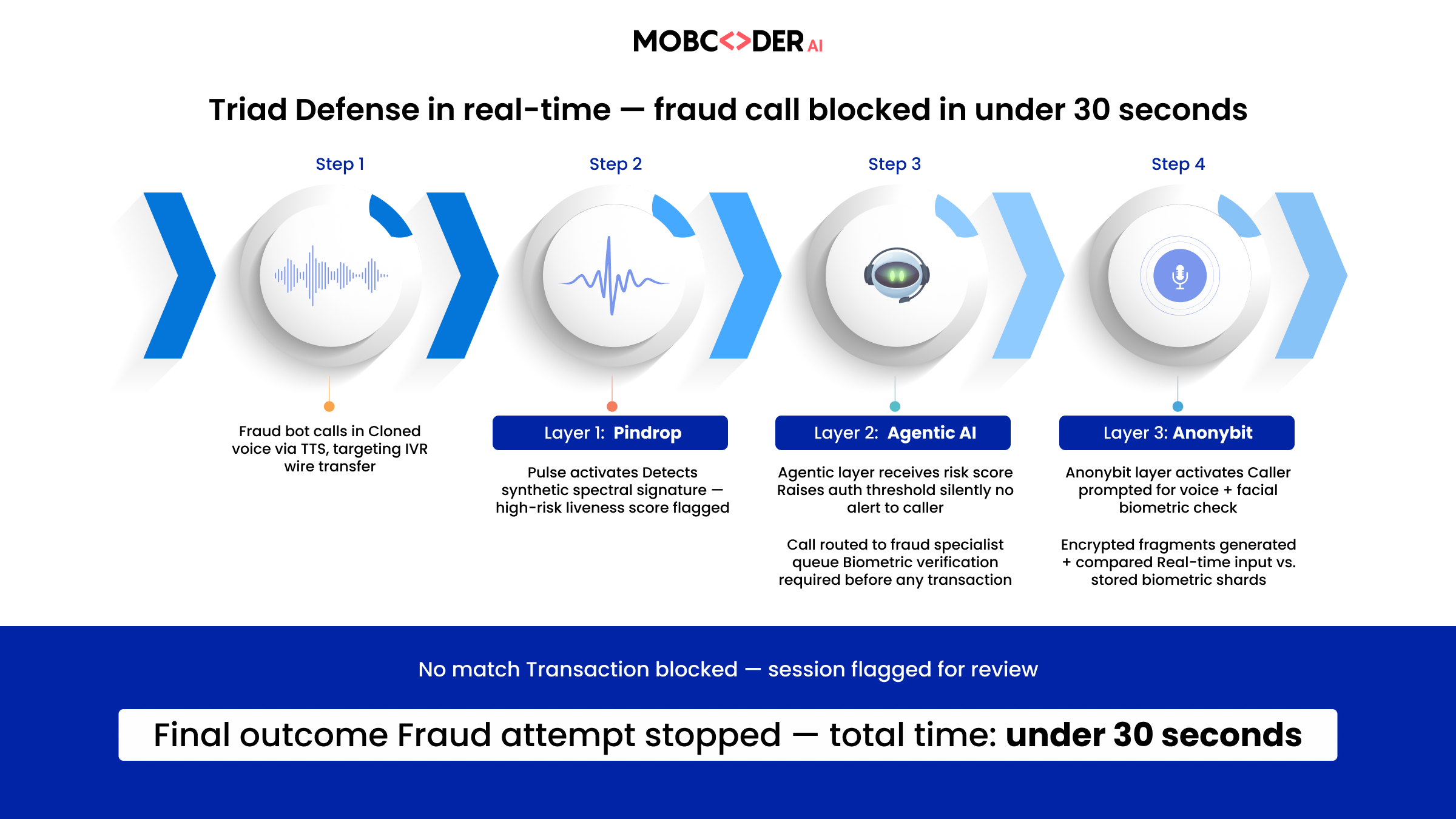
Here's the same fraud scenario played out, but this time with the Triad Defense in place.
A fraud ring obtains short public audio clips of an executive from interviews, webinars, or earnings calls and uses them to create a synthetic voice clone.
The bot calls in. Pindrop Pulse activates immediately, analyzing the audio in the background as the bot begins speaking. Within seconds, it detects the spectral signature of synthetic audio and assigns a high-risk liveness score. That score is passed instantly to the agentic security layer.
The agentic system raises the authentication threshold for the entire session - silently, without alerting the caller. It routes the call to a fraud specialist queue and flags that additional biometric verification is required before any transaction can proceed.
If the transaction is high-risk, the workflow can trigger additional biometric or identity verification, such as facial, voice, or multi-factor biometric checks, depending on the channel and user consent model.
Each layer covered what the others couldn't see alone. Agentic AI handled the orchestration and response logic. Pindrop caught the synthetic voice. Anonybit verified - or in this case, failed to verify - the claimed identity.
This is what "self-reinforcing" means in practice. The system doesn't just detect threats. It responds, adapts, and documents - in real time, without a human in the loop at each decision point.
A Simplified Decision-Engine Example (new section)
To make the orchestration layer concrete, here's a simplified illustration of how an agentic decision engine might combine a Pindrop-style liveness score with an Anonybit-style verification result to decide what happens next. This is illustrative pseudocode, not a production integration.
def decide_action(liveness_score, biometric_match, risk_context):
    """
    liveness_score: 0-100 from a Pindrop-style voice analysis
                    (higher = more likely synthetic/cloned)
    biometric_match: 0-1 confidence from an Anonybit-style
                    decentralized identity verification
    risk_context:   dict with transaction_value, channel, etc.
    """
    if liveness_score > 80:
        return {
            "action": "block_and_escalate",
            "reason": "High-confidence synthetic voice detected",
        }


    if liveness_score > 40 or biometric_match < 0.6:
        return {
            "action": "step_up_verification",
            "reason": "Ambiguous signals-require additional biometric check",
        }


    if risk_context.get("transaction_value", 0) > 10000:
        return {
            "action": "step_up_verification",
            "reason": "High-value transaction-always require secondary check",
        }


    return {"action": "allow", "reason": "Signals within normal range"}


# Every call to decide_action() should be logged with a timestamp,
# the inputs, and the decision-this audit trail is what lets a
# human reviewer (or regulator) reconstruct why the agent acted.
The important part isn't the exact thresholds-those get tuned per environment. It's the shape of the logic: no single signal makes the call alone, and every decision is logged so a human can review it after the fact.
Industry Applications: Who Needs This Most
- Banking and Financial Services - The most immediate use case. Contact center fraud in banking is industrialized. Voice cloning attacks targeting high-value account transfers are becoming a growing concern for financial institutions.
- Healthcare - Patient identity fraud is rising. Prescription fraud, insurance fraud, and unauthorized record access all exploit weak identity verification. Voice-based authentication in patient service lines is a growing attack surface.
- Insurance - Claims processing over phone and digital channels is a prime target for synthetic identity fraud. Pindrop's liveness detection integrated with Anonybit's biometric verification closes that gap.
- Telecommunications - SIM swap fraud often starts with a voice call to customer service. A fraudster who can clone a customer's voice and pass basic authentication can request a SIM replacement and take over an account within minutes.
- Enterprise Workforce Security - As organizations deploy AI agent development at scale, the question of "who authorized this?" becomes critical for every automated action. Anonybit's identity-bound agents concept ensures every consequential AI action is tied to a verified human.
Agentic AI vs Pindrop vs Anonybit - Quick Comparison
What to Consider Before Adopting This Stack
Integration complexity is real. These three systems need to communicate with each other and with existing infrastructure - contact center platforms, CRM systems, authentication workflows, case management tools. The value is in the integration, so implementation quality matters significantly.
False positive calibration takes time. Any system analyzing this many signals will generate false positives initially. Risk thresholds need to be tuned for each environment, especially in customer-facing contexts where friction has a direct impact on experience.
Legal and consent requirements need upfront clarity. Biometric data collection - even with Anonybit's decentralized model - involves consent obligations, disclosure requirements, and jurisdiction-specific regulations. Legal review before deployment is not optional.
Your team needs to understand what the system is doing. Autonomous threat response is only as good as the oversight around it. Teams should understand when the system escalates vs. blocks vs. flags - and have clear override processes. Maintaining an AI chatbot conversations archive is equally important - logged interaction histories from voice bots and virtual agents provide critical forensic evidence when investigating fraud attempts and support compliance documentation requirements.
None of this makes the technology less compelling. It's just the honest picture of what thoughtful adoption looks like.
The Future of AI-Powered Identity Security
The broader shift this stack represents isn't really about these three companies. It's about what enterprise security fundamentally needs to become. As organizations expand AI adoption across operations, security, and customer interactions, they're discovering that AI transformation is a problem of governance, not just technology.
Success depends on establishing clear accountability, identity verification, decision oversight, and auditability standards that ensure autonomous systems operate within defined business and regulatory boundaries.
Organizations that move on this early aren't just reducing fraud losses. They're building a structural advantage in customer trust - which, as AI-driven fraud becomes more publicly understood, is going to matter more than most businesses currently appreciate.
The question isn't whether identity security needs to evolve this way. It's whether your organization is ahead of that shift or catching up to it.
How Mobcoder AI Can Help You Build This Stack
Deploying an agentic fraud-defense layer like this is less about any single tool and more about the architecture holding it together. That's where our team comes in.
- Agentic AI development services-designing the orchestration layer that ingests signals from voice-analysis and biometric-verification tools and decides, in real time, whether to allow, escalate, or block a session.
- AI agent development services-building the individual specialized agents (fraud triage, session risk-scoring, case escalation) that make up the broader defense stack.
- Generative AI development services-for the explanation layer that turns a raw risk score into a plain-language summary a fraud analyst can act on in seconds.
- AI development services more broadly-for teams that also need the surrounding data pipelines, dashboards, and integrations with contact-center and CRM platforms.
For teams also securing messaging and communication channels, we build a dedicated messaging security agent that inspects chat, SMS, and messaging-platform traffic for phishing, social engineering, and data-exfiltration patterns-working alongside a voice-fraud stack like this one instead of as a disconnected tool. Talk to our team to explore what's possible for your environment.