


Healthcare is one of the most data-intensive and process-heavy sectors, with critical workflows spanning patient intake, insurance verification, billing, compliance, scheduling and records management. Behind every diagnosis, there are dozens of administrative steps like insurance verifications, billing codes, compliance checks, appointment scheduling, and records updates. These tasks consume enormous amounts of staff time and has significant room for human error.
This is where Robotic Process Automation in healthcare is changing the equation entirely.
RPA uses software bots to perform structured, repetitive tasks across digital systems, such as logging into portals, moving data between applications, filling forms and triggering workflow steps. For hospitals, clinics, and health systems, this means automating the work that keeps operations running while freeing clinical and administrative staff to focus on what actually matters i.e. patient care.
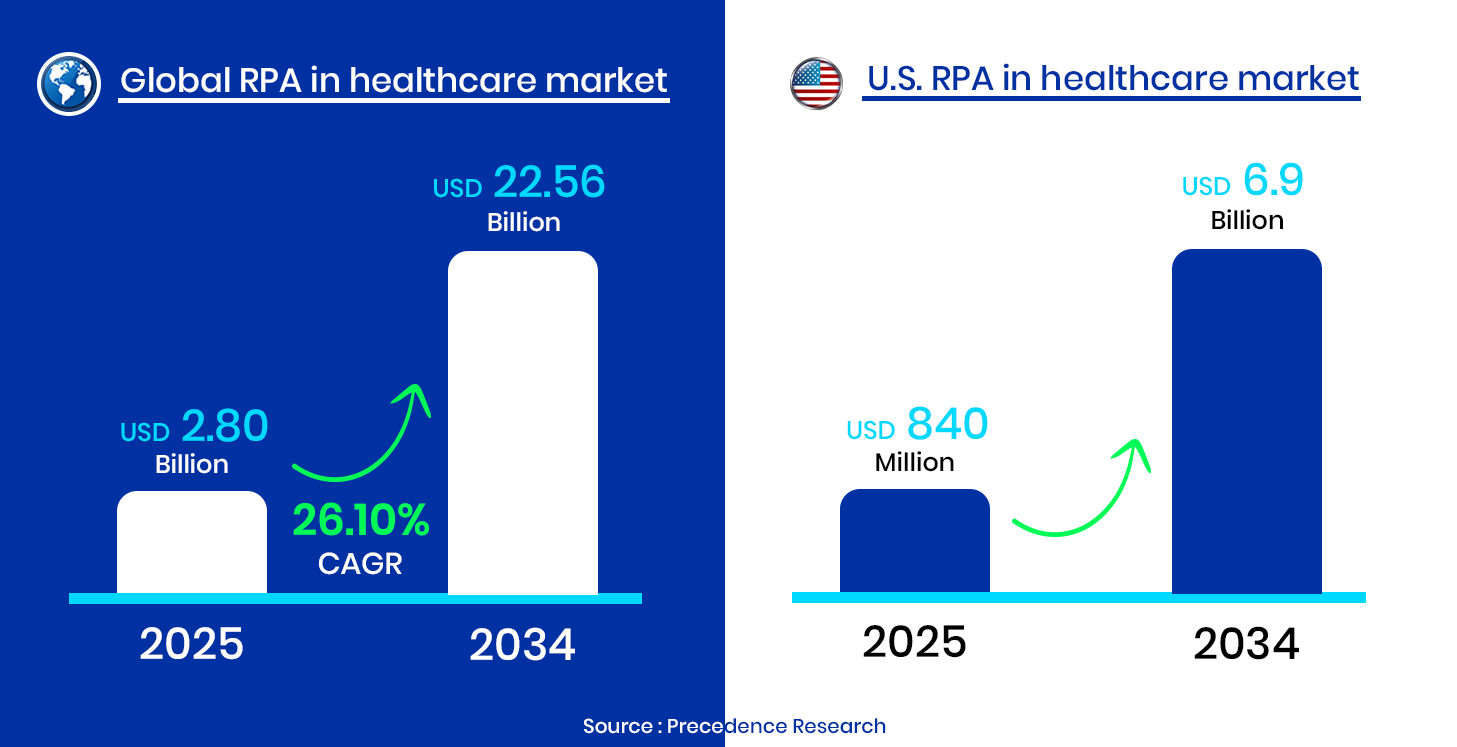
The numbers speak for themselves. According to Precedence Research, the global RPA in healthcare market was valued at USD 2.80 billion in 2025 and is projected to grow at a compound annual growth rate of 26.10%, potentially reaching $22.56 billion by 2034. In the United States alone, the market is expected to climb from $840 million in 2025 to nearly $6.9 billion by 2034. Healthcare organizations are not adopting RPA as an experiment, they are deploying it at scale because the alternative is simply unsustainable.
What Is Robotic Process Automation in Healthcare?
At its core, Robotic Process Automation (RPA) uses software robots to perform structured, repetitive digital tasks the same way a human employee would - logging into systems, copying and transferring data, filling forms, generating reports, and triggering workflows across applications.
In healthcare, this technology addresses a specific and persistent problem: the administrative burden that has grown alongside the complexity of modern medicine. According to the American Medical Association's 2024 prior authorization survey, physicians and their staff spend an average of 12 hours per week on prior authorization alone, and healthcare providers collectively spend $35 billion annually on related administrative costs.
RPA bots do not think - they execute. But that precision and consistency is exactly what makes them powerful in regulated environments like healthcare, where accuracy is non-negotiable and compliance is legally mandated.
There are three primary types of RPA deployments in healthcare settings:
- Attended RPA operates alongside a human employee, triggered by specific actions on a workstation. For example, a bot that instantly pulls up a patient's complete multi-provider history when a receptionist initiates a check-in process.
- Unattended RPA runs independently in the background, executing tasks without any human trigger - such as processing overnight insurance eligibility checks across thousands of patient records.
- Hybrid RPA combines both models, allowing bots to handle routine steps autonomously while escalating exceptions or complex cases to human staff for review.
Why Healthcare Organizations Are Adopting RPA Now
The timing of RPA adoption in healthcare is not coincidental. Many organizations are now realizing how AI transformation is a problem of governance. Without clear guardrails, auditability and control mechanisms, scaling automation in healthcare becomes a compliance risk rather than a competitive advantage.
- Rising Administrative Complexity: Modern healthcare involves multiple payers, evolving compliance requirements, interoperability demands across electronic health record (EHR) systems, and increasingly complex billing structures. Manual handling of these processes is inefficient and costly.
- Staffing Shortages: A 2025 Accenture survey found that 83% of U.S. healthcare executives listed boosting employee efficiency as a top priority, largely driven by workforce shortages across both clinical and administrative roles. Automation helps organizations do more with existing teams.
- Regulatory Pressure: Healthcare organizations must comply with HIPAA in the United States and GDPR in Europe, among other regulations. Manual compliance tracking is error-prone. RPA creates consistent, auditable workflows that make compliance monitoring far more reliable.
- Legacy Systems: Many hospitals still operate on legacy EHR platforms that lack modern API support. RPA bots can interact with these systems at the user interface level - emulating human navigation - which means automation can be deployed without expensive infrastructure overhauls.
In 2025, 58% of healthcare organizations used RPA in combination with AI, and that adoption rate is expected to rise significantly in the coming years as the technology matures and integrates more deeply with clinical workflows.
Key Use Cases of RPA in Healthcare
1. Revenue Cycle Management (RCM)
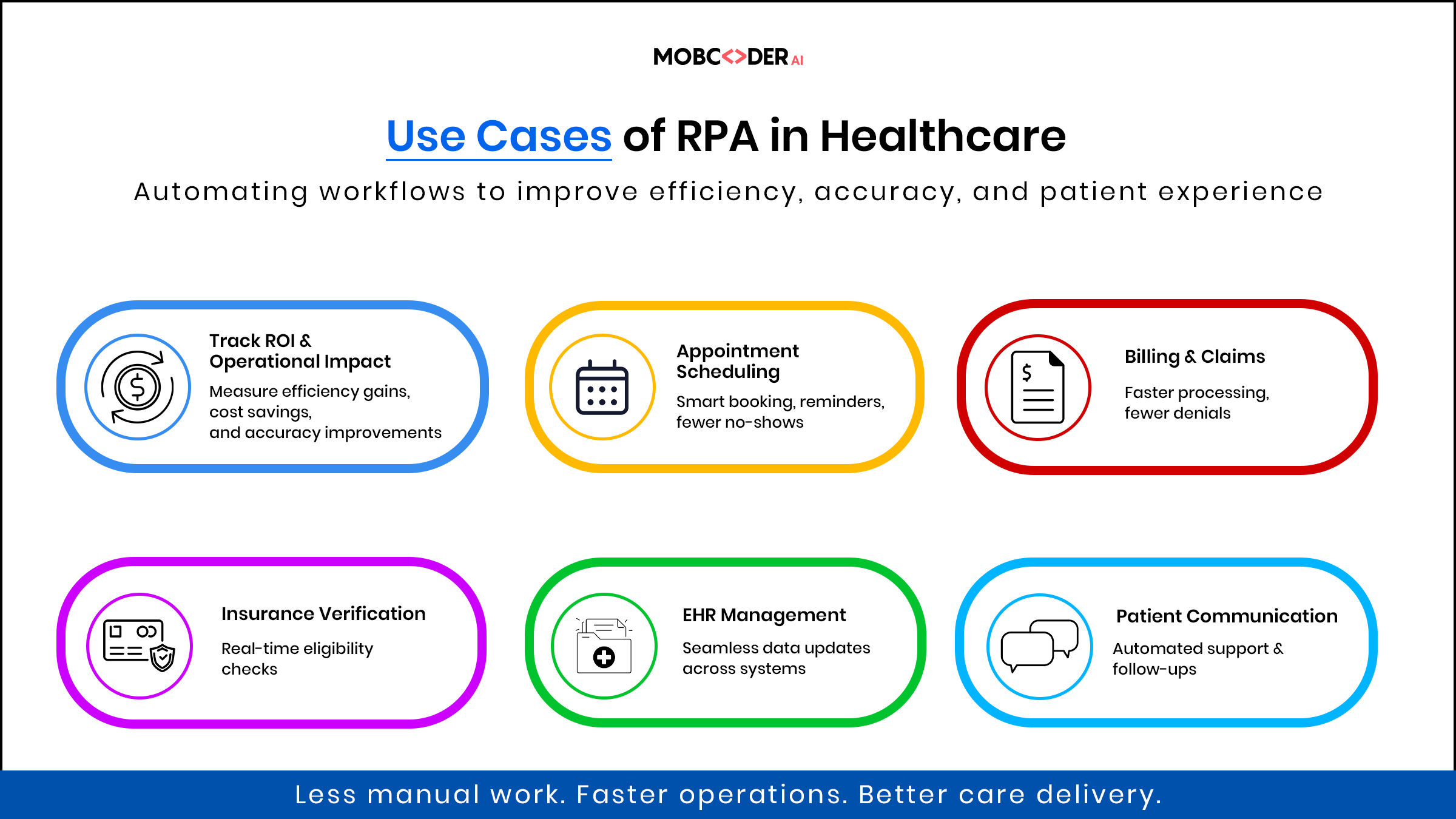
Revenue cycle management is arguably the most impactful application of healthcare automation today. RPA can automate the entire billing and collections workflow - from patient intake and insurance verification to claims submission, denial management, and payment posting.
A compelling real-world example: UiPath's partnership with Omega Healthcare, expanded in early 2025, automates over 100 million annual transactions in revenue cycle management. Coronis Health similarly partnered with UiPath in March 2025 to implement RPA across claims submission and denial detection, reducing claim denials by identifying discrepancies before submission and significantly improving cash flow.
Key RCM tasks automated by RPA:
- Insurance eligibility verification before appointments
- Prior authorization submission and status tracking
- Claims scrubbing and submission to payer portals
- Denial detection and resubmission workflows
- Payment posting and reconciliation
- Patient billing statement generation
2. Patient Scheduling and Appointment Management
RPA bots can manage appointment bookings, cancellations, and rescheduling across multiple systems simultaneously. They can send automated reminders via SMS or email, reducing no-show rates - which RPA adoption has been shown to cut by up to 30% in some implementations.
When a patient schedules an appointment, an RPA bot can simultaneously verify insurance coverage, check for required referrals, update the EHR, and assign the appropriate clinical resources - all within seconds.
3. Claims Processing and Prior Authorization
Prior authorization is one of the most administratively burdensome processes in healthcare. RPA bots can monitor payer portals continuously, submit authorization requests, check status updates, and route responses to the appropriate clinical or billing team members - eliminating days of manual follow-up.
AI-enhanced RPA systems using NLP and computer vision can now handle even the more complex parts of prior authorization that involve unstructured clinical documentation, achieving claims verification speeds nearly nine times faster than manual processing.
4. EHR Data Entry and Management
Data entry errors in electronic health records carry serious clinical risk. RPA eliminates manual transcription by automatically transferring patient information between systems - lab results into EHRs, discharge summaries to referring physicians, prescription records across pharmacy networks - with far greater accuracy than human data entry.
This is particularly important for healthcare organizations managing patients across multiple facilities or care settings, where fragmented records create both clinical and compliance risks.
5. Regulatory Compliance and Audit Readiness
HIPAA compliance requires consistent documentation, access controls, and audit trails across all patient data interactions. RPA creates structured, repeatable workflows that generate automatic logs - making compliance monitoring continuous rather than periodic.
Bots can also automatically monitor for policy changes and update internal workflows accordingly, reducing the risk of inadvertent compliance violations as regulations evolve.
6. HR and Staff Credentialing
Credentialing healthcare professionals is a slow, documentation-heavy process. RPA can automate the collection and verification of licenses, certifications, insurance documents, and background checks - significantly reducing the time required to onboard new clinical staff and maintain ongoing credential status across large health systems.
7. Supply Chain and Inventory Management
RPA bots can monitor medical supply inventory levels in real time, automatically generate purchase orders when thresholds are reached, cross-reference vendor pricing, and update procurement records - reducing waste and preventing critical supply shortages in clinical settings.
Benefits of Robotic Process Automation in Healthcare
The business case for RPA in healthcare is well-established, but the operational benefits extend beyond simple cost reduction.
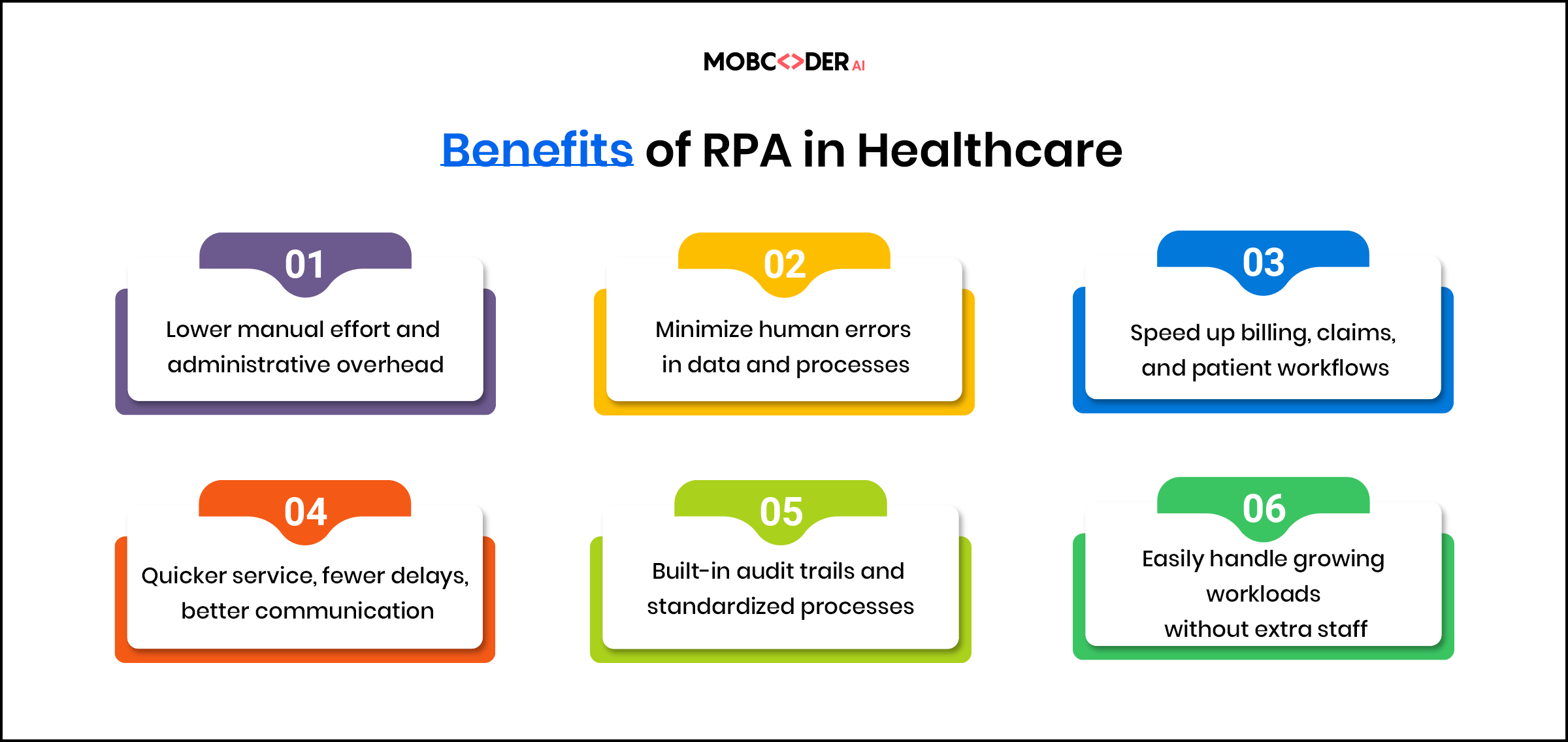
- Accuracy and Error Reduction: Automation can reduce data entry errors by up to 40%, which has downstream effects on billing accuracy, patient safety, and compliance. Bots execute processes the same way every time, eliminating the variability that human fatigue and distraction introduce.
- Speed and Throughput: Processes that take human staff hours to complete - running eligibility checks across hundreds of patient records, for example - are completed by RPA bots in minutes. This accelerates revenue cycles, improves patient throughput, and speeds up administrative response times.
- Staff Reallocation: When administrative staff are freed from repetitive data tasks, they can shift to higher-value work - patient interaction, complex case coordination, and activities that genuinely require human judgment and empathy.
- Cost Efficiency: Labor cost reductions through automation can be substantial. Some healthcare automation implementations using AI-enhanced RPA have reported labor cost reductions of up to 80% for specific workflow categories.
- Scalability: RPA bots can handle volume surges - seasonal patient load increases, pandemic-level demand spikes - without the delays and costs associated with rapid human hiring and training.
- Auditability: Every action a bot takes is logged, creating complete audit trails that simplify compliance reporting and internal quality assurance reviews.
Challenges to Consider Before Implementing RPA
RPA is powerful, but implementation is not without complexity. Healthcare organizations that approach RPA without sufficient planning tend to encounter predictable challenges.
Process Readiness: RPA works best on processes that are stable, well-documented, and high-volume. Attempting to automate a poorly defined or frequently changing workflow often results in bots that break frequently and require constant maintenance. The best implementations start with a thorough process audit.
Data Quality: Bots are only as effective as the data they work with. Inconsistent data formats, incomplete patient records, and legacy system quirks can cause automation failures. A data quality assessment should precede any RPA deployment.
Change Management: Clinical and administrative staff often have concerns about automation affecting their roles. Effective change management - communicating what will be automated, what will not, and how staff responsibilities will evolve - is essential for adoption.
Security and HIPAA Compliance: RPA bots accessing patient data must operate under the same security controls as human users. Access credentials, encryption, and audit logging for bot activity must be configured to meet HIPAA requirements from day one.
Integration Complexity: Integrating RPA with existing EHR systems, payer portals, and internal databases requires careful technical planning, particularly in environments with legacy infrastructure.
The organizations that succeed with healthcare RPA typically start with a stable, high-volume pilot process, define clear KPIs before launch, and build internal automation expertise progressively before scaling.
RPA and AI: The Intelligent Process Automation Evolution
Traditional RPA handles rule-based tasks well, but it has a ceiling. When workflows involve unstructured data - scanned documents, handwritten notes, complex clinical narratives - rule-based bots struggle. This is where the integration of AI with RPA creates what is increasingly called Intelligent Process Automation (IPA).
AI capabilities layered onto RPA infrastructure include natural language processing (NLP) to extract meaning from clinical text, computer vision to process scanned documents and images, and machine learning models that adapt to changing data patterns over time.
For healthcare specifically, this combination is enabling automation of significantly more complex workflows - AI-driven RPA systems that can process clinical intake forms, interpret handwritten physician notes, and handle prior authorization workflows that previously required human review at every step.
The shift from traditional RPA to AI-augmented intelligent process automation represents the next phase of healthcare digital transformation, and organizations building RPA capabilities today are positioning themselves to transition naturally into IPA as the technology matures.
At Mobcoder AI, our Intelligent Process Automation and Agentic AI solutions are specifically designed to bridge this gap - helping healthcare organizations move beyond rigid rule-based automation toward adaptive AI systems that can handle the complexity and exception-handling that modern clinical environments require.
How to Get Started with RPA in Healthcare
For healthcare organizations evaluating RPA adoption, a structured approach significantly improves the likelihood of a successful deployment.
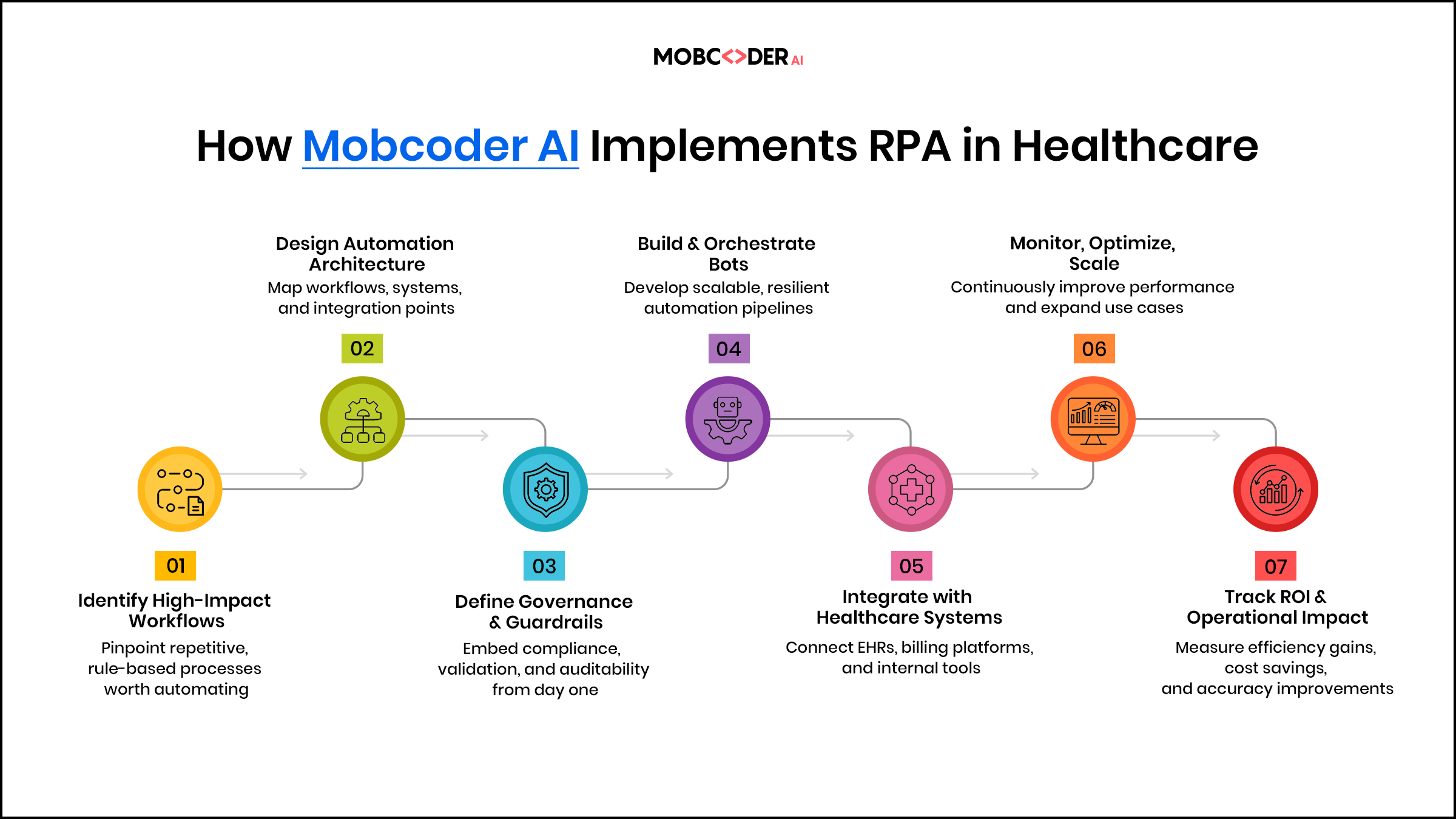
Step 1 - Identify the Right Processes
Begin with high-volume, rule-based processes that are currently causing measurable friction - claim submissions, eligibility checks, appointment reminders. Avoid starting with exception-heavy or poorly documented workflows.
Step 2 - Conduct a Process Audit
Before automating, map the current workflow in detail. Identify every step, decision point, and system touchpoint. Processes that seem simple often have hidden complexity that must be resolved before automation is viable.
Step 3 - Assess Data and System Readiness
Evaluate the quality and consistency of the data your bots will interact with. Identify integration requirements for your EHR, payer portals, and internal systems.
Step 4 - Define Success Metrics
Establish clear KPIs before launch - processing time reduction, error rate targets, cost savings, staff hours recaptured. Without baseline measurements, it is difficult to demonstrate or optimize the value of automation.
Step 5 - Pilot and Iterate
Deploy in a controlled environment first. Measure performance against your KPIs, identify failure points, and refine before scaling to additional processes or facilities.
Step 6 - Scale with Governance
As automation expands, establish a center of excellence or internal governance framework to manage both performance, security compliance, and ongoing maintenance. RPA at scale requires organizational ownership, not just technical deployment.
Our team at Mobcoder AI has worked with organizations across industries to deploy and scale AI automation solutions that meet both operational and compliance requirements. If your organization is evaluating healthcare process automation, our AI consultation services can help you identify where automation creates the most value and build a roadmap for responsible, scalable deployment.
The Future of RPA in Healthcare
The trajectory of robotic process automation in healthcare is clear. What began as a tool for automating discrete administrative tasks is evolving into an enterprise-wide operational layer that connects systems, enforces compliance, and increasingly supports clinical decision-making. And as automation matures, healthcare providers should also invest in systems like an AI chatbot conversations archive to store, analyze, and audit patient interactions.
Several developments are shaping the next phase of healthcare automation:
- Hyperautomation: The combination of RPA, AI, process mining, and advanced analytics into integrated automation ecosystems that can identify, prioritize, and automate processes autonomously.
- AI-Enhanced Clinical Workflows: RPA paired with machine learning is beginning to support clinical documentation, discharge planning, and care coordination - areas previously considered too complex for automation.
- Real-Time Patient Engagement: Automation is increasingly enabling real-time, personalized patient communication - appointment preparation instructions, post-discharge follow-up, medication adherence reminders - at a scale that no human workforce could sustain.
For healthcare leaders, the message is straightforward: RPA is no longer an emerging technology to evaluate on a future roadmap. It is a mature, proven operational capability that leading health systems are deploying at significant scale. The organizations that invest in automation infrastructure now will have meaningful structural advantages in cost, efficiency, and care quality as administrative complexity continues to grow.
Conclusion
Robotic Process Automation in healthcare is solving one of the industry's most persistent problems: the administrative overload that drains resources, introduces errors, and pulls clinical staff away from patients. From revenue cycle management and claims processing to EHR data management and compliance automation, RPA delivers measurable, scalable results that traditional operational improvements cannot match.
The technology is mature, the business case is established, and the market is growing rapidly. For healthcare organizations that have not yet invested seriously in automation, the cost of waiting is rising every year.
If you are ready to explore how intelligent process automation and AI-driven solutions can transform your healthcare operations, the team at Mobcoder AI is here to help you build a strategy that delivers real results - not just a pilot project.
Looking to deploy AI-powered automation across your healthcare workflows? Explore Mobcoder AI's Agentic AI, Machine Learning, and AI Consultation services to find the right solution for your organization.