


The hottest AI startups in Silicon Valley in 2026 are OpenAI, Anthropic, xAI, Waymo, Scale AI, Cursor, Cognition AI, Sierra, Perplexity AI, and Harvey AI. These are companies with real enterprise customers and multi-billion-dollar valuations, not just funding hype.
At Mobcoder AI, we see these startups as signals of what enterprise buyers now expect: AI that is measurable, governed, integrated, and useful beyond demos. This blog breaks down who's actually winning, what's driving their momentum, the whole company snapshot and what it means if you're a business thinking about where AI fits into your strategy.
The Hottest AI Startups in Silicon Valley Right Now
1. OpenAI
Everyone knows OpenAI, but the numbers in 2026 are genuinely staggering. The company closed a $180B+ billion funding in 2026 - the largest private fundraise in history. OpenAI has reached around 900M weekly ChatGPT users, while the ChatGPT app crossed 1B monthly active users in May 2026. ChatGPT has become the default starting point for a massive chunk of professional work: writing, coding, research, analysis.
But OpenAI's bigger story is infrastructure. Their API powers thousands of products built by other companies. If you're using an AI tool today, there's a decent chance OpenAI is somewhere in the stack underneath it.
If you're building AI products or integrating AI into your workflows, understanding the OpenAI ecosystem is non-negotiable. In our AI development services, we also build on top of frontier models such as GPT-5.5, Claude, Gemini, and open-source models where appropriate.
2. Anthropic
Anthropic closed a $30 billion Series G round in Q1 2026, pushing its valuation to around $380 billion. The company builds Claude - a family of AI models that has become the go-to choice for banks, law firms, and healthcare organizations that can't afford hallucinations or unpredictable outputs.
What Anthropic has figured out is that "trustworthy AI" is itself a massive market. For regulated industries, choosing a model that is reliable and auditable isn't a nice-to-have - it's a requirement.
If you operate in a high-stakes industry, Anthropic's approach to AI safety matters a lot. We also build agentic AI systems powered by Claude for enterprise clients who need both capability and accountability.
3. xAI
SpaceX announced it is acquiring xAI in an all-stock merger (xAI becomes a wholly owned SpaceX subsidiary), tied to SpaceX's planned IPO at a reported ~$1.5T valuation. Whether or not you take that mission statement literally, what xAI has built in under three years is impossible to ignore. The Grok model family has improved at a pace that surprised even its critics, and its integration with X (formerly Twitter) gives xAI something no other lab can replicate — a live, real-time feed of human thought at global scale.
xAI also moved fast on infrastructure, building the Colossus supercomputer cluster in Memphis into potentially the largest single-site AI compute facility in the world. In January 2026, the company closed a $20 billion funding round, cementing its place among the top tier of AI companies.
4. Waymo
Waymo has been called the longest-running moonshot in Silicon Valley. It started as Google's self-driving car project in 2009, a skunkworks experiment that most of the industry thought was a decade too early. Seventeen years later, it is running the world's most advanced commercial robotaxi fleet across six US cities, and the numbers are no longer speculative.
Waymo completed 15 million paid trips in 2025 with annualized revenue now at $355 million and growing 127% year over year. In February 2026, it raised $16 billion in the largest autonomous vehicle funding round in history, tripling its valuation from $45 billion to $126 billion in under two years. Waymo is no longer a bet on the future of transportation. It is the future of transportation, operating now.
5. Scale AI
A 19-year-old MIT dropout, Alexandr Wang, founded Scale AI in 2016. Scale became the data backbone of the AI industry, the company that every major AI lab, defense contractor, and autonomous vehicle maker relies on to train their models. In 2025, Meta paid approximately $14 billion to acquire a large stake in Scale, and Wang was named Meta's Chief AI Officer. That endorsement from the world's most data-rich social platform validated everything Scale had built. Today Scale operates at the intersection of commercial AI and US national security, serving the Department of Defense alongside Silicon Valley's biggest names.
6. Anysphere (Cursor)
Four MIT graduates built Cursor in a dorm room with a thesis that sounded almost too obvious. The code editor is the most important interface in software development, and no one has rebuilt it for the age of AI. Founders forked VS Code and layered deep AI into every corner of the development experience, autocomplete that understood entire codebases, a chat interface that could refactor across dozens of files, and an agent mode that could plan, write, test, and iterate without the engineer holding its hand at every step. The market responded with a speed no one predicted.
Cursor went from $100 million ARR in January 2025 to $500 million by June, $1 billion by November, and $2 billion by February 2026 - the fastest B2B software scale in recorded history. The growth has been remarkable. Cursor has become one of the most visible AI-native developer tools, with strong adoption among engineering teams, and it shows no signs of slowing down as AI becomes standard in software development workflows.
This is directly relevant to companies using generative AI development services, the tooling around AI development is evolving as fast as the models themselves.
7. Cognition AI (Devin)
When Cognition launched Devin in March 2024 as the first AI software engineer, the reaction was split down the middle. Half the developer community was thrilled. The other half published detailed teardowns arguing the demo was staged and the capabilities overstated. Two years of production deployments have settled that debate.
Goldman Sachs, Citi, Mercedes-Benz, etc all use Devin in live engineering workflows. Cognition's own CEO disclosed that more than 90% of all code committed internally at Cognition is now written by Devin - the company's product building the company itself. A $1 billion raise at a $26 billion valuation in May 2026 cemented Devin's place as the most audacious bet in the hottest startups in Silicon Valley.
8. Sierra
Bret Taylor co-chaired OpenAI's board, served as Salesforce's co-CEO, and was Twitter's chairman. When someone with that career decides their next move is a startup, people pay attention. Taylor partnered with Clay Bavor — who ran Google's AR and VR division for years and together they built Sierra with a single thesis: enterprise customer service is broken, and AI agents can fix it at a scale humans never could.
Sierra's agents do not just answer questions, they refinance mortgages, process insurance claims, manage returns, and handle billing disputes end to end. The company started with four design partners. Today it counts more than 40% of the Fortune 50 as customers. As of May 2026, Sierra raised $950 million in a Series E at a $15.8 billion valuation, the clearest signal yet that enterprise AI agents are no longer a pilot program. They are operational infrastructure.
9. Perplexity AI
Perplexity isn't a search engine in the traditional sense. It's an answer engine - you ask it something, and instead of returning ten blue links, it gives you a direct, cited response pulled from live sources. The company is simultaneously building a browser layer and an agent platform on top of that foundation, which makes it one of the most ambitious bets in Silicon Valley right now.
The interesting thing about Perplexity is how it's changing user behavior. For research-heavy tasks, Perplexity is changing how many users interact with search-style workflows. That kind of behavioral lock-in is exactly what investors look for. In thirty months, Perplexity went from a $121 million seed-stage company to a $22.6 billion platform, a 165x valuation jump. By April 2026, it had hit an estimated $500 million in annualized revenue, processing over 780 million monthly queries across 100 million active users.
10. Harvey AI
Harvey AI is purpose-built for the legal industry. It helps lawyers with research, contract drafting, and case analysis at a scale no human team can match alone. The fact that Harvey has become one of the most visible examples of vertical AI in legal workflows, especially around research, drafting, and matter analysis signals something important: the era of generic AI tools is giving way to AI that deeply understands specific professional domains. This is what people mean when they talk about "vertical AI" - AI that knows your industry's language, norms, and workflows, not just general-purpose capabilities.
As a company, Harvey went from 82 employees and a $715 million valuation in 2023 to 350 employees and an $11 billion valuation by March 2026, with $190 million in annual recurring revenue. It now serves 1,300+ customers across 60+ countries, including 50% of the Am Law 100, the hundred most revenue-generating law firms in America.
11. ElevenLabs
Piotr Dąbkowski and Mati Staniszewski grew up in Poland watching badly dubbed American films. The experience was so jarring with the wrong voice, the wrong tone, the wrong emotion, that it planted a seed neither of them forgot. Dąbkowski went to Google as a machine learning engineer. Staniszewski went to Palantir as a deployment strategist. Years later, they built ElevenLabs to solve the problem that had bothered them since childhood: making AI-generated voices indistinguishable from a human one.
12. Runway ML
The runway did not start in Silicon Valley. It started at NYU's Interactive Telecommunications Program, a graduate school that produces artists, designers, and filmmakers, not tech founders. Cristóbal Valenzuela, Anastasis Germanidis, and Alejandro Matamala-Ortiz were students there when they became obsessed with what AI could do for creative work. They built Runway as a creative AI suite, not a developer tool, and that positioning turned out to be the right bet. Runway's Gen-2 model was used in the production of the Oscar-winning film Everything Everywhere All at Once.
What makes Runway one of the hottest AI startups in Silicon Valley is where it says it is going next: world models, AI systems that do not just generate video, but understand the physics, spatial relationships, and causality of the world.
13. Glean
What Glean figured out is that companies have enormous amounts of knowledge locked inside Slack threads, Google Docs, Confluence pages, and Salesforce records and almost none of it is actually findable when people need it. Glean's AI connects all of that and makes it searchable and actionable.
Arvind Jain spent years at Google as a Distinguished Engineer. He understood better than most how powerful search could be when done right and how broken it becomes when you try to apply it to the sprawling, fragmented internal knowledge of a real enterprise. Most companies have documents in Google Drive, conversations in Slack, tickets in Jira, customer records in Salesforce, and code in GitHub and almost none of it is findable when someone actually needs it. Glean was built to fix that.
14. Character.AI
Character.AI lets users create and converse with AI characters, fictional personas, historical figures, celebrities, or entirely invented personalities for entertainment, companionship, education, or just curiosity. The engagement numbers are unlike anything in the consumer AI space. Users spend more time per day on Character.AI than on almost any other application. The platform has over 100 million monthly active users and a depth of usage that most social media apps would envy. Google recognized the underlying model capability and signed a significant technology licensing deal in 2024.
15. Safe Superintelligence Inc. (SSI)
OpenAI's co-founder and Chief Scientist founded Safe Superintelligence Inc. with former Apple AI head, with a mission statement unlike any other company in Silicon Valley: build safe superintelligence, and nothing else. No product. No enterprise SaaS. No chatbot. Just foundational research aimed at AGI, insulated from commercial pressure by design. Investors believed the mission enough to value SSI at $32 billion with zero revenue. That number is less about financial logic and more about a bet that the man who built the foundations of modern AI and then walked away from the most valuable AI company in the world, knows something the rest of us are still figuring out.
16. Thinking Machines Lab
Mira Murati ran OpenAI's operations through its most consequential years. She was the CTO who shepherded GPT-4, DALL·E, Sora, and the ChatGPT launch, the products that changed the world's relationship with AI. When she left OpenAI in 2024 and founded Thinking Machines Lab, the question was not whether she could raise money. It was what she would build. Her answer: AI models that are personalizable, interpretable, and genuinely safe, systems that users can actually understand and adapt to their own needs, rather than black boxes that produce outputs no one can fully explain. The company raised $2 billion at a $12 billion valuation before launching a single public product, attracting top researchers from AI labs across the world based entirely on Murati's credibility and vision. In 2026, Thinking Machines Lab will be one of the most watched pre-product companies in technology.
17. Poolside
Jason Warner spent years at GitHub as its CTO, the person overseeing the platform where the world's software actually gets built. He watched GitHub Copilot launch, saw what AI could do for developers, and concluded that the real opportunity was not an AI tool layered on top of a general model, but a foundation model trained from the ground up specifically for code. That insight became Poolside. Its strategy is deliberately enterprise-first: not trying to win individual developers with a freemium product, but targeting serious engineering organizations that need AI coding capabilities that go deeper than what a general-purpose LLM can reliably provide.
18. Physical Intelligence (π)
The four founders of Physical Intelligence came out of Google DeepMind's robotics division, and they left with a shared conviction: the missing ingredient in robotics was not better hardware. It was better software. Specifically, AI that could understand the physical world well enough to let robots operate in it reliably, picking up objects, opening doors, navigating environments that were never designed for machines. Physical Intelligence is not building robots. It is building the AI brain that goes inside all of them.
19. Surge AI (The Bootstrapped Unicorn)
Times when every AI startup raises hundreds of millions before shipping a product, Edwin Chen built something remarkable: a billion-dollar data labeling company without taking a single dollar of outside investment. Chen, a former Twitter ML engineer, understood that the AI industry's dirty secret was its dependence on human-generated training data and that nobody had built the infrastructure to produce it at the quality and scale the market needed. Surge AI did exactly that, quietly and efficiently, growing to over a billion dollars in annual revenue while its VC-backed competitors burned through fundraising cycles.
In 2026, when every AI startup claims capital efficiency as a virtue, Surge AI is the only one that actually practiced it from day one.
20. Pika Labs
Pika Labs arrived so fast and so viral that it briefly broke the internet. When the company opened its waitlist in late 2023, half a million people signed up in a single week, not because of a marketing campaign, but because the product was genuinely startling. Users typed a description and got back a short, animated video. The quality was not perfect, but it was good enough to make people stop and think: this changes things. Pika's bet is on simplicity and accessibility, making AI video generation available to people who are not professional filmmakers or technical users. In a category that also includes Runway and Sora, Pika is positioning itself as the tool that anyone can use rather than the tool with the deepest capabilities.
21. Twelve Labs
Most AI search tools treat video as an afterthought, extracting transcripts and searching the words, while ignoring everything that makes video actually powerful: the visuals, the actions, the context, the emotion. Twelve Labs was built to fix that. Its models are trained specifically to understand video as video, recognizing scenes, objects, actions, and concepts at a semantic level that goes far beyond what you can get by analyzing frames as images. Twelve Labs raised $50 million in a Series A in 2024 and has been steadily expanding its enterprise client base in media, security, and sports analytics, three industries sitting on enormous amounts of video data they currently cannot search.
22. Sentrial
Most AI companies in 2026 are focused on building AI products. Sentrial is focused on watching them, monitoring AI models in production for accuracy drift, bias, anomalies, and risk in real time. It is the kind of company that becomes more important the more AI gets deployed, not less. Sentrial integrates directly into deployment pipelines, tracking model health continuously and alerting teams before small anomalies become large problems.
23. Stilta
Patent law is one of the most document-intensive, technically demanding, and high-stakes areas of legal practice and it has been almost entirely untouched by AI. Stilta is changing that with an AI-native workflow platform built specifically for patent attorneys. Its software reviews patent portfolios, tracks prior art, suggests claim language, and manages the procedural complexity of the patent prosecution process end to end.
24. Mango Medical
Surgical planning for orthopedic procedures, knee replacements, hip replacements, complex bone reconstructions, currently takes days. A surgeon receives a patient's imaging, reviews it, consults with colleagues, and manually works through the procedure plan. Mango Medical has built an AI agent that compresses that process into minutes. Mango is trying to own one specific, high-stakes workflow where AI can demonstrably save time without compromising patient outcomes. In a healthcare system chronically short on specialist time, that narrow focus may be exactly right.
25. Lovable
Where Cursor serves professional developers and Replit targets non-technical builders, Lovable sits in between. It generates full-stack applications, not code snippets, and does it fast enough that teams at startups and enterprises use it to validate product ideas before committing engineering resources. In the AI coding race, competitors like Anysphere raised $2.3 billion at a $29.3 billion valuation, while Lovable achieved a $6.6 billion valuation, making it Europe's fastest-growing AI startup and one of the most closely watched full-stack generation platforms globally.
The Bigger Picture: AI Transformation Is No Longer Optional
Here's the thing about everything above: it's not just interesting news about cool startups. It represents a structural shift in how businesses are going to operate.
AI transformation is a problem of governance as much as technology. Companies that are winning with AI in 2026 aren't just the ones with the best models - they're the ones that figured out how to deploy AI responsibly, with the right guardrails, the right integrations, and the right human oversight built in. That's as much an organizational challenge as it is a technical one.
The hottest AI startups in Silicon Valley have all, in their own way, cracked this code. They're not building AI for the sake of AI. They're building AI that solves a specific problem, integrates into existing workflows, and proves its value through measurable outcomes.
For businesses not in Silicon Valley, the takeaway is this: you don't need to build foundational AI models. You need to use the infrastructure these companies are creating - and you need someone who actually knows how to build with it.
Quick Comparison: All 25 Hottest AI Startups in Silicon Valley (2026)
Here's a side-by-side look at every company covered in this list - their focus area, latest valuation, and flagship product.
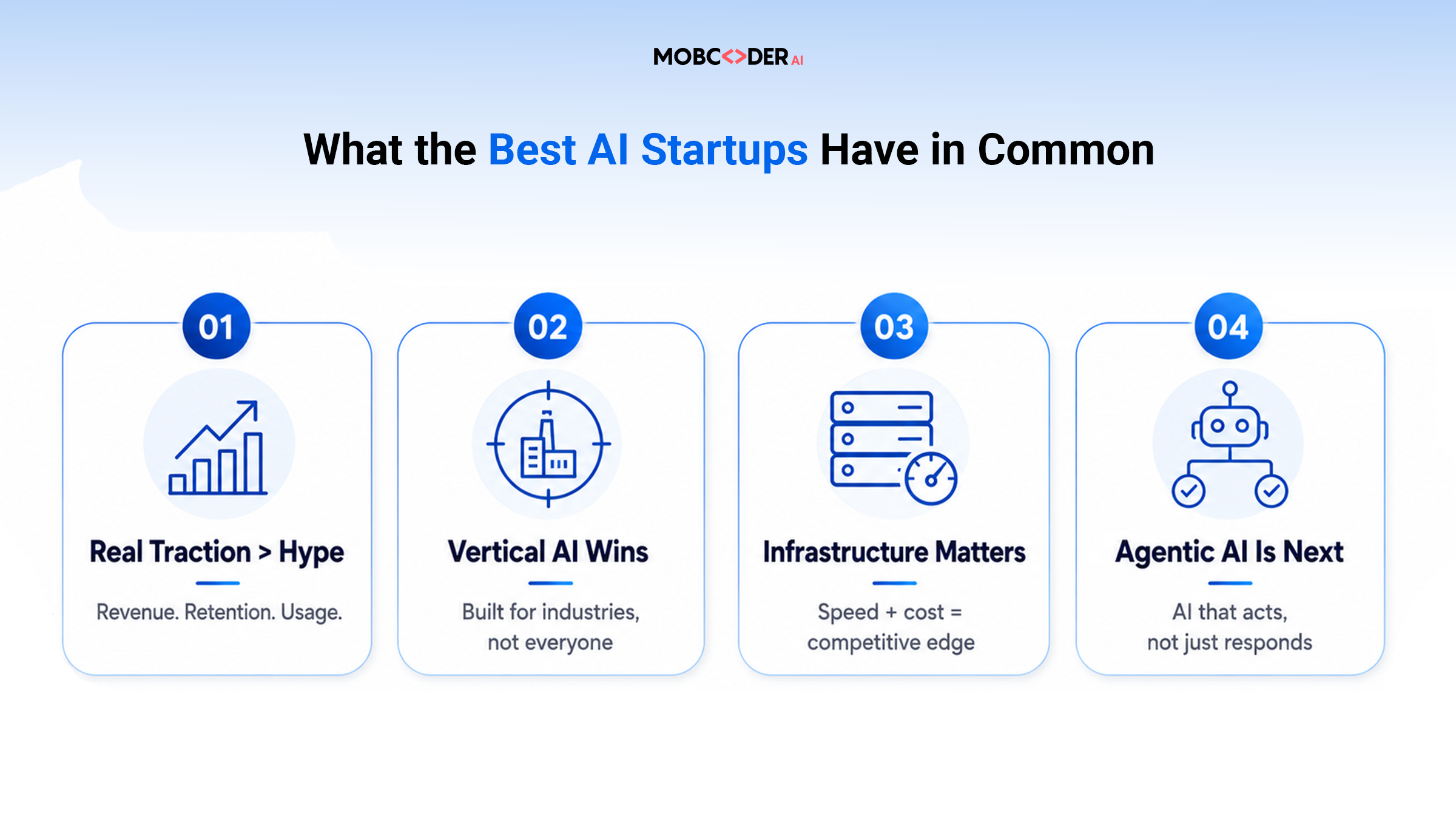
What the Best AI Startups in the Silicon Valley Have in Common
Looking across all the companies above, a few patterns stand out:
Real traction beats big valuations. The companies that are actually winning have paying customers, retention data, and revenue growth - not just impressive funding announcements. Investors have learned to look past hype.
Vertical AI is outperforming horizontal AI. General-purpose tools are crowded. The companies growing fastest are those solving specific problems in specific industries - legal, enterprise search, coding, customer service.
Infrastructure is as important as models. Companies like Groq prove that the AI race isn't only about who builds the biggest model. It's also about who builds the fastest, most cost-effective infrastructure to run those models in production.
Agentic AI is the next big wave. Multiple companies on this list are building AI that acts, not just AI that answers. Autonomous agents that complete tasks end-to-end are where the market is moving. Companies like Pindrop and Anonybit are also building in adjacent spaces around voice authentication and identity - showing that agentic AI has security implications that smart companies are already addressing.
Is Mobcoder AI also a Silicon Valley Startup?
We're not a Silicon Valley startup. We're an AI development company in the US, helping businesses use the AI infrastructure built in the Valley.
That means building custom AI agents for your specific workflows. Integrating LLMs like Claude and GPT-4o into your existing stack. Developing generative AI solutions that fit your industry and your data. And building agentic AI systems that automate the repetitive, multi-step work that's eating your team's time.
The companies on the hottest startups list are defining what AI can do. Whereas, we take care of the execution and help you actually built AI-forward platforms for your business.