








"Which is better, US or global generative AI companies?” is the wrong question - it assumes one category wins universally, when the honest answer depends entirely on what you're optimizing for: raw model capability, cost, data residency, or language coverage. Here's what actually differs, without the inflated market-size statistics that don't help anyone make a vendor decision.
What US-Based Generative AI Providers Actually Do Well
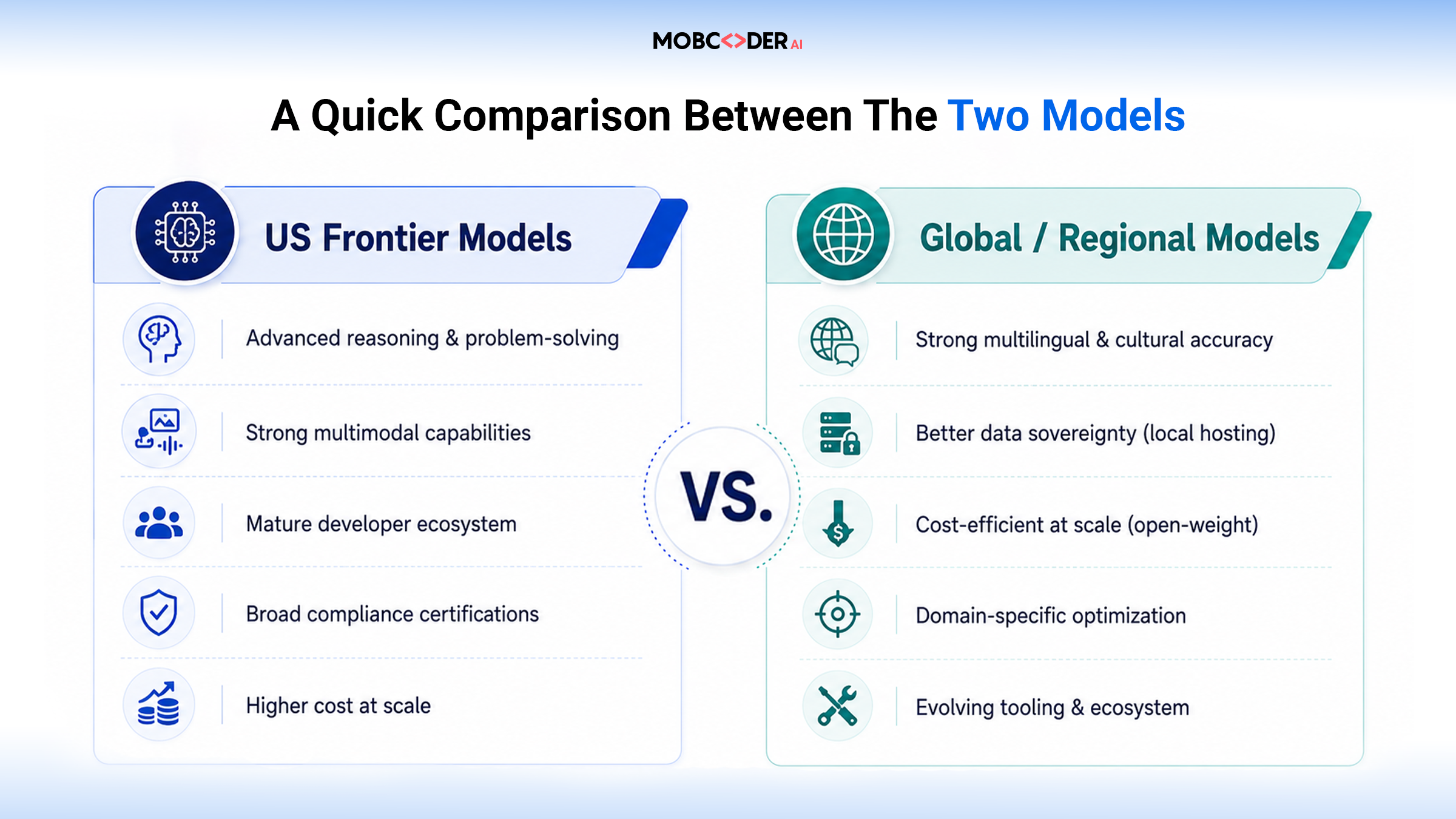
Most of the frontier large language models in active enterprise use - the GPT family, Claude, Gemini - are built and funded by US companies, backed by some of the largest computer investments in the industry. This translates into a real, measurable advantage in raw reasoning capability and multimodal understanding for general-purpose tasks.
Beyond the models themselves, the surrounding ecosystem is genuinely mature: extensive API documentation, SDKs across every major language, and prebuilt integrations with AWS, Azure, and Google Cloud that make deployment faster than building from scratch. US providers have also invested heavily in compliance infrastructure - SOC 2, ISO 27001, and HIPAA alignment are standard offerings now, which matters directly for finance, healthcare, and government use cases where that compliance isn't optional.
The agentic AI capability wave - models that can reason, plan, call APIs, and act rather than just respond - has also been disproportionately driven by US labs, which is relevant if your roadmap includes autonomous systems rather than purely conversational ones.
The tradeoffs: higher cost per API call, licensing restrictions on proprietary model weights that limit self-hosting, and less control over where your data physically gets processed and stored.
What Global Providers Actually Do Well
Providers based outside the US - Mistral AI in France, various open-weight models out of China and elsewhere - compete seriously in specific dimensions rather than trying to match frontier US labs on every benchmark.
Multilingual accuracy and cultural context is a genuine differentiator: models built with multilingual data from the ground up tend to handle non-English languages and culturally specific responses more naturally than US models that added multilingual support later. For companies operating primarily in non-English markets, this matters more than raw English-language benchmark scores.
Data sovereignty is another real advantage in regions governed by GDPR, India's DPDP Act, or China's AI regulations - local providers can keep sensitive data within-country, which is often a hard requirement for public sector and financial clients, not a nice-to-have.
Cost efficiency follows from a structural difference: many global models are open-weight and self-hostable, removing the per-token API cost entirely for organizations with the infrastructure to run them. This makes them attractive for cost-sensitive deployments or startups scaling usage where API costs would otherwise compound fast.
Some global providers also focus on deep domain-specific fine-tuning - models trained specifically on clinical data or banking KYC patterns - that can outperform generic large-scale models on those narrow tasks specifically.
The tradeoffs: smaller integration ecosystems, less mature developer tooling and documentation, and in some cases more limited multimodal capability compared to the frontier US models.
The Decision Framework That Actually Matters
- Rather than picking a “side,” the more useful exercise is mapping your specific requirements against what each category offers:
- Need maximum reasoning capability for complex, general tasks? US frontier models currently lead here.
- Need data to stay within a specific country's borders? A local/regional provider may be a regulatory requirement, not just a preference.
- Operating primarily in non-English markets? Evaluate multilingual benchmarks specifically - don't assume a US model's English performance transfers cleanly.
- Cost-sensitive at high usage volume? Open-weight, self-hostable models can meaningfully change your unit economics at scale.
- Building autonomous, agentic systems? US providers currently have the deepest agentic tooling ecosystem, though this gap is narrowing.
A Quick Side-by-Side on the Factors That Usually Decide This
- Raw reasoning quality on complex, multi-step tasks: US frontier models currently hold a measurable edge, though the gap narrows with every major release cycle.
- Cost per million tokens at scale: global open-weight, self-hosted options typically win decisively once usage volume crosses a certain threshold.
- Compliance certifications (SOC 2, HIPAA, ISO 27001): more uniformly available across major US providers today, though this is changing as global providers mature their compliance offerings.
- Non-English language accuracy: varies significantly by specific language and provider; don't assume either category wins universally - test against your actual target languages.
- Developer tooling and documentation maturity: US ecosystems are generally more mature and battle-tested, which reduces engineering time during initial implementation.
- None of these factors should be weighted equally for every business - a healthcare company with strict HIPAA requirements and an all-English customer base will weigh this list very differently than a multinational retailer operating across a dozen languages with tight per-transaction cost margins.
Why Hybrid Strategies Are Becoming the Default
Increasingly, the most sophisticated enterprise deployments don't pick one model or one provider - they route different tasks to different models based on context, cost, and data sensitivity. A reasoning-heavy task might go to a frontier US model; a customer-facing interaction in a non-English market might route to a model fine-tuned for that language; a request involving sensitive data subject to local regulation might route to a self-hosted model that never leaves the company's own infrastructure.
This kind of model orchestration requires real engineering work - routing logic, cost monitoring, fallback handling when one provider has an outage - but it produces meaningfully better outcomes than locking into a single vendor and accepting whatever tradeoffs come with that choice.
RAG: The Technique That Matters More Than the Model Choice
For most enterprise use cases, retrieval-augmented generation (RAG) - grounding model responses in your own verified documents rather than relying purely on what the model learned during training - has a bigger impact on output quality and hallucination reduction than which specific frontier model you choose. A well-built RAG pipeline on a mid-tier model often outperforms a poorly grounded implementation on a frontier model, because the hallucination problem is largely a retrieval and grounding problem, not purely a model intelligence problem.
This is worth knowing before a vendor conversation turns entirely into a debate about which underlying LLM is “best” - ask instead about their RAG engineering practices: how they handle document chunking, semantic search quality, and retrieval ranking, since that's usually where the actual accuracy gains come from in production.
Governance Applies Regardless of Provider
Whichever provider or hybrid strategy you land on, the governance questions don't change: how are model decisions logged and audited, what guardrails prevent prompt injection or data leaks, and who's accountable when the system produces a wrong or harmful output. This becomes especially important as generative AI outputs increasingly feed directly into autonomous, agentic workflows rather than sitting in front of a human reviewer for every output. We cover this governance layer in more depth in our piece on why AI transformation is fundamentally a governance problem, not a model selection problem.
Where Mobcoder AI Fits
Mobcoder AI works across both ends of this landscape - benchmarking and evaluating US and global models against your actual data, building domain-specific RAG pipelines that reduce hallucination meaningfully, fine-tuning smaller models for cost and latency efficiency, and supporting cloud, hybrid, or on-prem deployment depending on what your data residency and compliance requirements actually demand.