


According to the American Medical Association’s 2025 reporting on physician sentiment, 57% of surveyed physicians identified reducing administrative burdens through automation as healthcare AI’s biggest area of opportunity. Meanwhile, the 2024 CAQH Index estimated that the U.S. medical and dental industries could save $20.5 billion annually by automating routine administrative work.
AI agents take healthcare automation and these numbers a step further. They can coordinate multi-step workflows, retrieve information from connected systems, use approved tools, and move tasks forward within defined permissions. With appropriate human oversight, they can help streamline complex processes while ensuring that clinical judgment, sensitive decisions, and critical approvals remain in human hands.
In this blog, we explore 18 AI agent use cases in healthcare, spanning clinical workflows, patient engagement, administrative operations, and medical research. If you’re evaluating whether AI agents are the right fit for your healthtech business, these examples will help you identify valuable opportunities.
What Are AI Agents in Healthcare?
AI agents in healthcare are autonomous software systems designed to pursue a defined goal by interpreting instructions, gathering relevant information, selecting permitted actions and coordinating tasks across connected tools or applications.
Depending on their design or architecture, they may use large language models (LLMs), retrieval-augmented generation (RAG), APIs, workflow engines, rules-based systems and specialized machine learning models.
For example, an AI agent in a hospital’s billing department could check a claim’s status, find missing documents, notify the billing team, and track the issue until it is resolved. It would follow the hospital’s access rules and flag issues that need human intervention.
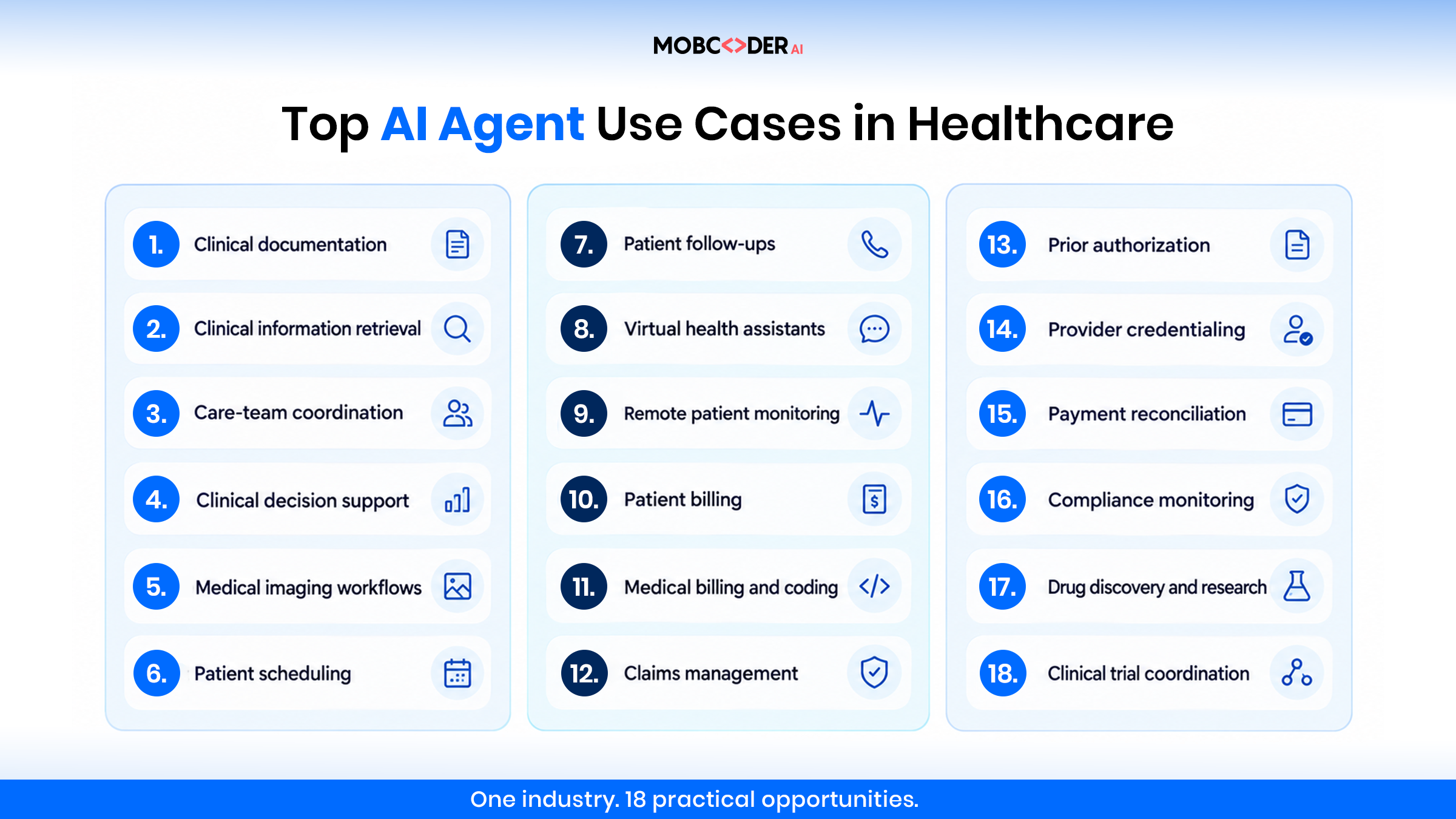
18 Use Cases of AI Agents in Healthcare Industry
Here are 18 practical use cases that show how healthcare providers and healthtech businesses can use AI agents to improve day-to-day operations.
1. Clinical Documentation and Ambient Scribing
Clinical documentation is a natural starting point for healthcare AI because clinicians must capture patient encounters accurately while maintaining a meaningful conversation with the patient.
An AI-enabled documentation workflow can process an authorized clinical conversation, draft a structured note, identify relevant details, and prepare the documentation for clinician review.
An agent can extend this workflow by coordinating related tasks, such as:
- Organizing information into the required note format.
- Identifying missing fields or inconsistencies.
- Preparing draft instructions or follow-up documentation.
- Routing the note for clinician review and approval.
- Sending approved information to the appropriate system.
For instance, after an outpatient consultation, the system could prepare a draft visit summary and identify the follow-up tasks associated with the encounter. With the right agentic AI development services, healthcare organizations can build such workflows to coordinate documentation, connect with existing systems, and route tasks for review. A clinician would review the output and approve any changes before the information becomes part of the official record.
2. Clinical Information Retrieval
Clinicians often need to assemble information from multiple sources before making a decision. Relevant details may be distributed across electronic health records (EHRs), laboratory systems, imaging reports, medication lists, and clinical guidelines.
An AI agent can help retrieve authorized information from these systems and organize it into a concise, source-linked summary.
A typical workflow might involve:
- Receiving a clinician's request for information.
- Retrieving permitted records from connected systems.
- Organizing findings chronologically or by clinical category.
- Highlighting missing information or conflicting entries.
- Presenting the summary with links to the original sources.
For example, before a follow-up appointment, an agent could prepare a timeline of relevant laboratory results, previously documented allergies, and outstanding tests for the clinician to review.
This is particularly useful when information is spread across different applications or requires manual navigation.
3. Care-Team Coordination and Handoffs
A patient's care journey can involve physicians, nurses, specialists, laboratory teams, pharmacists, and administrative staff. Each transition introduces the possibility of a missed task or delayed communication.
AI agents in healthcare can help coordinate these handoffs by monitoring approved workflow events and tracking outstanding actions.
For example, when a patient is discharged, an agent could:
- Identify follow-up tasks documented in the discharge plan.
- Route tasks to the appropriate team or work queue.
- Check whether required administrative steps have been completed.
- Notify staff about overdue tasks.
- Escalate unresolved issues according to established rules.
A similar workflow could help coordinate referrals between primary care providers and specialists, tracking whether the required documentation has been received and whether the referral has progressed.
4. Clinical Decision Support and Risk Escalation
Clinical decision support systems can help identify patterns or risk indicators in patient data. AI agents can potentially coordinate the workflow around those signals.
For example, a validated risk model may flag a patient for further review. An agent could retrieve the relevant supporting information, assemble a review summary, notify the designated clinician, and track whether the alert has been addressed.
The agent's role is to help move information through the appropriate process—not to treat a model's prediction as a confirmed diagnosis.
Potential applications include:
- Routing validated risk alerts to the appropriate care team.
- Preparing supporting information for clinician review.
- Tracking unresolved alerts.
- Escalating time-sensitive items according to approved protocols.
- Documenting how an alert was handled.
5. Medical Imaging Workflow Coordination
AI-enabled medical imaging tools can support tasks such as image analysis, prioritization, and identifying findings that require further review. An AI agent can potentially coordinate the surrounding workflow.
For instance, when an approved imaging tool flags a study for urgent review, an agent could route the case to the appropriate work queue, notify the responsible team, and track whether the review has taken place.
Other possible functions include:
- Checking whether imaging orders contain required information.
- Coordinating study status across connected systems.
- Routing results to the appropriate clinical team.
- Tracking follow-up tasks after a radiology report is completed.
- Escalating workflow delays under approved policies.
The U.S. Food and Drug Administration reported that more than 1,600 AI-enabled medical devices had been authorized for marketing in the United States as of September 2026. This demonstrates the breadth of AI-enabled medical technology, although these authorizations do not mean that all such devices use AI agents.
6. Patient Scheduling and Intake
Scheduling an appointment can involve more than finding an available time. Staff may need to confirm the type of appointment, check prerequisites, gather information, identify the appropriate department, and communicate instructions.
A scheduling agent can coordinate these steps through approved scheduling systems and communication channels.
A typical workflow could include:
- Collecting the patient's appointment request.
- Identifying the required appointment category.
- Checking availability and applicable scheduling rules.
- Requesting confirmation from the patient.
- Recording the appointment through an authorized integration.
- Sharing preparation instructions and escalating exceptions.
For example, a patient requesting a specialist appointment might need a referral or previous test results. An agent could identify the missing requirement and guide the patient or administrative team through the next step.
7. Patient Reminders and Follow-Ups
Missed appointments and incomplete follow-ups can disrupt care and create additional administrative work. AI agents in healthcare industry can coordinate reminders using appointment data, approved communication channels, and predefined follow-up rules.
Possible tasks include:
- Sending appointment reminders.
- Confirming attendance or cancellation requests.
- Providing approved preparation instructions.
- Rescheduling appointments through connected systems.
- Routing unanswered or unusual requests to staff.
- Tracking whether a required follow-up has been completed.
For example, if a patient cancels an appointment, an agent could offer available replacement slots under the clinic's scheduling rules and update the booking after confirmation. For a clinical follow-up, the agent could send an approved reminder and notify the care team if the workflow remains incomplete.
8. Virtual Health Assistants and Patient Navigation
Patients frequently have practical questions about appointments, clinic locations, preparation instructions, billing, and navigating healthcare services. A virtual assistant can answer common questions, while an AI agent can potentially complete related administrative tasks when connected to authorized systems.
For example, a patient asking about an upcoming appointment could receive approved preparation instructions, confirm the appointment, request a change, or be routed to the relevant department.
Useful functions include:
- Answering administrative questions from approved knowledge sources.
- Helping patients navigate services and departments.
- Providing appointment and preparation information.
- Directing patients to appropriate human support.
- Coordinating approved booking or registration tasks.
9. Remote Patient Monitoring Coordination
Remote patient monitoring systems can collect information from connected devices, such as blood pressure monitors, glucose meters, and wearable sensors. Validated algorithms may identify readings or patterns that require attention.
An AI agent can coordinate the workflow after a signal is generated.
For example, when an approved monitoring system flags a reading for review, an agent could check the relevant workflow status, assemble permitted context, notify the designated care team, and track whether the alert has been acknowledged.
Potential tasks include:
- Organizing monitoring data for review.
- Routing alerts based on established protocols.
- Tracking follow-up actions.
- Sending approved reminders about device use or measurements.
- Escalating unresolved alerts.
10. Patient Billing and Financial Assistance
Healthcare billing can be difficult to navigate, especially when patients have questions about estimates, insurance coverage, payment options, or financial assistance.
An AI agent in healthcare can help patients understand approved information and coordinate administrative requests.
For example, a patient asking about an outstanding bill could be guided through the available payment options. If financial assistance may be relevant, the agent could explain the application process, identify the required documents, and route the request to the appropriate team.
Potential tasks include:
- Retrieving approved billing information.
- Explaining standard billing terminology.
- Providing information about payment plans.
- Guiding patients through financial assistance applications.
- Checking the status of administrative requests.
- Routing disputes or complex cases to billing staff.
11. Medical Billing and Coding Support
Medical billing and coding require information from clinical documentation, coding guidelines, payer requirements, and organizational policies.
AI can assist with documentation review and coding suggestions. An agent can coordinate the surrounding process by identifying missing information, preparing a review queue, and tracking unresolved items.
For example, before a claim is submitted, an agent could check whether required documentation is present, compare the available information with configured billing rules, and flag discrepancies for a qualified coder.
Possible functions include:
- Identifying incomplete documentation.
- Preparing coding suggestions for review.
- Checking required fields before submission.
- Routing exceptions to coding specialists.
- Tracking corrections and resubmissions.
- Maintaining an audit trail of workflow actions.
12. Claims Management and Denial Prevention
Claims processing involves checking submitted information, responding to payer requests, tracking statuses, and resolving denials. The work often crosses provider billing systems, payer portals, and document repositories.
AI agents in healthcare can help coordinate these steps by gathering relevant records and tracking claim progress.
A workflow might involve:
- Checking a claim's status through an authorized connection.
- Identifying a missing document or stated denial reason.
- Retrieving the relevant supporting documentation.
- Preparing a draft response or work item.
- Routing the case to the appropriate reviewer.
- Tracking the appeal or resubmission status.
For example, if a payer requests additional documentation, the agent could assemble the relevant materials for billing staff and monitor the case until the required action is completed.
13. Prior Authorization Workflows
Prior authorization can require providers to assemble clinical documentation, check payer-specific requirements, submit requests, and respond to additional information requests.
An AI agent can help coordinate the administrative process across provider and payer systems.
Potential tasks include:
- Identifying the applicable authorization requirements.
- Checking whether required documents are available.
- Organizing supporting clinical information.
- Preparing an authorization request for review.
- Tracking submission status and deadlines.
- Routing requests for additional information to the appropriate team.
For example, an agent could identify that a request is missing a required document and notify the responsible staff member before the submission moves forward.
14. Provider Onboarding and Credentialing
Bringing a new clinician into a healthcare organization can involve collecting qualifications, verifying licenses, checking credentials, completing forms, and coordinating approvals across departments.
An AI agent can track the process and identify outstanding requirements.
For example, it could:
- Create an onboarding checklist based on the provider's role.
- Collect documents through approved channels.
- Check whether required fields and documents are present.
- Route verification tasks to the responsible team.
- Notify stakeholders about outstanding items.
- Track progress against internal milestones.
The agent could also answer routine internal questions about onboarding policies using an approved knowledge base.
15. Payment Reconciliation and Revenue Management
Healthcare organizations may receive payments through multiple channels, including insurers, patients, payment processors, and financial institutions. Reconciling those payments with invoices and claims can require considerable manual effort.
An AI agent in healthcare can help compare transaction records, identify mismatches, and prepare exceptions for review.
A typical workflow could include:
- Retrieving authorized payment and billing records.
- Matching transactions using approved identifiers and rules.
- Flagging unmatched or duplicate entries.
- Preparing reconciliation summaries.
- Routing discrepancies to finance staff.
- Tracking the resolution of outstanding items.
For instance, if a payment does not match the expected amount for a claim, the agent could assemble the related transaction details and create a review task rather than automatically adjusting the account.
16. Compliance Monitoring and Audit Readiness
Healthcare organizations must manage policies, access permissions, documentation, retention requirements, and other compliance obligations. Evidence needed for an audit may be distributed across multiple systems.
AI agents can help collect approved evidence, monitor workflow completion, and prepare audit materials.
Possible applications include:
- Retrieving relevant policy documents.
- Checking whether required records are present.
- Tracking completion of compliance-related tasks.
- Identifying missing documentation for human review.
- Preparing audit evidence packages.
- Maintaining records of agent actions and approvals.
For example, an agent could help a compliance team assemble evidence that a defined internal process was completed, highlighting missing items rather than declaring the organization compliant.
17. AI-Assisted Drug Discovery and Research
Drug discovery involves evaluating biological targets, analyzing scientific literature, generating hypotheses, and coordinating complex research activities. AI systems can assist researchers with information retrieval, pattern analysis, and candidate prioritization.
An agent-based workflow could help organize these tasks by retrieving approved research data, summarizing relevant publications, invoking specialized analysis tools, and recording the provenance of findings.
Potential applications include:
- Searching and organizing scientific literature.
- Summarizing evidence around a research question.
- Coordinating approved bioinformatics tools.
- Comparing candidate molecules using validated computational workflows.
- Tracking experiments and research tasks.
- Preparing evidence summaries for scientific review.
For example, a research agent could gather publications related to a biological target, organize findings by evidence type, and prepare a source-linked briefing for a scientist to assess.
18. Clinical Trial Recruitment and Research Coordination
Clinical trials require teams to identify potential participants, review eligibility criteria, manage documentation, coordinate visits, and maintain study records.
AI can help researchers search permitted datasets and organize information relevant to trial feasibility. An agent can coordinate the associated administrative workflow.
Possible tasks include:
- Searching approved research datasets for potential eligibility matches.
- Comparing documented information against predefined criteria.
- Identifying missing information for authorized review.
- Coordinating recruitment and screening tasks.
- Tracking consent and documentation milestones.
- Managing reminders and visit coordination.
For example, an agent could identify records that appear to match a study's preliminary criteria and send them to the authorized research team for further assessment.
Research-Backed Statistics: What the Evidence Tells Us
The growing use of AI in healthcare provides context for the opportunities described above. However, it is important to distinguish broad AI adoption from the adoption and proven impact of AI agents specifically.
The evidence points to an important distinction: adoption is progressing, but the value of an AI agent depends on the particular workflow, the quality of its integrations, how often it handles exceptions correctly and whether the resulting improvements can be measured. Healthcare organizations should evaluate agents against operational and clinical objectives rather than relying on general AI adoption figures.
A Related Example of Secure AI Engineering
Healthcare AI systems need more than a capable language model. They need a clear purpose, controlled access to information, dependable retrieval, and a design that makes the system's boundaries explicit. Mobcoder AI's Acuron AI provides a related example of this engineering principle through its positioning as a secure AI analyst designed without access to patient data or patient records.
While Acuron AI is not a clinical agent, it highlights an important principle for healthcare AI development: security starts with defining what an AI system can access and what it is allowed to do.
The same principle applies when building AI agents for healthcare. These systems should be designed to:
- Access only the information they need for a specific task.
- Follow access permissions when connecting to databases and other systems.
- Keep actions traceable so teams can review what the agent did and why.
- Involve human reviewers in sensitive decisions and approvals.
- Stay within defined limits rather than accessing unauthorized information or performing unapproved actions.
These are design considerations, not a claim that Acuron AI has been deployed in a healthcare setting. Healthcare-specific implementations need their own privacy, AI agent security, clinical and regulatory validation.
Conclusion
We hope this guide has helped you explore how AI agents can support healthcare operations beyond virtual assistants. From clinical documentation, patient scheduling, and care coordination to billing, claims management, compliance, drug discovery, and clinical research, AI agents can help healthcare organizations save data, costs and time.
Every healthtech has different needs, and the right use case depends on its goals, existing systems, and operational challenges. If you’re exploring how AI agents could work for your specific use case, our team can help you evaluate the possibilities and identify the right approach. Share your requirements with us.