










A contract review tool identifies a termination clause in a 20-page PDF. The demonstration takes less than a minute, and the result looks accurate. Then someone uploads an agreement with missing pages and a liability clause buried in an appendix. The tool misses the provision but presents its findings with the same confidence.
That gap between a compelling demonstration and a reliable application is where generative AI projects get tricky. Real products have to cope with bad inputs, protect the business data and allow the user to check the evidence behind each answer. A 30 day MVP is a way for a business to test those requirements before they go and build a full platform.
In this guide, we'll walk you through how to build a generative AI MVP in 30 days, from picking a very specific use case all the way through to testing the product with real users. It's all about what you can actually validate in a month, rather than what you can eventually promise to automate.
What Is a Generative AI MVP?
A generative AI MVP is a usable early product built around one specific task. Unlike a demonstration assembled from ideal examples, it must support the steps users take before and after receiving an AI-generated result. Its purpose is to show whether the technology meaningfully improves an existing process.
A procurement team going through supplier agreements would need to be looking for the payment terms, the renewal terms and the liability clauses and then comparing those against company policy. An MVP could do that extraction of the clauses and then link each one back to its source. It wouldn't be doing any of the contract negotiation, contract approval or contract replacement work.
Prototype vs. Proof of Concept vs. MVP: What Changes?
These stages answer different questions. A prototype shows the intended interaction; a proof of concept tests whether the technology can perform the task; an MVP establishes whether people can use the result in practice.
Can You Really Build a GenAI MVP in 30 Days?
Yes, for a tightly scoped application with accessible data and limited dependencies. A document summarizer using an established model API may fit the schedule. A healthcare application involving multiple hospital systems, patient records, and extensive approvals probably will not. The timeline should reflect engineering and governance work, not just model integration speed.
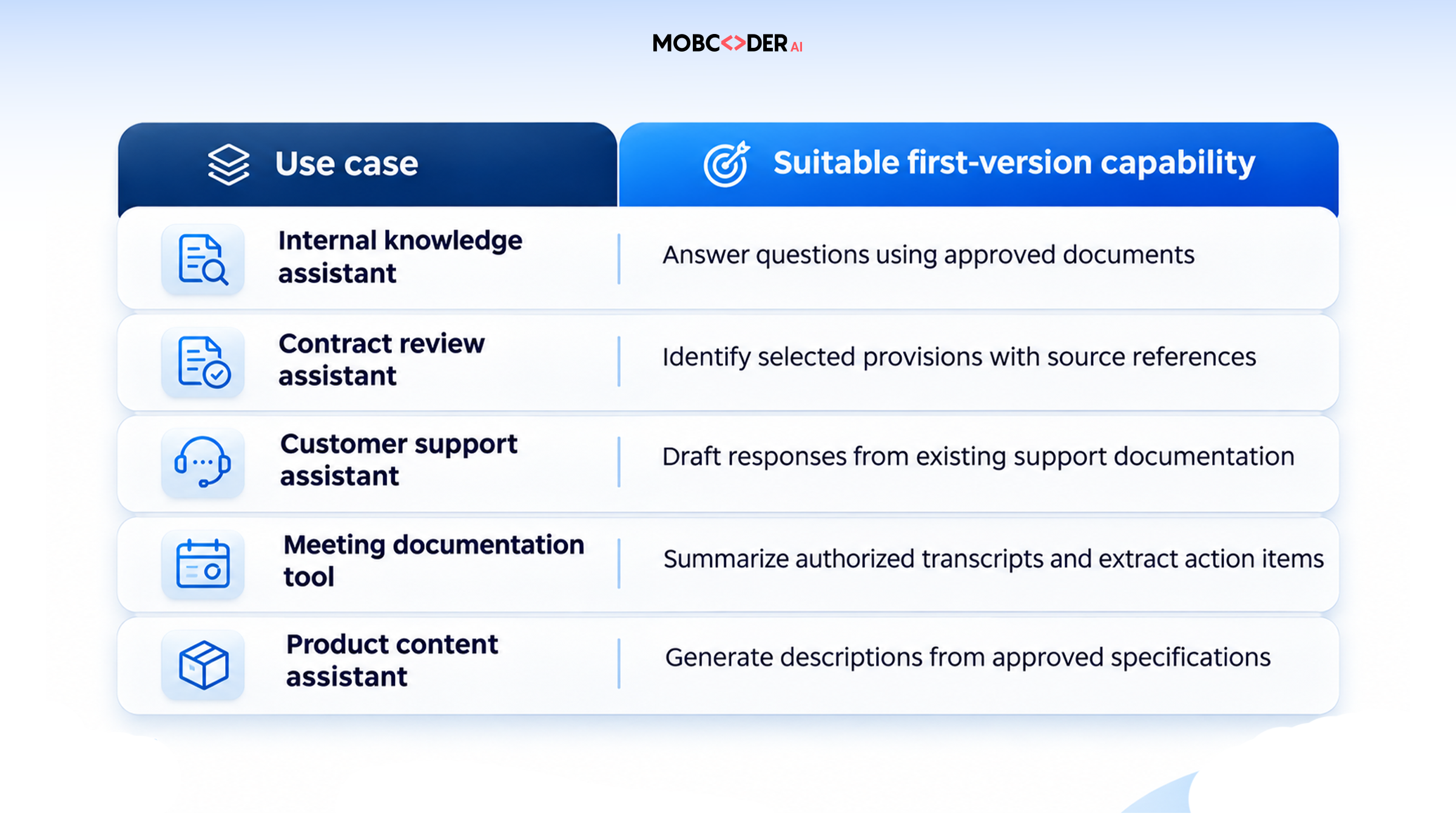
For businesses planning to build a GenAI MVP, the best starting point is a task with a measurable outcome. A customer support assistant could draft responses from one approved knowledge base before connecting to every communications system. This focused approach to generative AI development tests the core assumption without delaying it behind a larger feature list.
Even these projects depend on timely access to information and decisions. The goal is a controlled, testable MVP, not necessarily an unrestricted public launch.
How to Build a Generative AI MVP in 30 Days
To build a GenAI MVP within 30 days, every week needs a clear output and a decision about what comes next. The following roadmap uses an illustrative contract review assistant that identifies payment, termination, and liability provisions. It is a planning example, not a claim about a completed Mobcoder client project.
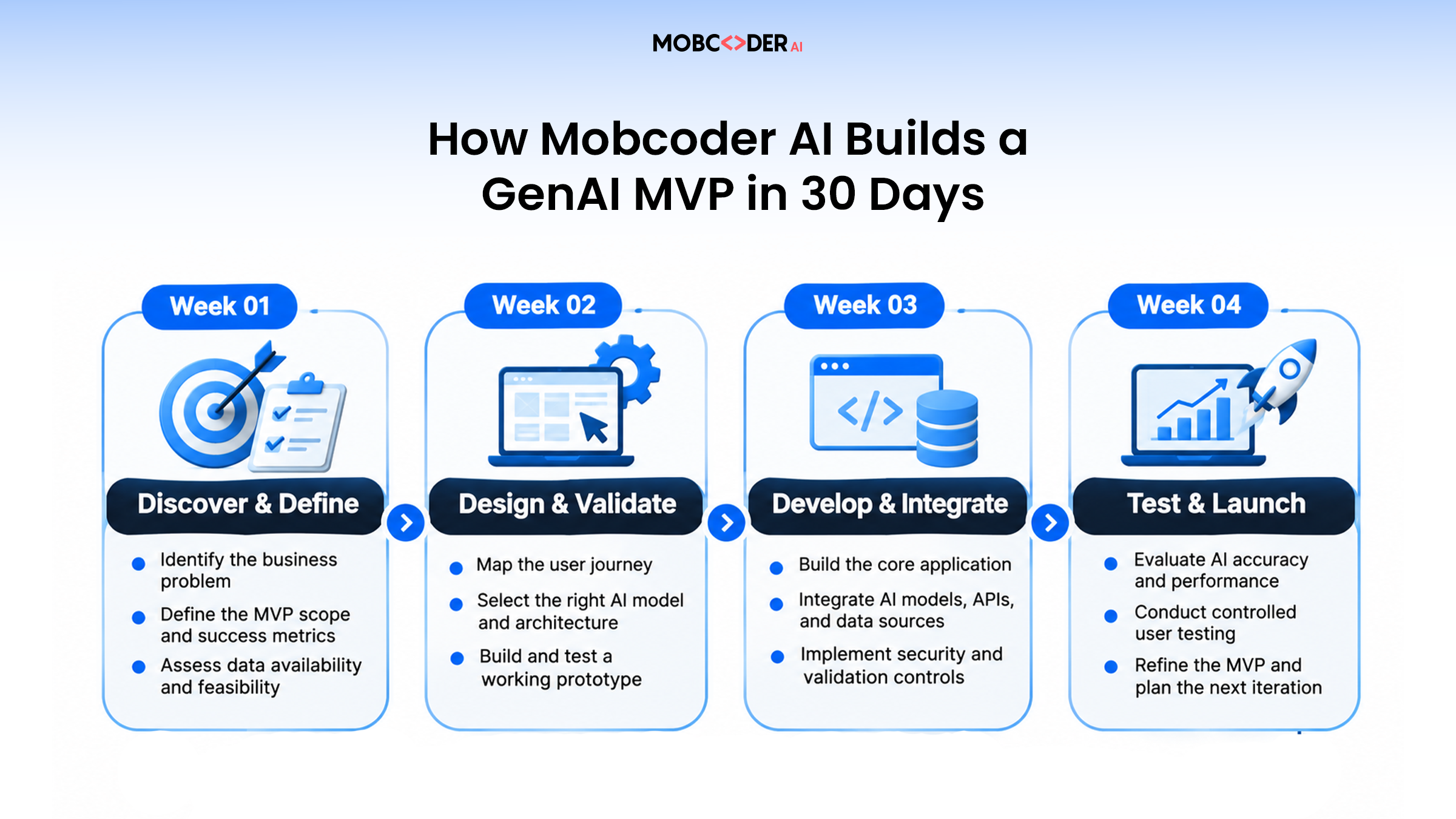
Week 1: Define the Problem and Validate the Use Case (Days 1–7)
The first week establishes the user, the problem, and the evidence that would make the product worth pursuing. Teams that begin by choosing a model often miss the larger workflow the user is trying to complete.
Days 1–2: Investigate the Existing Process
Watch how the procurement staff go about locating the clauses and then comparing them against policy. If it's quick to find the clause but the actual evaluation against policy is the slow bit then a simple extractor won't be the answer. The MVP might well need to show the relevant policy alongside the contract passage.
Days 3–4: Choose Users and Define Success
Pick a small group of regular users and establish the baseline review times, the frequent errors and the acceptable results. For the contract assistant we'll be tracking clause identification, source/reference accuracy and employee correction time. Define the acceptance criteria prior to testing so the team isn't in a position to re-define success in terms of the results they like.
Days 5–7: Finalize Scope and Confirm Data Availability
Secure the representative contracts, clarify the permissions and identify the supported file types. Don't include automated legal judgement, contract negotiation or broad repository integrations in this initial version unless they are absolutely essential to the test.
Week 1 deliverable: Approved scope, target users, sample data, success criteria, and exclusions.
Week 2: Design the Workflow and Select the AI Architecture (Days 8–14)
The second week converts the generative AI use case into an interaction and tests whether the intended model and data approach can support it. The design should make answers verifiable, not merely easy to generate.
Days 8–9: Map the User Journey
A procurement employee uploads an agreement, selects the review type, examines extracted clauses, and opens the original passages. Source links matter: if employees must search the contract again to verify every finding, the application may save little time.
Days 10–11: Evaluate Foundation Models and Data Requirements
Test candidate models on long contracts, tables, missing pages, and unusual clause locations. Decide whether direct document processing is enough or whether retrieval-augmented generation (RAG) is needed to compare agreements with internal policy. Choose based on representative results, not model reputation.
Days 12–14: Build and Test the Technical Prototype
Connect the model to a simple interface and test it on some difficult examples. If it gets an answer wrong then you need to work out whether that's due to an extraction error, a retrieval failure or an interpretation error. Each of those is a different thing and so it's far more useful to work out which one it is than just to keep on re-prompting.
Week 2 deliverable: Working prototype, selected architecture, initial evaluation, and known limitations.
Week 3: Develop the Core Application (Days 15–21)
Now we've got a prototype which is in effect a usable workflow. The team now need reliable processing, controlled access and sensible behaviour in the case of an incomplete input or a service failure.
Build the End-to-End Workflow
Implement authenticated uploads, document parsing, model calls, structured findings, source references and a review interface. Maintain the link between each finding and the original passage (even if the model has summarised the passage in simpler terms). That traceability is what enables the review to take place.
Introduce Validation and Security Controls
Separate extracted evidence from model interpretation. Flag unsupported findings for human review rather than expressing false certainty. Confidential agreements may require document-level permissions, protected storage, and carefully controlled logs. The NIST Generative AI Profile offers a useful reference for reliability, privacy, and information-integrity risks. Consequential legal decisions still require qualified human oversight.
Test More Than the Successful Workflow
Check unreadable files, unsupported formats, missing data, expired sessions, failed APIs and repeated requests. Users should get meaningful errors and be able to recover without losing their work. Access restrictions must remain in place in the event of a failure.
Week 3 deliverable: End-to-end application with validation, access controls, error handling, and usable review screens.
Week 4: Evaluate, Launch, and Decide What Happens Next (Days 22–30)
The final week is all about establishing whether the MVP actually works in the real world. A working interface is not in any way evidence that the product is going to improve anyone's work.
Days 22–24: Run Structured Evaluations
Compare the findings against a reference set which has been reviewed by appropriately qualified people. Measure correct clause identification, source accuracy, treatment of missing information, response time and cost. Include the difficult documents rather than just the documents the application is obviously going to cope with.
Days 25–26: Release to a Controlled User Group
Observe a small group completing real tasks. Ask which findings they correct, whether citations are trustworthy, and whether their total review time actually falls. A limited group can expose workflow problems; it cannot establish performance across every possible contract.
Days 27–30: Review Results and Plan the Next Iteration
Compare pilot evidence with Week 1 criteria. If clause extraction works but citations fail, prioritize traceability. If employees reject too many answers, investigate data quality and model behavior before adding features. The decision to expand should follow the results.
Week 4 deliverable: Controlled MVP release, evaluation report, user feedback, and prioritized next steps.
The 30-Day MVP Delivery Checklist
These are planning milestones, not guaranteed deadlines. Resolve serious security or accuracy issues before a broader release, even if it changes the schedule.
What Technology Stack Do You Need for a GenAI MVP?
A generative AI application needs more than a model, but an MVP rarely needs a full enterprise platform. Start with the necessary user interface, backend, data access, and evaluation tools. Add infrastructure only when the workflow requires it.
Foundation Models and Application APIs
Existing foundation models can support extraction, summarization, and analysis without custom training. Compare them using real inputs and measure output quality, latency, cost, context limits, and data policies. Simpler tasks may work well with smaller models; complex reasoning may require a stronger model or several processing stages.
Direct Model Integration, RAG or Fine-Tuning?
Use direct integration when the model works mainly from supplied inputs. Choose RAG when answers must draw on approved, changing documents. Consider fine-tuning only when testing demonstrates a recurring specialized need that simpler approaches cannot address efficiently. Fine-tuning does not keep a model current with changing internal policies.
Application Infrastructure
A practical MVP may use a web frontend, backend services, a database, model APIs, and cloud hosting. It may also need secure file storage, authentication, secrets management, and monitoring. The right architecture depends on data sensitivity and integrations, not on the number of components in a reference diagram.
Businesses evaluating generative AI development services should ask whether the architecture supports the task without needless maintenance. For organizations considering Mobcoder generative AI services, the priority is fitting model integration and enterprise connectivity to the systems already in place.
How Much Does It Cost to Build a Generative AI MVP?
Why Cost per Successful Task Matters
A cheaper model is not necessarily cheaper to use. If it regularly requires reruns and employee corrections, its total cost may exceed that of a model that completes the task correctly on the first attempt. Compare cost per successfully completed task, including human review where required, and estimate spending from the expected request volume and tested performance rather than a generic price range.
Common Mistakes That Delay a GenAI MVP Launch
Even capable teams can spend the month building features that do little to answer the central product question. The following mistakes are common and preventable.
Building Too Many Features Before Validation
Reporting dashboards, personalization, and extensive integrations can wait unless you need them to test the core workflow. Every extra feature increases development and testing effort before the team knows whether the product is worth expanding.
Choosing Models Before Assessing Data
A strong model cannot reliably compensate for missing pages, outdated policies, or poor document extraction. Check data quality, ownership, and availability before selecting the architecture.
Treating RAG as an Accuracy Guarantee
RAG can retrieve outdated material or miss the relevant passage, and a model can misinterpret correctly retrieved content. Evaluate retrieval and generation separately so that fixes target the actual failure.
Leaving Security Until Deployment
Even a small pilot may process confidential documents. Design permissions, storage, data isolation, and logging controls from the start. The AI Agent Security Checklist provides related guidance on authentication, permissions, and monitoring.
Measuring Activity Instead of Value
High request volumes can reflect experimentation rather than improvement. Track whether users accept the results, how much correction is required, and whether the application completes the task more effectively than the existing process.
Should You Build a GenAI MVP In-House or Work With a Development Partner?
An internal team may be the best choice when it already has the model, integration, security, and evaluation skills needed. External support can help when specialized document processing, enterprise connectivity, or additional delivery capacity is missing. Either approach should produce a clear scope, documented assumptions, a testing plan, and ownership arrangements.
The value of generative AI development services is in solving those engineering problems and validating a usable product, not merely connecting a chat interface to a model.
How Mobcoder AI Approaches Generative AI MVP Development
A knowledge assistant, contract reviewer, and customer support tool may use similar models, but their data access, integrations, and review requirements differ. Mobcoder AI’s work spans custom applications, foundation model integration, RAG, enterprise connectivity, testing, and deployment. Through generative AI services, businesses can assess how those capabilities fit existing workflows without committing to unnecessary complexity.
Mobcoder AI’s expansion in agentic AI capabilities is also referenced in a USA Today press release. For an initial MVP, the important decision is whether the task truly requires tool orchestration or whether a simpler model-driven workflow is sufficient.
Conclusion
Building a generative AI MVP in 30 days is possible when the problem is narrow, data is accessible, and you define success before development. The meaningful result is not a long feature list; it is evidence that the application helps people complete work reliably. Identifying a failed assumption early can be as valuable as a successful pilot because it prevents a larger investment in the wrong solution.