
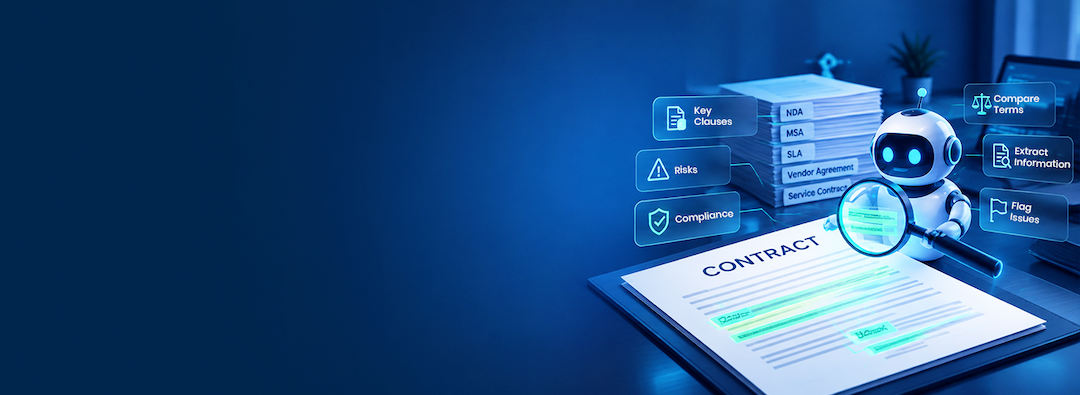

Contracts contain some of the most important information a business works with. It ranges from obligations, pricing, timelines, compliance requirements to termination conditions and renewal terms. Reviewing these documents manually can take hours or even days, particularly when teams need to compare multiple agreements or verify each clause against internal policies, regulations or technical specifications.
AI contract review uses artificial intelligence to make this process faster and more structured. Instead of relying entirely on manual document reading, AI can extract relevant information, identify clauses, compare terms, flag potential risks and surface deviations for human review.
The technology becomes even more capable when contract review is built using an AI agent rather than a standalone document analysis model. An AI contract review agent can retrieve information from connected sources, apply business rules, reason across multiple documents, cite the evidence behind its findings and route exceptions into the appropriate workflow.
What Is an AI Contract Review?
A manual document-processing system might need to extract information by reading every single line. A more advanced AI system can scan documents using natural language processing (NLPs) and machine learning to understand the context surrounding terms.
An AI contract review agent takes this further by connecting document analysis with actions and workflows. Instead of simply returning a list of findings, the agent can retrieve supporting documents, apply predefined rules, create an exception for review, update a connected system, or route the issue to the appropriate team.
This makes AI contract review particularly useful for organizations dealing with large volumes of contracts, complex regulatory requirements or document-heavy operational processes.
How Does AI Contract Review Work?
AI contract review typically combines document processing, artificial intelligence, information retrieval, business rules, and validation rather than relying on a single model response.
Document Upload, OCR and Text Extraction
AI contract review starts with document ingestion. A production system should be able to work with common formats such as PDFs, Word documents, scanned contracts, and document images.
Digitally generated documents can usually be processed through direct text extraction, while scanned documents require Optical Character Recognition (OCR) to convert page images into machine-readable text.
However, extracting the words is only part of the process. The system should preserve the structure of the original document, including headings, sections, clauses, tables, page numbers, and other relationships. For example, knowing that a particular sentence belongs to a liability section and appears on a specific page can be important when the system needs to explain why it has flagged that provision.
Identifying Important Clauses, Parties, Dates and Obligations
Once the document has been processed, the AI can identify and organize important contractual information.
This may include the parties involved, effective and expiration dates, payment terms, renewal conditions, termination rights, confidentiality provisions, liability limits, indemnification obligations, governing law, service-level commitments, and responsibilities assigned to each party. Instead of manually searching a 1000-page agreement for every relevant provision, users can access a structured view of the information that matters to their specific workflow.
Flagging Risky, Missing or Unusual Clauses
An AI contract review system can also identify provisions that may introduce business, financial, regulatory, or operational risks. Depending on the organization's requirements, it could flag unlimited liability, unusually broad indemnification, automatic renewal conditions, missing termination rights, weak confidentiality provisions, or terms that differ significantly from approved contract templates.
The important part is that the AI should not simply label a provision as “high risk.” It should explain why the clause was flagged and provide the evidence supporting the finding..
Using RAG to Ground Contract Analysis in Trusted Sources
Large language models provide strong language understanding, but organizations should not expect a model to rely only on its general training when analyzing business contracts.
Retrieval-Augmented Generation (RAG) allows an AI system to retrieve relevant information from approved sources before generating an answer or analysis.
For contract review, these sources could include internal legal policies, standard contract templates, approved clause libraries, regulatory documents, previous agreements, procurement guidelines, or organizational requirements. Suppose a company has a defined policy for acceptable liability provisions. Rather than asking the model to make a judgment based only on its general knowledge, the system can retrieve the relevant internal policy, identify the applicable section of the contract, and analyze the two together.
This creates a more context-aware AI contract review workflow and makes it easier to ground findings in the organization's actual standards.
Comparing Contracts and Different Versions
Contracts often go through multiple rounds of negotiation before they are finalized. Comparing those versions manually can be difficult, especially when a seemingly small wording change alters a significant contractual obligation. AI contract review can compare an original agreement with a revised version, a vendor contract with an approved template, or two competing supplier agreements.
More advanced systems can go beyond highlighting textual differences. They can explain the potential significance of those changes.
Keeping AI Findings Backed by References and Citations
One of the most important requirements for AI contract review is traceability.
If an AI system identifies an automatic renewal condition, users should be able to see the relevant clause, section, or page where that condition appears. If the system uses information retrieved through RAG, it should also identify the policy, template, regulation, or other source used to support the finding.
This creates a clear connection between the AI's conclusion and the information behind it.
Adding a Validation Layer Before the Final Output
A production-grade AI contract review system should not necessarily rely on a single model response.
The workflow can separate extraction, analysis and validation into distinct stages. One component can identify relevant clauses and contractual information, another can assess those clauses against business rules or trusted sources, and a validation layer can check whether the resulting finding is actually supported by the original document.
For example, if an AI agent identifies a potential compliance issue, the validation stage can verify that the relevant clause exists, that the correct document version was analyzed, and that the evidence supports the generated conclusion. If the system cannot establish sufficient evidence, the finding can be marked for additional review rather than presented as a definitive conclusion.
What Are the Benefits of AI Contract Review?
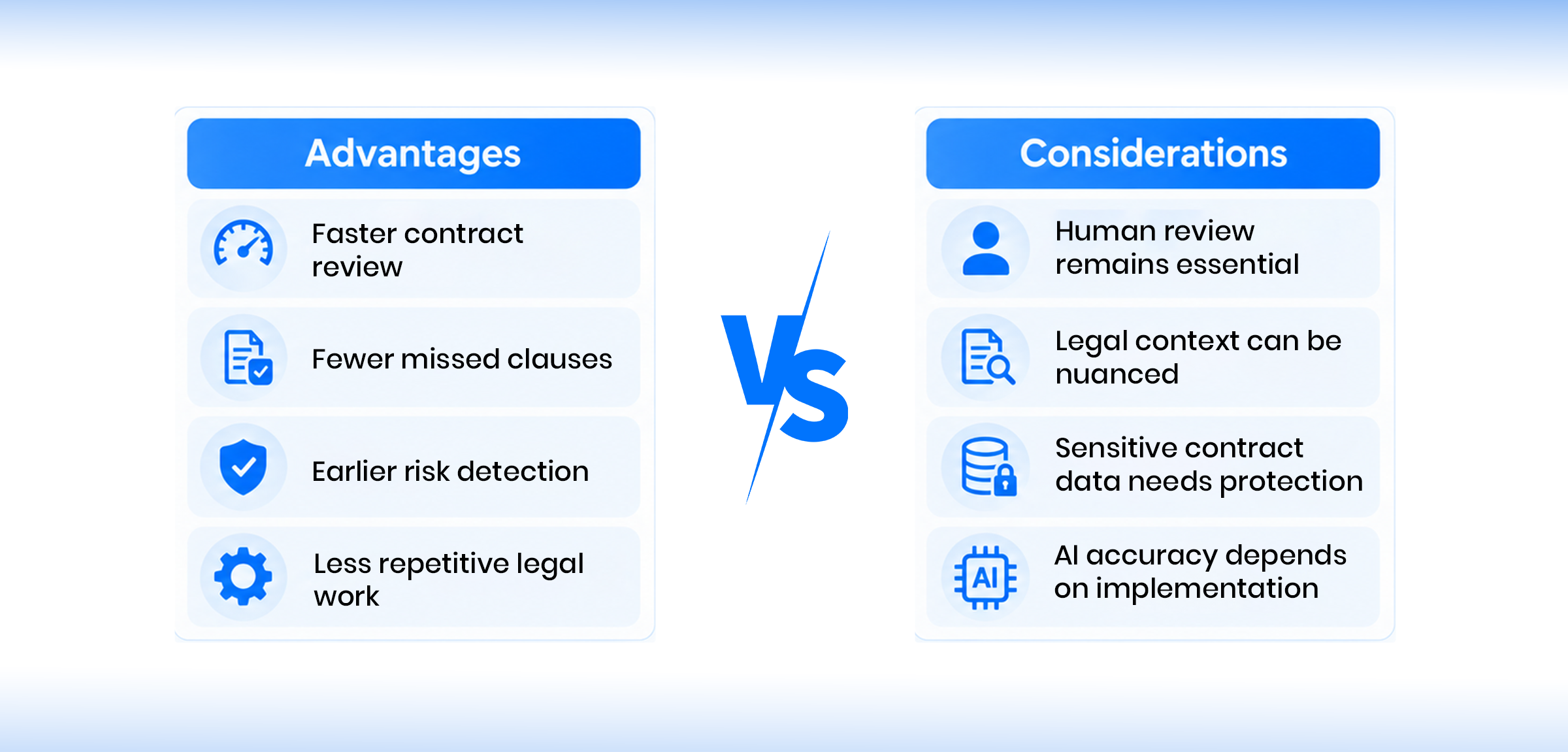
The business value of AI contract review depends on the workflow being automated, but several benefits apply across industries.
- Faster document analysis. AI can process and organize large volumes of contractual information far more quickly than manual review alone.
- Greater consistency. When contracts are reviewed against defined policies and rules, organizations can establish a repeatable first-pass review process rather than relying entirely on individual reviewers to remember every requirement.
- Better visibility into contractual risk. AI can surface deviations, missing clauses, unusual terms, and potential conflicts earlier in the process.
- Scalability. Teams can review more agreements without increasing manual review effort at the same rate.
- Workflow automation. With an agentic architecture, findings can feed directly into downstream processes such as exception management, compliance workflows, document generation, reporting, or approval queues.
How to Implement AI Contract Review Agents in Your Business
A practical implementation usually starts by identifying the contract workflows that consume the most manual effort. This could be reviewing supplier agreements, comparing contracts against approved templates, checking regulatory requirements, extracting obligations, monitoring renewals, or analyzing large document packages during procurement or project execution.
The next step is to define the information the AI needs and the systems it needs to access. This may include contract repositories, policy libraries, CRM or procurement platforms, document management systems, databases, and internal knowledge sources.
From there, the AI architecture can be designed around the workflow. A simple use case may require document intelligence, RAG, and an LLM. A more complex workflow may benefit from specialized agents, tool integrations, approval workflows, audit logging, and governance controls.
Mobcoder AI applied this approach with GovGig, building a multi-agent AI system for federal construction contracting. The system processes contracts and supporting documents, performs clause-level compliance checks, and connects the extracted contract intelligence with downstream workflows such as submittals, RFIs, schedules, reporting, and claims.
Evaluation should happen throughout development using representative documents and predefined success criteria. This helps organizations determine whether the system is actually improving review speed, consistency, accuracy, and operational outcomes.
The final stage is production deployment with monitoring and continuous improvement. Contract language, policies, regulations, and business requirements change over time, so an AI contract review system should be designed to evolve with them.
How AI Contract Review Agents Save Time and Reduce Costs
Now you now know the the value of an AI contract review agent goes beyond analyzing documents. With AI agent development, businesses can connect contract analysis with their policies, data sources, and existing systems to automate multiple steps in the review workflow.
Instead of manually finding clauses, checking policies, comparing versions, documenting risks, and routing exceptions, an agent can coordinate these tasks in one workflow, reducing repetitive work and freeing legal teams to focus on decisions that require human judgment.
A standalone AI model can analyze a document and return an answer. An AI agent can take the next step. It can retrieve the relevant policy, compare the contract against it, validate the finding, create an exception, and route it to the right person or system.
Challenges and Limitations of AI Contract Review Agents
AI contract review agents requires careful implementation. The key challenges are:
How Mobcoder AI Builds AI Contract Review Solutions
At Mobcoder AI, we approach AI contract review as a workflow engineering problem, not simply a document summarization problem. We can build AI systems that ingest and understand complex documents, retrieve information from authorized sources, analyze clauses against business rules, identify risks and exceptions, provide source-grounded findings, and connect those findings to the systems where the next action needs to happen. Our architecture can include LLMs, RAG, vector databases, document intelligence, agent orchestration, API integrations, enterprise data sources, governance layers, and human approval workflows based on the requirements of the use case. Contact us if you need to build one too.