








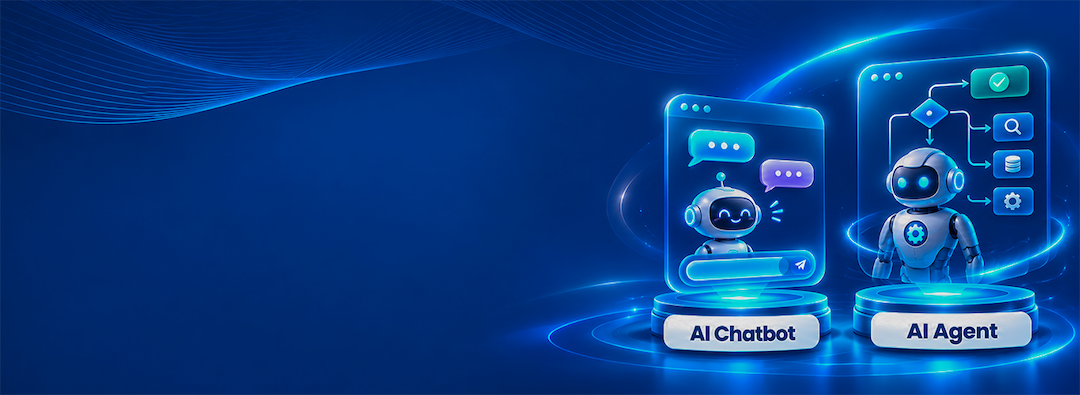

The difference between an AI chatbot and an AI agent is simple: An AI chatbot answers questions while an AI agent can take things a step further by making decisions and executing tasks.
Imagine a customer whose online order is delayed. A chatbot can check the tracking details and share an update. An AI agent can investigate the delay, check the replacement policy, initiate the next steps, and keep the customer informed, provided it has the required access and permissions.
Both technologies serve different purposes. Understanding how they work, where they overlap, and what sets them apart can help businesses choose the right solution for their needs.
What Is an AI Chatbot?
An AI chatbot is a software application designed to interact with people through text or voice. It helps users find information, get answers to questions, make simple requests, and navigate services.
Businesses commonly use chatbots for customer support, product inquiries, employee help desks, and website navigation, making information and assistance more accessible without requiring a human support representative for every interaction.
Not all chatbots work the same way. Rule-based chatbots follow predefined rules and conversation paths. AI-powered chatbots use technologies such as Natural Language Processing (NLP) and Large Language Models (LLMs) to understand user queries and generate more natural responses. More advanced chatbots can also search knowledge bases, retrieve live account information, and perform actions through connected applications. Their capabilities depend on how they are designed, the systems they can access, and the permissions they have.
For example, if an employee wants to know about the company's leave policy, a chatbot can retrieve the relevant information, explain eligibility requirements, and guide them through the application process. With the right integrations, it may even submit the leave request through the existing system. For many organizations, this level of functionality is enough to make everyday services easier to access.
What Is an AI Agent?
An AI agent is a software system that employs AI to understand its environment, work toward a specific goal, make autonomous decisions, and use approved tools to complete tasks without needing human intervention at every single step. The agent does not run on a single fixed sequence, it adapts along the way.
Let’s understand from the example of onboarding an employee. An AI agent could be set up to check whether the employee has all the necessary documentation, start the account creation, request for the system allocation, and provide a thorough update of the employee's onboarding status. If there is an approval missing, it would simply pause that step and alert the respective POC. There may be a number of applications involved but the agent would be managing it all around a single objective.
The most common feature which increases the usefulness of an AI agent is its ability to carry a task across multiple steps. Still, autonomy is not the same as unrestricted access. Businesses must decide what information an agent can use, what actions it can take, and when an employee must approve the next step.
What Are the Key Differences Between an AI Chatbot and an AI Agent?
1. Conversation vs. Task Execution
A chatbot essentially just enables the user to talk to the business or get information. An AI agent goes further in that it can work towards an outcome which may involve multiple steps and multiple applications. Both are useful in their own right. They just address different aspects of the same problem.
Take a customer who's questioned an invoice. The chatbot will explain the billing policy, pull up the invoice and give them the instructions on how to raise a dispute. An AI agent could go through the payment history, compare the invoice against the account records, spot the likely discrepancy and then prepare a correction for approval.
The second route is the one that deals with the work behind the request. If the customer just wanted the billing policy explained then you'd add a whole layer of complexity and that's it.
2. Autonomy and Decision-Making
Chatbots generally operate within a set of predefined conversational capabilities. They can be programmed to understand complex queries, retrieve information and initiate specific actions. The application will usually dictate what workflows are available.
An AI agent has more scope in terms of which of the approved steps it picks to take next. An IT support agent for instance could read an error report, look at the relevant logs, check for any similar incidents and then suggest an appropriate troubleshooting step. If that initial look doesn't explain the problem it can go on to gather more information or escalate.
This flexibility is a massive time saver when the work doesn't follow a predictable pattern. It also means controls are extremely important. You've got to work out which decisions are going to be automated and which are going to be reviewed by a human.
3. Integration With Business Systems
Both chatbots and AI agents can connect to databases and business apps. A chatbot could pull order information or create a support ticket via an API. Having the ability to connect to an external system doesn't in any way make it an AI agent.
The difference is evident when you've got a task that spans multiple systems. A delivery dispute for instance would require you to check the order database, check the shipment records, check whether the replacement is actually eligible, update the support case and then of course get the customer informed.
An agent can coordinate those steps. The app itself still has to deal with missing data, unavailable services, duplicate requests and permission limits. Good integration is about the entire process working reliably rather than just a few APIs getting connected. As we detail in our Agentic AI vs Traditional Automation article, the value of an agent based system comes from it being able to assess the information and determine what the next appropriate action should be (within the constraints of the system).
4. Memory, Context, and Proactive Work
Many modern chatbots will have a memory of the conversation history or will be able to pull in stored customer information in order to provide a more relevant response. Memory in itself doesn't make something an agent. What usually happens is the requirement that the system has to carry on with an uncompleted task over a number of steps.
An agent handling vendor onboarding, for instance, might follow document verification, pending approvals, account creation, and open requests all at once. When an approval comes in, it continues with the permitted workflow. Nobody has to start over.
Agents can also react to business events (e.g. a support case that's been delayed, a renewal due date approaching etc). That requires the appropriate triggers, integrations and permissions of course. None of that just appears as a result of an app using a language model.
Conversational AI vs Agentic AI: What Does It Mean for Businesses?
Conversational AI enables people to talk to software in natural language. It's the technology behind chatbots, virtual assistants, voice interfaces and all sorts of other applications where the user is interacting with the software via questions and answers. The key benefit is in making information and services more accessible.
Agentic AI is all about achieving goals via decisions and actions. The agent may use a language model to parse the information it's working with, but it also needs tools and workflows to actually do something with that information. It's not necessarily going to need a chat interface in order to perform.
When you're comparing conversational AI to agentic AI the real question is this one: will better communication solve the problem or do you actually need to look at the process of the conversation itself? A company which is just inundated with the same old customer queries is a perfect candidate for conversational AI. A company where the people are spending hours and hours of their time pulling together information from disparate systems is a much better candidate for agent based automation.
The two can also work side by side. A chatbot takes the user’s request while an agent handles the work behind the scenes.
AI Chatbot vs AI Agent: Real Business Use Cases
Customer Support and Service Operations
Chatbots can answer FAQs, provide order updates, give product information and direct the customer to the correct team. They're ideal when the customer is looking for a quick answer to a fairly standard question and the business wants support to be easier to get to.
AI agents come in when resolving a request takes investigation or several actions. A damaged-product complaint is a good case. The business may need to review the order, check the replacement policy, confirm inventory, and prepare a new shipment. An agent could coordinate all of that and escalate unusual or high-value cases for human approval.
Sales and CRM Operations
A sales chatbot can answer product questions, capture contact details, do some basic qualification and assist with the booking of meetings. That improves the communication with the prospect and the sales process underneath is exactly the same.
An AI agent could take it a step further. It could review incoming leads, check existing customer records, identify gaps, and prepare follow-up tasks for the sales team. With the right permissions, it could also spot stalled opportunities and flag them to the responsible salesperson.
IT Support and Employee Services
Employee chatbots can explain internal policies, pull up the troubleshooting guides and walk people through the common support requests. For the kind of issue that you can predict, that's often faster than an employee having to go and search around a number of documents or just call support.
An AI agent could go and look at the monitoring tools, gather the diagnostic data and then correlate that to an existing incident. It could then initiate an approved troubleshooting procedure. Anything that touches production services or employee access would still need to go through the appropriate permissions and approvals.
Finance, Procurement, and Compliance
Finance and procurement teams are frequently faced with information that's spread across invoices, purchase orders, customer records and the various approval systems. A chatbot can be used to explain financial policies or walk an employee through the process of submitting a request. An agent can also be used to investigate the differences between the records.
It could compare the invoice to the purchase order, spot a discrepancy and produce the relevant supporting documentation for review. The final sign-off would still be with an authorised employee. The outcome is less duplication of effort, without necessarily handing over the actual financial decision making to the AI.
How Can a Business Move From a Chatbot to an AI Agent?
You don't necessarily have to replace your existing chatbot to get AI agents. You can quite often add capabilities in a step by step fashion as your requirements become clearer. If you're looking at conversational AI development services then you should also be asking whether your current chatbot architecture is capable of supporting further integrations and more complex workflows.
Here’s how it might work for an online retailer. It starts with a chatbot that answers delivery questions. Later, it connects the bot to live tracking data so customers can check their own orders. Then the chatbot adds the functionality where it can also create support tickets as per predefined workflow. Each step delivers real value, and none requires the system to make independent decisions.
The need for an agent shows up when the retailer wants to automate harder requests. Creating a ticket is no longer enough. The system may have to investigate the delivery problem, check several records, determine available resolutions, and coordinate what happens next.
That change brings with it new technical requirements: tracking the progress of the task, selecting the appropriate tools to use, validating the actions, dealing with any failures and recording what the system has actually done.
Going gradually allows the business to test each capability in turn before handing the system any more autonomy. It also prevents the need to make unnecessary changes to workflows that are already working very well.
What Are the Costs and Risks of AI Agents Compared With Chatbots?
Any comparison of the cost of an AI chatbot with that of an AI agent should be based on the full application, not just on the cost of using the model. The chatbot will have its own set of requirements in terms of conversation design, knowledge base integration, response testing and content refresh. The agent will have all of that plus the requirement to connect to a number of business systems, have tools for task coordination, additional monitoring and processes for dealing with failure of an action.
The risks are of course different too. A wrong chatbot answer could lead someone down the wrong path or simply confuse them. A wrong agent action could change a customer record, send the wrong message or trigger a transaction that absolutely shouldn't have been.
Both deserve attention. But a system that can act needs stronger controls, because its mistakes hit business operations directly.
Security and Human Oversight
Give AI agents only the access that their specific tasks require. The app itself should be the one to check whether any sensitive action is being undertaken. Don't trust the model to make that determination.
Human approval is of particular importance in relation to payments, account changes, sensitive customer information and anything else that's potentially irreversible. Businesses also need to have clear processes in place for failed requests, conflicting records and instances where the agent simply can't safely determine what to do.
Our AI Agent Security Checklist ( covers these requirements: authentication, access permissions, data protection, monitoring, and approval controls).
Measuring the Business Value
You can measure chatbot performance on answer accuracy, customer satisfaction, support resolution, escalation rates and the amount of effort required to deal with the basic queries. Agents have to do more than just have a conversation.
For an agent the useful metrics would be number of tasks completed, processing time, correction effort, number of failed actions, number of times it required human intervention and cost per successful workflow. Those are the metrics that tell you whether it's actually improved the process or simply moved the work from one place to another.
There’s no universal percentage improvement that applies to every chatbot or AI agent. Real returns depend on the workflow, implementation quality, the systems already in place, and how employees use the application.
How We Approach Conversational AI and Agent Development at Mobcoder AI
At Mobcoder AI we start with the business problem and the work that the user needs to get done. A customer facing chatbot, an internal knowledge assistant and an agent driven support app may well be using the same AI models, but the way they need to access data, the integrations they need, the way they need to be tested and the security requirements can be very different. We look at those requirements first and then recommend conversational assistance, agent based execution or a combination.
Through our conversational AI services, we help businesses build AI-powered chatbots, virtual assistants, voice-enabled applications, multilingual interactions, and connected conversational experiences. Our approach to Mobcoder conversational AI services is to build around existing business processes while keeping future integrations and capabilities in mind. When a workflow needs more than information, we also look at how approved tools and business systems can support task execution.
We look at a related decision in our discussion of agentic AI and traditional automation. The principle underneath is the same: advanced technology is worth it when the business process actually needs it. We’d rather select capabilities that help people get work done reliably than pile on complexity for its own sake.
Choose the Technology That Fits the Work
The difference between a chatbot and an AI agent gets clearer once you look past the first question and ask what has to happen next. If an accurate answer resolves the request, a chatbot may be enough. If the work involves investigation, decisions, and coordinated actions across systems, an AI agent may be the better fit. Sometimes combining the two is the most practical route.
At Mobcoder AI, we focus on what the technology needs to achieve, not on adding complexity for its own sake. A reliable chatbot can create more value than an unnecessary agent. A carefully designed agent can remove a lot of manual effort from complicated workflows. If you’re weighing either approach, contact our team to discuss your business requirements and map out a suitable development strategy.