


In 2024, companies raced to integrate large language models. In 2025, copilots entered enterprise workflows. In 2026, the ambition shifted again, this time toward autonomous systems that plan, decide, and act without constant human instruction.
The conversation around agentic AI development services keeps getting framed around models - which LLM to use, which prompt performs best, which provider is faster. That's the wrong focus. Agentic AI isn't a prompt engineering challenge. It's an operational systems problem, and treating it like a model selection exercise is how most agentic AI projects end up stuck in pilot purgatory.
The Oversimplification: “It's Just a Smarter ChatGPT”
When someone can't precisely explain how a system works, they default to comparing it to ChatGPT. That's understandable for a quick explanation, but it's misleading for anyone actually evaluating or building these systems.
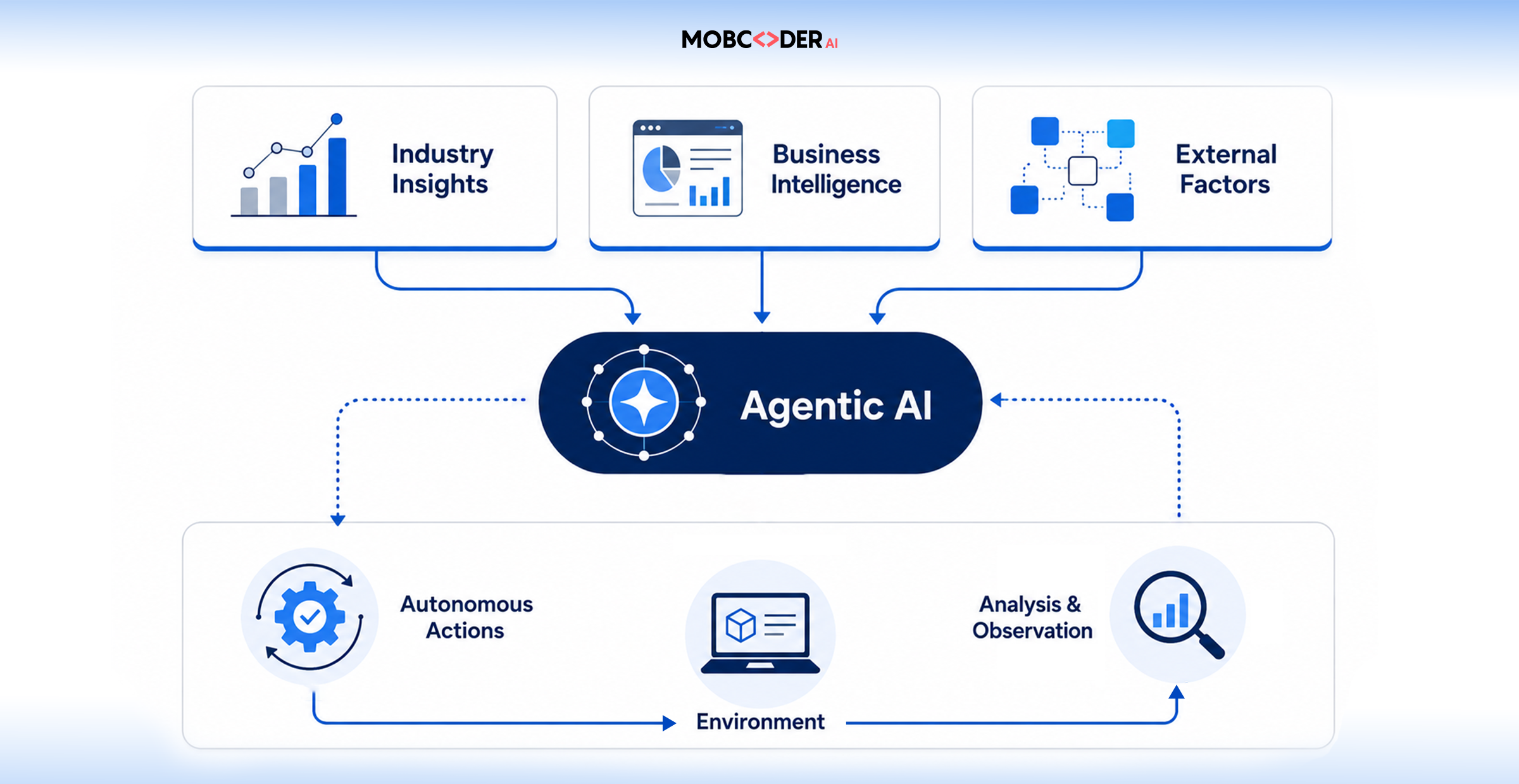
Generative AI is reactive: you ask, it answers. Agentic AI is goal-driven: you define an objective, and it plans, reasons, chooses tools, takes actions, evaluates outcomes, and iterates without a human writing every step. The real difference isn't intelligence - it's autonomy.
Enterprise-grade agentic AI systems combine decision loops, tool invocation, memory layers, multi-step reasoning, and self-correction mechanisms. This is structurally different from a chatbot implementation, and it needs to be evaluated, priced, and engineered differently.
Truth One: Agentic AI Is an Orchestration Problem
Most discussions revolve around model capability. The real engineering work lives in orchestration - the layer that decides what happens between the model and the outcome.
Model routing determines which model handles which task, and when the system escalates to a stronger, more expensive model versus when a lightweight one suffices. Without intelligent routing, costs explode and performance degrades unpredictably.
Tool invocation logic matters just as much: autonomous agents create value by using tools - APIs, databases, CRMs, internal systems - not by generating text. The questions that actually matter are under what confidence threshold a tool gets invoked, what validation happens before execution, and how tool misuse gets prevented.
Decision trees and escalation layers define enterprise trust: when does the agent proceed autonomously, when does it ask for human review, when does it stop entirely? And state management - short-term session memory, long-term vector memory, task-level tracking - determines whether the system behaves intelligently across time or resets its understanding with every interaction.
Agentic AI development services succeed when they invest in orchestration logic, not just model capability. Orchestration is where enterprise reliability gets built.
Truth Two: Reliability Engineering Determines Adoption
An AI agent that's 85% correct is impressive in a sandbox. It's catastrophic in production. Reliability engineering is the invisible layer separating experiments from infrastructure - hallucination containment, confidence scoring frameworks, structured output validation, simulation-based testing, and long-horizon task stability checks.
In enterprise deployments, reliability often matters more than raw intelligence. Custom agentic systems need to anticipate edge cases, ambiguity, and unexpected user behavior. Without structured evaluation frameworks, autonomy stops being a capability and becomes operational risk.
Truth Three: Cost Engineering Is the Hidden Battlefield
The real cost of agentic AI isn't model access - it's poorly engineered workflows that call expensive models far more often than necessary. Companies that scale successfully use model cascading (routing simple tasks to cheap models, escalating only when needed), per-task token budgeting, latency-aware routing, and adaptive reasoning depth that doesn't “think harder” than a task actually requires.
The companies that win with agentic AI don't necessarily use the most powerful models available. They use the most economically engineered systems. Cost discipline, not raw model quality, is what defines scalability here.
Truth Four: Governance Is Not Optional
Governance determines whether agentic AI survives legal, regulatory, and operational scrutiny once it's actually handling real volume. Production-grade systems require full audit trails of agent decisions, permission hierarchies, regulatory compliance mapping, human override mechanisms, and risk scoring architecture. Autonomous systems need to be able to answer why they made a given decision, what data they accessed, and who approved their authority scope. Autonomy without governance isn't innovation - it's exposure, and liability scales faster than the innovation does in enterprise environments. We've broken this down in more depth in our piece on why AI transformation is fundamentally a governance problem, not a model problem.
Truth Five: Agentic AI Is a Systems Investment, Not a Feature Upgrade
Treating agentic AI like a product enhancement misses how deep its operational footprint actually runs. It touches DevOps pipelines, cloud infrastructure, monitoring systems, security frameworks, data architecture, and organizational workflows. You're not adding AI to your product for the sake of having advanced technology - you're adding an autonomous operational layer to your organization, and that shift requires systems thinking, not feature thinking.
Why In-House Agentic AI Efforts Commonly Stall
Even technically strong internal teams struggle here. The common breakdowns: no structured evaluation framework, no simulation environment for stress testing, no visibility into cost per task, over-reliance on prompt engineering as if it were the whole solution, and no cross-functional ownership when the project spans engineering, compliance, and operations simultaneously.
Building agentic AI isn't just a data science problem - it's an architectural, operational, and organizational problem at once, which is why many enterprises eventually seek an experienced agentic AI development company rather than continuing to scale internal experiments that never quite reach production readiness.
What Production-Grade Agentic AI Services Actually Deliver
Serious agentic AI development services don't sell model access - they deliver operational architecture: system-level design, orchestration strategy and model routing, cost engineering frameworks, reliability testing pipelines, governance implementation, and continuous performance optimization. The value isn't an impressive demo. It's a stable autonomous infrastructure that keeps working six months after launch.
A Practical Way to Audit Your Own Readiness
Before signing off on an agentic AI initiative, it's worth running a short internal audit rather than jumping straight to vendor selection. Map out which of your processes are well-defined enough to automate with simple rules versus which genuinely require judgment under ambiguity - only the second category needs full agentic architecture. Identify who in your organization would own escalation decisions if the agent encounters a situation it can't resolve confidently. And estimate, even roughly, how many times per day the system would need to run, since that volume directly drives the cost-engineering decisions discussed above.
This audit usually takes a few days of internal discussion and saves months of mismatched expectations later. Organizations that skip it tend to discover the real complexity of their use case midway through a build, which is the most expensive point to discover.
The Questions Enterprises Should Actually Be Asking
Most organizations ask: “Which model should we use?” That's the wrong starting question. The right ones: How do we evaluate autonomous decisions at scale? What's our escalation logic for uncertainty? What's our cost ceiling per workflow? How do we monitor behavioral drift over time? Who owns accountability for agent decisions? These aren't model questions - they're operational questions, and operational questions determine enterprise success or failure here.
From Experiments to Infrastructure
Agentic AI is transitioning from experimentation to infrastructure. Companies that treat it like a feature will struggle with reliability, cost, and governance. Companies that treat it like an operational system will build durable competitive advantage. The future of enterprise automation won't be defined by who uses the largest model - it'll be defined by who designs the most resilient orchestration architecture.
If you're evaluating agentic AI development services, start by auditing your orchestration logic, reliability engineering, cost architecture, and governance frameworks. Not your prompt library. Autonomy without operational discipline isn't innovation - it's exposure.