








"AI agent” has become one of those terms banks throw around without much precision - used interchangeably with chatbot, with RPA, with basically any automation that touches a customer. That looseness causes real problems when a bank's compliance team is trying to figure out what actually needs an audit trail.
Here's a clearer breakdown: what AI agents actually do differently in banking, where they're already delivering measurable results, and the governance questions that come up the moment autonomy enters a regulated workflow.
The Actual Difference Between a Banking Chatbot and an AI Agent
A chatbot answers a question from a fixed set of possible responses. An AI agent reads a situation, decides what to do about it, and takes an action, sometimes across multiple systems and that too without a human writing out every step in advance.
Concretely: a chatbot can tell a customer their account balance. An AI agent can notice a flagged transaction, pull the customer's transaction history, cross-reference it against known fraud patterns, decide whether to freeze the transaction or escalate to a human analyst, and log the reasoning without a human triggering each step.
That distinction matters for budgeting and risk assessment. A chatbot project is mostly a conversation-design exercise. An AI agent project is a systems integration and governance exercise, and it should be priced and resourced that way.
Where Banks Are Actually Seeing Results
Skipping the generic “AI will transform banking” framing - here's where the ROI is concrete enough to be worth building around right now:
KYC and Onboarding
Document collection, identity verification, and approval-chain routing for new accounts is repetitive, rules-heavy, and high-volume - exactly the profile of a process that benefits from an agent that can verify documents, flag inconsistencies, and route exceptions to a human, instead of a human touching every single application.
Transaction Monitoring and Fraud Detection
This is the highest-maturity use case in banking AI right now. Agents that watch transaction streams in real time, score anomalies, and either auto-block or escalate based on confidence thresholds are already standard at larger institutions - the differentiator now is reducing false-positive rates, since over-flagging legitimate transactions creates its own customer-experience and operational cost.
Loan Origination
From initial inquiry through document collection, underwriting support, and disbursement, an agent can manage the full pipeline while keeping customers updated in real time - a process that traditionally required a loan officer to manually track status across multiple systems.
Reconciliation and Settlement
Less visible to customers but operationally significant: agents that automatically match transactions across ledgers, flag discrepancies, and accelerate settlement cycles cut down on what used to be hours of manual reconciliation work per day in mid-sized banks.
The Governance Layer Banks Cannot Skip
This is the part most vendor pitches gloss over. Deploying an autonomous agent in a regulated industry without a governance framework isn't a minor oversight - it's the difference between a system regulators will approve and one that creates legal exposure the first time it makes a consequential mistake.
At minimum, a banking AI agent deployment needs:
A complete audit trail of every autonomous decision - what data the agent accessed, what it decided, and why.
A defined escalation threshold - the confidence level below which the agent must hand off to a human rather than acting alone.
Named human accountability for every category of decision the agent is authorized to make - not “the AI team,” but a specific role with the authority to pause the system.
Identity verification controls for any agent that can authorize transactions or modify accounts - increasingly handled through dedicated voice and biometric verification layers as agentic systems take on more sensitive actions.
We've written more extensively about why this governance layer is the actual bottleneck in most enterprise AI deployments - not model quality - in our piece on why AI transformation is fundamentally a governance problem.
Why Multi-Agent Systems Outperform Single Agents in Banking
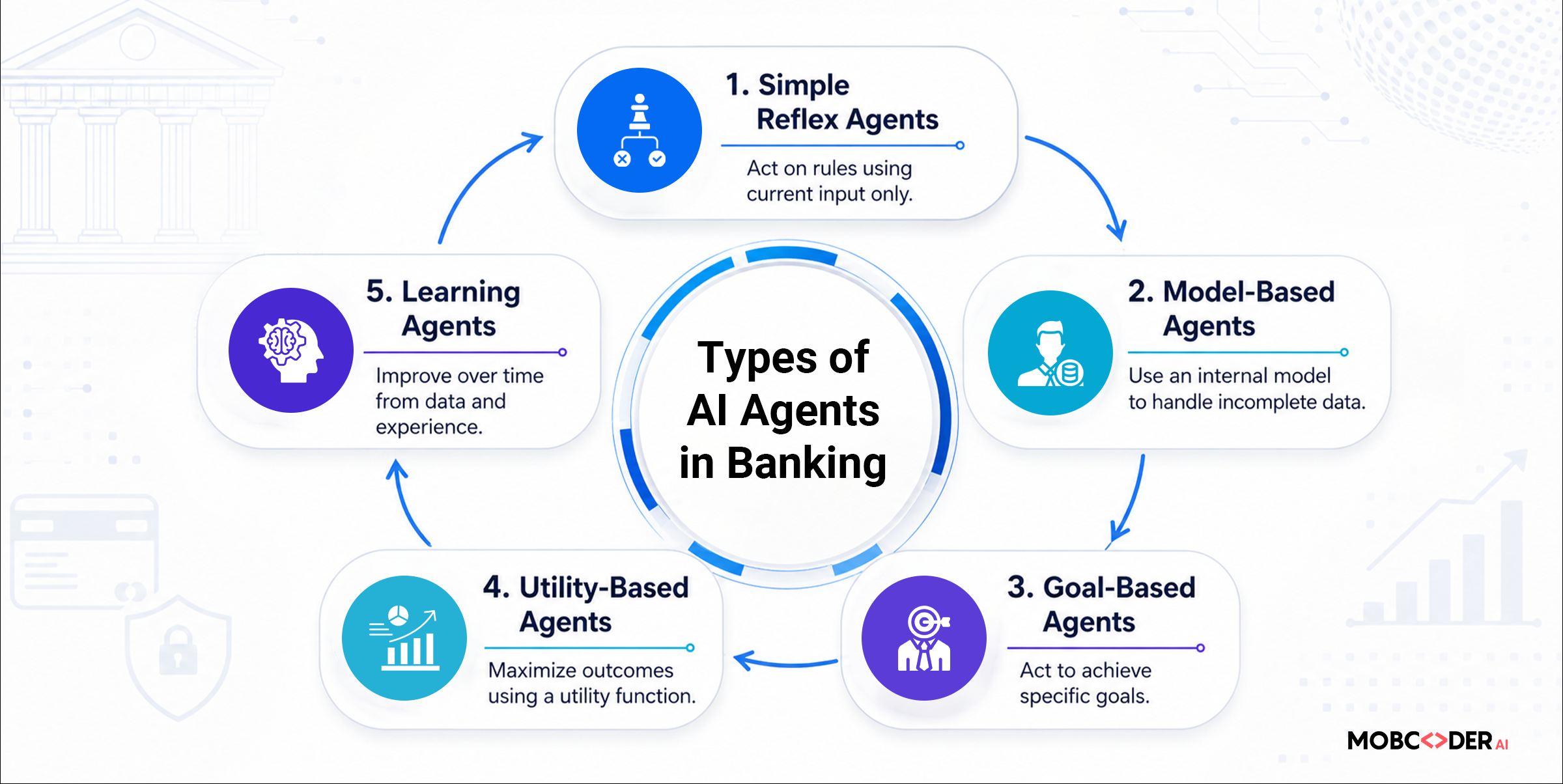
A single AI agent trying to handle credit risk, fraud detection, and compliance checks all at once tends to perform worse than a system where each task is handled by a specialized agent that does one thing well. This is a deliberate architectural choice, not just added complexity for its own sake.
In a well-designed multi-agent banking system, one agent might focus exclusively on estimating credit risk from a borrower's financial history, another on cross-referencing transactions against known fraud signatures, and a third on verifying that the overall workflow stays within regulatory bounds. They pass information between each other and a coordinating layer makes the final call, or escalates to a human when the agents disagree or confidence is low.
The practical benefit is accuracy through specialization, a fraud-detection agent trained and tuned specifically for anomaly patterns will outperform a generalist agent trying to do everything, the same way a specialist doctor usually outperforms a generalist on a specific condition.
What Customers Actually Notice
From a customer's perspective, the visible difference between bank-as-usual and an AI-agent-powered bank shows up in a few specific moments: a loan decision that comes back in hours instead of days, a fraud alert that resolves itself before the customer even notices a problem, or a support interaction where the system already knows the full context of a previous conversation rather than asking the customer to repeat themselves.
None of this requires customers to understand or even notice the underlying agentic architecture - which is, in a sense, the point. The best banking AI deployments are invisible in their mechanics and only visible in the outcome: faster, more accurate, less frustrating interactions.
Common Mistakes Banks Make With AI Agent Rollouts
- Automating the wrong process first - starting with a low-volume, edge-case-heavy workflow instead of a high-volume, well-defined one delays ROI and erodes internal confidence in the project.
- Treating governance as a post-launch task - retrofitting audit trails and escalation logic after a system is already handling live transactions is significantly more expensive and risky than building it in from day one.
- Underestimating integration complexity - the AI model is rarely the hard part; connecting it cleanly to core banking systems, often decades old, usually takes longer than building the model itself.
- No clear owner for agent decisions - when accountability for an agent's actions is spread across multiple teams, accountability for fixing mistakes tends to disappear entirely.
What This Costs and How Long It Takes
Banking AI agent projects vary more in price than most categories because of compliance overhead. Realistic ranges:
- Single-process agent (e.g., KYC document review): $80,000*–$180,000*
- Fraud detection agent with real-time monitoring: $150,000*–$350,000*
- Multi-agent loan origination pipeline: $200,000*–$500,000*
- Timelines run 4–8 months for a single-process deployment, longer for anything touching core banking systems or requiring formal regulatory sign-off.
*The mentioned numbers are just for an estimate. The final cost of development and deployment depends on the type of agents, scope of work and actual timelines.

How This Differs From Traditional Bank Automation
Banks have been automating processes for decades - batch processing, rule-based fraud flags, scripted IVR systems. The shift with AI agents isn't that automation is new to banking; it's that the automation can now handle situations its designers didn't explicitly anticipate.
A rule-based fraud system flags a transaction if it matches a predefined pattern - say, a purchase over $5,000 in a country the customer hasn't visited before. It will miss fraud that doesn't match a known pattern, and it will flag plenty of legitimate transactions that happen to match one. An AI agent, by contrast, can weigh dozens of contextual signals simultaneously - spending history, device fingerprint, time of day, merchant category, recent account activity - and make a probabilistic judgment closer to what an experienced fraud analyst would make, rather than a fixed yes/no rule.
This is a meaningful upgrade, but it comes with a corresponding responsibility: a rule-based system's logic is fully transparent and auditable by design. An AI agent's reasoning needs to be made transparent deliberately, through logging and explainability tooling, or it becomes a black box that's hard to defend to a regulator or an unhappy customer.
Where Mobcoder AI Fits
Mobcoder AI builds agentic AI systems for banking and financial services clients with audit logging, escalation logic, and compliance mapping designed from the start - not added after a pilot proves the concept works. Our team works with advanced LLM frameworks, vector databases, and event-driven architectures to build systems designed for high availability, auditability, and regulatory scrutiny from day one.
If you're trying to figure out where AI agents fit in your bank's automation roadmap, the conversation worth having isn't “which vendor has the best model” - it's “which process has enough volume and clear enough data to justify the governance investment.” Get that scoping right, and the rest of the project gets considerably easier.