


Generative AI in product development gets described in two extremes: either it's about to replace designers and engineers entirely, or it's an overhyped chatbot wrapper that doesn't actually change anything. Neither is accurate. What's actually happening is narrower and more useful than the hype, and worth understanding precisely if you're deciding where to invest.
Where Generative AI Genuinely Changes the Workflow
The honest version: generative AI is good at producing variations and options quickly, and at automating well-defined, repetitive technical tasks. It is not good at making the final judgment call on which option is right - that still requires a person who understands the business context, the customer, and the tradeoffs involved.
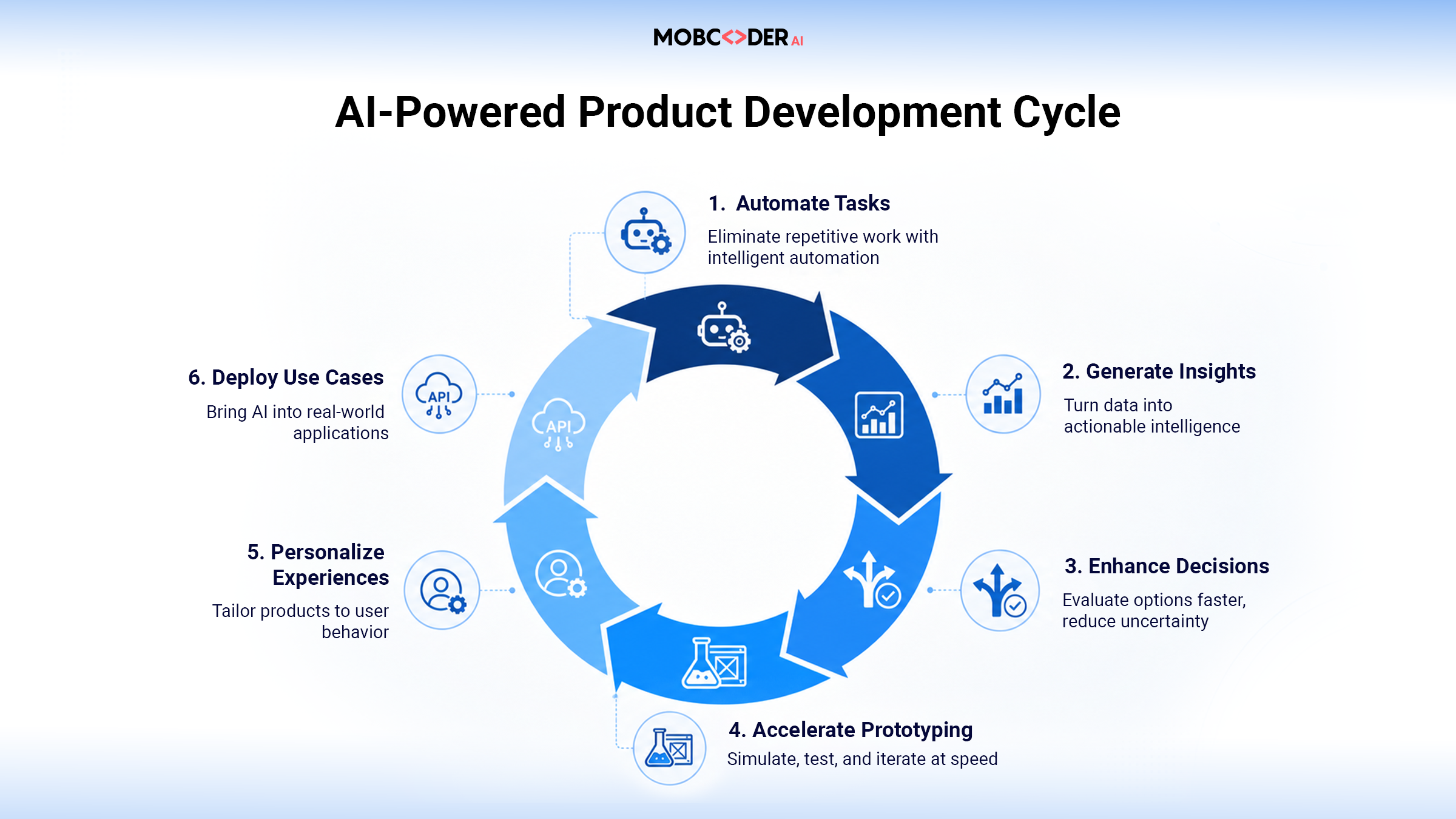
Concept Generation
Feed a generative AI system with specific parameters - cost ceiling, material constraints, target demographic - and it can produce dozens of concept variations in the time it would take a human team to sketch two or three. This genuinely speeds up early ideation, but the output quality depends entirely on how well-specified the constraints are; vague prompts produce vague, unusable variations.
Design and Prototyping
Integrated with CAD and 3D modeling tools, generative design can propose structural variants optimized for specific goals - lighter materials that maintain strength in aerospace and automotive contexts, ergonomic forms in consumer goods. Paired with simulation tools and digital twins, teams can test these variants virtually before committing to physical prototypes, which meaningfully cuts both cost and iteration time.
Engineering and Code
For software teams, generative AI assists with code generation, documentation, and test-script creation, catching some errors before they reach production. For hardware teams, it can help optimize circuit or mechanical layouts across competing constraints of size, cost, and efficiency. In both cases, the realistic framing is acceleration of a human engineer's work, not replacement of their judgment.
Testing and Validation
Testing is one of the most resource-intensive phases of product development, and this is where generative AI's predictive and simulation capabilities add real value - modeling user interactions, running stress tests, and generating synthetic test data to cover rare edge cases that would be expensive to test physically. Customer and market feedback can then loop back into the system for continuous refinement.
Post-Launch Personalization
Generative AI's role doesn't end at launch. Once a product ships, AI tools can analyze real-time usage data to segment audiences and personalize features, making a degree of mass customization possible - product variants tailored to region, customer preference, or behavior pattern, at a scale manual customization couldn't reach.
A Realistic Example of the Full Loop
Consider a mid-size consumer electronics company redesigning a product housing. A traditional process might take a design team three weeks to produce five hand-sketched concepts, narrow them to one, and build a single physical prototype to test fit and durability - only discovering a structural weakness after the prototype is built.
With generative AI integrated into the workflow, the same team feeds in material constraints, weight targets, and manufacturing tolerances, and receives dozens of structurally optimized variants within hours. Simulation tools test each variant virtually for stress points before a single physical part is machined, surfacing the same structural weakness in simulation instead of in a $4,000 prototype. The team still makes the final call on which design best fits the brand and user experience - that judgment doesn't move to the AI - but they're choosing from a stronger, pre-validated set of options instead of starting from a blank page.
This is the realistic shape of the benefit: faster iteration and fewer expensive surprises, not a replacement for the people making the actual product decisions.
Where the Hype Outpaces Reality
A few claims circulating about generative AI in product development deserve more skepticism than they usually get:
“AI will design entire products end-to-end with minimal human input.” In practice, generative AI proposes options within constraints a human defines; it doesn't independently decide what a product should be or why customers would want it.
“Generative AI eliminates the need for physical prototyping.” It significantly reduces the volume of physical prototypes needed by catching problems in simulation first, but for safety-critical or highly tactile products, physical validation still matters and won't fully disappear.
“Any generative AI tool works the same regardless of your data.” Output quality is directly tied to how well the system understands your specific materials, manufacturing constraints, and historical product data - a generic, ungrounded model will produce generic, often impractical suggestions.
The Real Risks Worth Planning For
Data quality is the most underestimated risk: AI outcomes depend heavily on the diversity and quality of training data, and poor data leads to biased or impractical design suggestions that look plausible but fail in practice. Ethics and governance matter more as these systems take on more decision-influencing roles - transparent, explainable outputs are necessary to maintain trust with both internal teams and customers.
This governance question deserves more attention than most product-development articles give it. As generative AI output increasingly feeds directly into downstream automated decisions - rather than just sitting in front of a human reviewer - the same accountability and audit-trail questions that apply to any autonomous AI system start to apply here too. We've covered this dynamic in more depth in our piece on why AI transformation is fundamentally a governance problem.
There's also a real intellectual property question worth flagging upfront: AI-generated designs may raise IP and data security concerns depending on training data provenance, and this needs to be addressed contractually with any vendor before generative tools touch proprietary product data.
A Practical Rollout Approach
Identify clear, high-impact use cases first - concept generation, rapid prototyping, or personalization, rather than trying to apply generative AI everywhere at once.
Build a strong data foundation - collect, clean, and structure the product and historical design data the system will actually need to produce useful, grounded output.
Start with a pilot - validate ROI on one process before scaling generative AI tools across multiple teams or departments.
Keep humans in the loop deliberately - build review and approval steps into the workflow rather than treating AI output as final.
Track concrete metrics - iteration speed, cost reduction, and design quality, not just “we're using AI now” as a vague success criterion.
Where This Goes Next
The realistic near-term trajectory is generative AI becoming embedded directly into existing design and engineering tools rather than existing as a separate standalone product - AI assistants proposing options inside the CAD software engineers already use, rather than requiring a context switch to a separate chat interface. Digital twins paired with generative design will likely become standard for simulating full product ecosystems before physical commitment, and mass customization at the individual customer level will become more economically viable as personalization tooling matures.
None of this replaces the core judgment that makes a product good - understanding what customers actually need and why. Generative AI compresses the distance between an idea and a testable version of it. The idea, and the decision about whether it's worth pursuing, still belongs to people.
Where Mobcoder AI Fits
Mobcoder AI builds generative AI tools for product teams that need grounded, data-specific output rather than generic suggestions - integrating with existing design and engineering workflows instead of asking teams to adopt a separate disconnected tool. For teams exploring more autonomous, agentic applications of generative AI beyond static design generation, our agentic AI development services extend this into systems that can act on generated outputs directly.